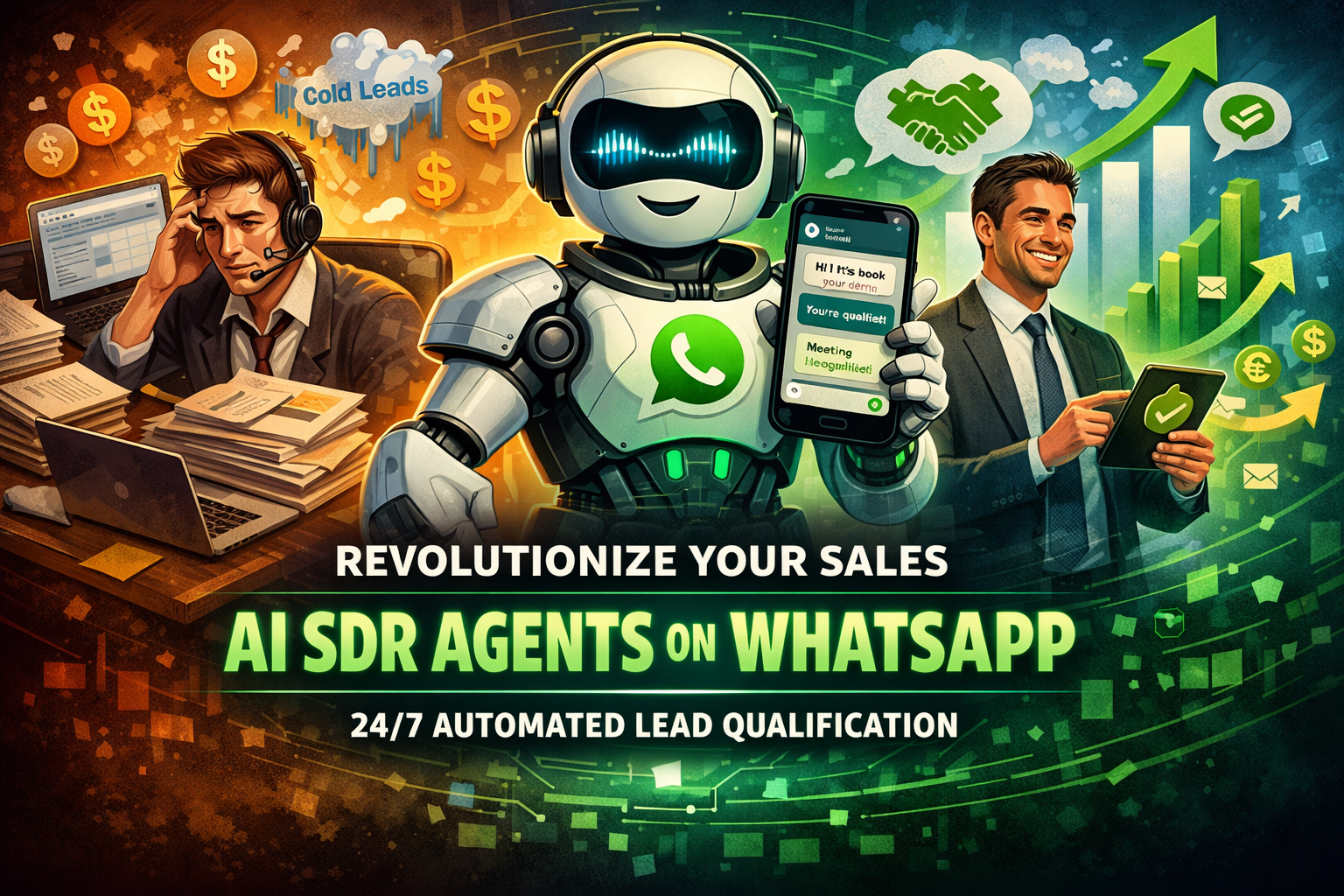
Business Process Automation with Artificial Intelligence: from Static Rules to Adaptive Decisions
Automation of business processes is no longer something futuristic or limited to tech giants. Today, it has basically become mandatory for any company that wants to operate efficiently in a digital, competitive, and unpredictable market. Even traditional businesses that, until recently, ran almost everything on paper are realizing that relying on manual tasks and centralized decisions blocks scale, increases costs, and, most importantly, limits the user experience across all channels.
With customers always connected, distributed teams, and a massive amount of data being generated at every click, trying to manage critical processes based only on emails, spreadsheets, and manual approvals is like trying to control a complex production line using a whiteboard and marker. You can start that way, but it becomes unsustainable as operations grow and new products, integrations, partners, and regulatory requirements show up.
This is where business process automation comes in as the central engine of operations. It connects systems, people, and information, reduces friction, cuts down repetitive tasks, and frees up the team to focus on what truly requires human analysis. But most companies took their first step in this journey with a model based on static rules: the classic if X happens, do Y.
This model works fine at the beginning, when the process is simple and the volume is manageable. The problem is that real business rarely follows the script. Exceptions start to appear, context shifts, new customer types emerge, risk levels vary, seasonality kicks in, and a bunch of details show up that the original rules never anticipated. The result is that the flow that was supposed to be automatic starts generating exception queues, rework, and a huge dependency on manual intervention.
It is exactly at this frontier between what was designed on paper and what actually happens in real operations that Artificial Intelligence (AI) plays a decisive role. Instead of relying only on preprogrammed decisions, AI makes it possible to turn rigid processes into adaptive decision environments, meaning decisions that adjust in real time to customer context, risk, operational capacity, and business goals at that specific moment.
Throughout this article, the idea is to show in a practical way how to move from a model purely based on static rules to a scenario where automation is driven by data, continuous learning, and AI, without losing governance, security, or predictability.
Why a model based only on static rules locks your business down
When a business process is designed only with fixed rules, everything seems organized and under control. You define inputs, conditions, and outputs: if the order amount is higher than X, send it for approval; if the customer is late on payments, block them; if a field is empty, send the form back. On paper, it looks great. In practice, the story is different.
As volume grows and the business landscape changes, more and more cases pop up that do not fit any predictable path. Orders with unusual product combinations, customers with irregular histories, medium-risk situations, regulatory exceptions, temporary internal policy changes. Every new detail becomes another branch in the decision tree, another rule, another patch.
Soon, what used to be a simple flow turns into a maze that is hard to understand, hard to maintain, and almost impossible to evolve. Some classic signs that a model based only on static rules is clogging your operation:
- Huge queue of exception cases that require manual review
- Conflicting or outdated rules that nobody remembers why they were created
- Dependence on specific people to interpret unanticipated situations
- Constant feeling that automation creates more problems than it solves
In industries like credit, healthcare, insurance, and telecom, this problem is even more evident. Imagine a credit analysis flow based only on a fixed criteria table. If the customer deviates slightly from that pattern, they are automatically rejected, even if their overall behavior is positive. The company loses opportunities, the customer leaves frustrated, and the team later has to manually review what the system denied.
In other words, static rules do matter, but on their own they are not enough to handle today’s complexity. What is missing is the ability to interpret nuance, combine signals, and learn from what has worked or failed in the past. That is where AI comes in.
How Artificial Intelligence transforms decision-making
When we talk about AI applied to process automation, we are not talking about replacing everything with some magic algorithm. The idea is to add an intelligence layer that can look at far more data, spot patterns humans would not easily see, and make adaptive decisions in real time.
Instead of working with just a handful of fixed variables, AI models can evaluate a much broader set of signals, such as:
- Customer interaction history across different channels
- Behavior patterns over time
- Current usage context (device, time of day, location)
- Real-time transactional and operational data
- Aggregated information from similar cases
With this, processes that used to work only as if A then B start operating in a kind of contextual mode. Decisions are no longer 100% rigid and begin to factor in probability, expected risk, business impact, and future trends. In a fraud analysis flow, for example, the system no longer needs to automatically block anything that looks unusual. It can weigh the signals and choose between approving directly, asking for extra confirmation, or blocking.
The key point here is that AI does not throw away static rules. In fact, it uses them as a safety and governance layer. Fixed rules still define hard boundaries that cannot be crossed, such as legal restrictions or non-negotiable risk limits. AI operates in the gray area, where there are doubts, nuance, and room for adaptation.
In practice, this model cuts down the number of cases going to exception queues, speeds up user response, and increases decision accuracy. Over time, as the system gathers more data, adaptive decisions get even better because the model learns from past hits and misses.
Where AI really makes a difference in business processes
Not every point in a flow needs AI. In many steps, a simple, well-designed rule is more than enough. But there are some types of decisions where Artificial Intelligence tends to bring very relevant gains:
- Risk analysis: credit, fraud, compliance, and security in general
- Service prioritization: support queues, ticket routing, dynamic SLAs
- Recommendation: products, offers, next best action in the user journey
- Demand forecasting: operational capacity, inventory, staff allocation
- Anomaly detection: technical failures, process deviations, abnormal behavior
In all these scenarios, relying only on static rules means either being too conservative (and missing opportunities) or too permissive (and increasing risk). With AI, the process adjusts more precisely, case by case, using as much context as possible.
Another area where AI shines is in continuous analysis of how the process is actually performing. Instead of waiting months for a manual flow review, models can monitor thousands of process instances running every day and point out:
- Where bottlenecks and delays are most frequent
- Which factor combinations generate the most rework
- Which step in the flow hurts conversion the most
- Which types of decisions are misaligned with expected outcomes
With this information, it becomes much easier to redesign automation, test targeted tweaks, and measure impact based on real data instead of gut feeling.
Hybrid model: combining safety and flexibility
In practice, the most solid approach today is to work with a hybrid model that blends a stable structure with adaptive intelligence. Instead of choosing between rules or AI, the company organizes the process into well-defined layers, something like:


- Static rules layer: defines what is mandatory, forbidden, minimum, and maximum. This is where internal policies, regulatory limits, security criteria, and everything that must be predictable and auditable live.
- Adaptive decision layer: uses AI to choose between different valid options within the boundaries defined by the previous layer. This is where personalization, prioritization, recommendation, and fine-tuning come in.
In a service request flow, for example, the rules layer can automatically block requests that do not meet minimum requirements, while AI decides who should be served first, which channel is best for that customer, and what type of solution is most likely to solve the problem on the first try.
The nice thing about this model is that it eases the natural fear of losing control when people talk about AI. The company still knows exactly what can never happen, while letting the machine help in areas where humans would struggle to analyze volume, variables, and patterns at the same time.
On top of that, this setup supports continuous evolution. The organization does not have to redo everything at once. It can start by adding AI to just one step in the flow, measure results, calibrate, expand to another point, and so on, always backed by the safety net of static rules protecting the process.
User experience as the success metric
At the end of the day, the best way to see whether the mix of automation, rules, and AI is actually working is to look at the user experience. When the design is right, some effects become very clear:
- Faster, more consistent responses across different channels
- Fewer back-and-forth steps to solve the same issue
- Stronger sense that the system understands each person’s context
- Reduction in silly errors and unfair or disproportionate decisions
From the end user’s point of view, there is no such thing as AI, rules engine, or process orchestrator. What exists is: did it solve my problem or not. If the combination of static rules and adaptive decisions is well aligned, the process flows smoothly and almost goes unnoticed. The technology fades into the background, and what remains is a feeling of ease.
Behind the scenes, though, there is a robust orchestra playing: real-time data streaming in, models being updated, business policies enforced, exceptions handled, risks assessed, and performance indicators feeding continuous improvement cycles. This is the essence of business process automation with AI today: less rigid scripting and more living, adaptive systems connected to real user needs.