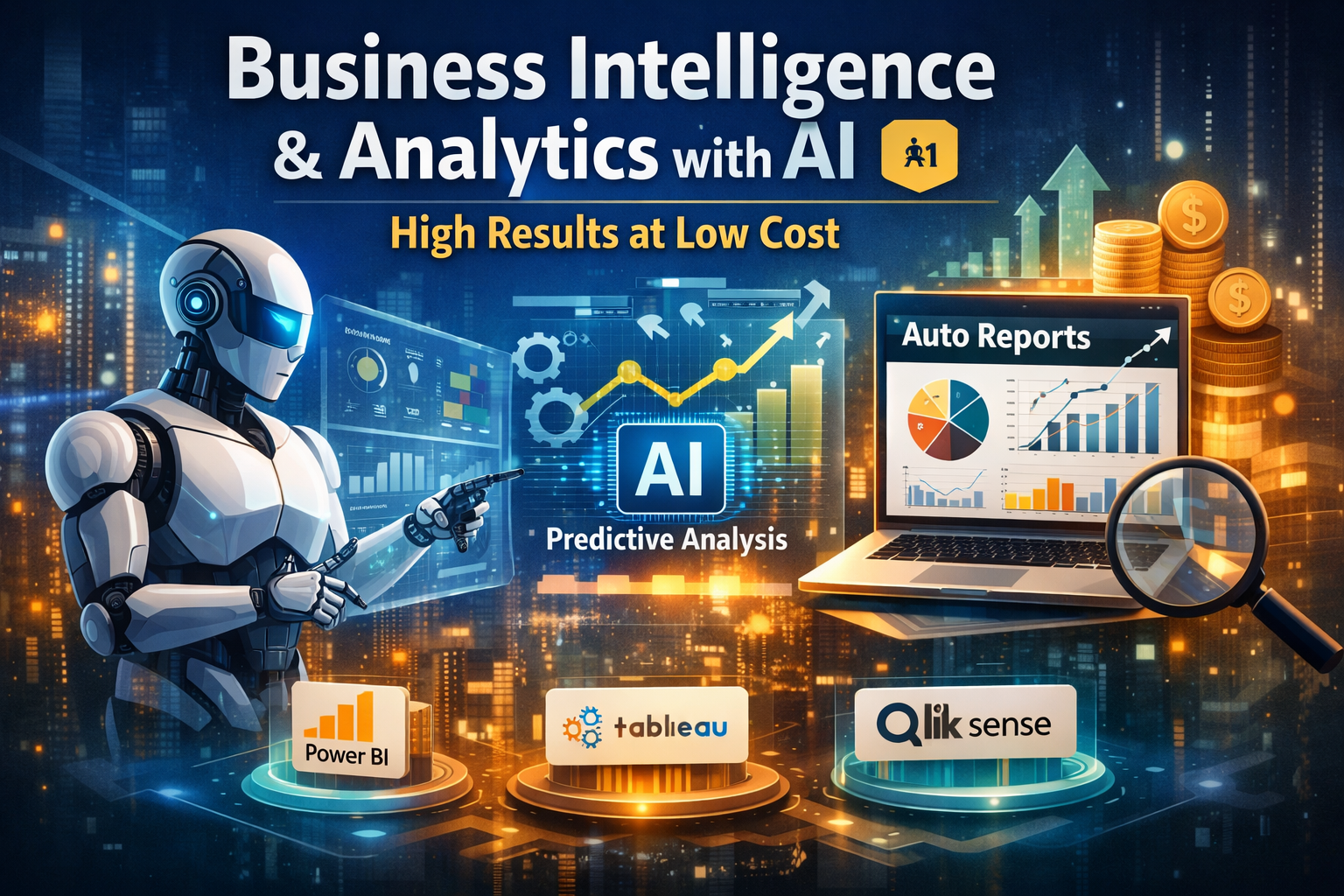
Business Intelligence and Analytics with AI is capable of transforming raw data into real-time predictions, recommendations, and decisions.
Content Summary
- Difference between traditional BI and AI-powered BI
- How AI improves BI reports
- Market figures
- Practical cases
- AI tools for data analysis in SMEs
- Recommended smart pipeline
- Practical benefits
👉 Keywords: business intelligence and analytics, artificial intelligence for data analysis, AI tools for BI, how to use AI in data analysis, AI-powered report automation, AI-powered predictive analytics.
In this guide, you will understand the difference between traditional BI and AI-powered BI, how artificial intelligence for data analysis improves reports, and which tools make a practical difference for SMEs. In addition to real-world case studies, presented clearly and directly, facilitating your decision-making process on what to adopt and implement in your business.
What is the Difference Between Business Intelligence and Analytics with AI?
The main difference is that traditional Business Intelligence (BI) analyzes past and descriptive data, while Analytics with AI goes further, generating predictive and prescriptive insights in real time.
In classic BI, reports show what happened: last month’s sales, team performance, operational costs. With integrated AI, the same dashboard answers what will happen and even what to do next.
For example: a report that previously took 3 days to produce manually can now be generated in minutes in Power BI with Copilot, which uses natural language to transform raw data into visual predictions, like a GPS that indicates alternative routes and even anticipates traffic jams.
This is a shift in approach that can transform your business with faster and smarter decisions.
How Does AI Improve BI Reports in Practice?
AI improves Business Intelligence (BI) reports by reducing production time by up to 50%, automating repetitive analyses, and generating predictive dashboards that identify patterns invisible to the naked eye.
Instead of analysts spending days cleaning data and creating charts, trained algorithms process information in minutes, eliminating backlogs and freeing up the team for strategic tasks. According to studies, AI automation reduces report generation time by between 35% and 50%.
Example of how to use Tableau GPT and Qlik Sense, tools that go beyond the descriptive: they suggest future trends and correlations that would often go unnoticed, transforming reports into true opportunity radars.
Another advancement is the application of NLP (Natural Language Processing): managers can ask in natural language, “what was the impact of the last campaign on the average ticket?” and instantly receive an interactive visualization as an answer.
In practice, this means faster reports, accessible to any user level, and with insights that guide business decisions in real time.
SEE HOW ARTIFICIAL INTELLIGENCE HAS REVOLUTIONIZED RETAIL IN THIS ARTICLE.
What are the market numbers for Business Intelligence and Analytics in 2026?
The market for Business Intelligence and Analytics with AI is accelerating rapidly. In 2024, 78% of companies worldwide were already using artificial intelligence applied to BI to accelerate reporting and improve strategic decisions, showing that analysis based solely on traditional methods is already obsolete.
From a financial standpoint, the sector generated $25.4 billion in 2024 and is expected to almost triple by 2033, reaching $60.3 billion, driven by AI-powered predictive analytics solutions, real-time reporting, and integrations with intelligent pipelines [Verified Market Reports].
The sectors most advanced in this adoption are: technology (85%), finance (61%), and retail (68%). Even in emerging markets, the movement is strong; Latin America projects growth above 11% CAGR until 2028 (LinkedIn).
DISCOVER THE ROI OF INVESTING IN AN AI AND AUTOMATION TOOL IN THIS ARTICLE.
Which companies have already implemented it and what are their results?
Large companies have already proven that AI applied to Business Intelligence generates real ROI.
- Banco do Brasil: implemented AI in back-office processes and reduced execution time by 35%, saving approximately $ 380 million and achieving a 316% ROI in the first year.
- Bradesco: created an AI-powered analysis framework that increased the accuracy of project ROI measurement by 89% and reduced decision-making time by 67%.
- Natura & Co: used AI in its supply chain, resulting in operational efficiency gains and advances in sustainability—reducing waste and optimizing product transportation and storage.
- Toyota: applied Qlik Sense with associative AI to logistics operations, resulting in greater productivity and real-time visibility of logistical bottlenecks.
Case Summary
| Company | Scenario | Action | Quantified Result |
| Banco do Brasil | Financial Back-office | AI System for Automation and Analysis | -35% time, $380 million savings, 316% ROI |
| Natura &Co | Supply Chain | AI for Optimization and Sustainability | Improvement in Operational Efficiency and Sustainability |
| Bradesco | ROI Management in AI | Framework for measuring AI ROI | + 89% ROI accuracy, -67% decision time |
| Toyota | Logistics operations | Qlik Sense with AI for associative analysis | Improved productivity and logistics |
| Amazon | E-commerce | Integrated AI for personalization and efficiency | Accelerated average growth 15% CAGR |
SEND “N8N” ON OUR WHATSAPP AND DISCOVER THE PERFECT PROJECT FOR YOUR BUSINESS
Which Data Analytics AIs to use?
If before data analysis was a privilege only for large companies and depended on manual and time-consuming reports, today The arsenal of AI tools for data analysis puts speed and intelligence at the heart of decision-making, and is accessible to any type of business.
Some examples of tools you can start using in your business today:
* Power BI (with Microsoft Copilot AI): combines traditional reports with automatic forecasts and natural language Q&A, allowing you to ask “what will the margin be next quarter?” and receive predictive charts in seconds (BMR-e).
* Tableau GPT: A leader in advanced visualizations and predictive analytics, it reveals hidden patterns and transforms large volumes of data into intuitive dashboards (BeAnalytic).
* Looker Studio: The power of native integration with Google Cloud, ideal for companies already operating with cloud data and wanting to scale predictive insights.
* Qlik Sense: Brings an associative engine + AutoML, allowing analysts to explore relationships between data that would go unnoticed on other platforms.
* Perplexity AI / Notebook LM: AI search, perfect for **strategic searches**, market benchmarking, and quick explanations from unstructured data.
* N8N: the brain of orchestrated automation, connecting Databases, BI, LLM, API, CRM, and ERP without integration limits. Essential for transforming insights into practical actions.
Table with the best AI tools for analytics
| Tool | AI Features | Integrations | When to Use | Limitations |
| Power BI | Microsoft Copilot, NL Q&A, forecasting, auto insights | Microsoft ecosystem (Azure, Excel, Teams), n8n | Microsoft-centric organizations, affordable cost | Limitations in advanced visualizations |
| Tableu | Tableau GPT, advanced visualizations, auto Insights | Salesforce, diverse cloud data sources | Sophisticated visual analysis, large enterprises | High cost, learning curve |
| Looker | AI for cloud analytics, predictive insights | Google Cloud, Snowflake, dbt | Organizations with a cloud-focused strategy | Requires a technical team, medium-high cost |
| Qlik Sense | AutoML, associative engine, pattern suggestions | Various ERPs, CRMs, and on-premises and cloud databases | Sectors that demand flexible data exploration | Can be complex for beginners |
| ThoughtSpot | NLP Q&A, auto insights, forecasting | Extensive integrations with databases and CRM | Easy access to insights for non-technical users | Price and complexity of deployment |
| Sigma | Auto insights, team collaboration | Integration with cloud warehouses (Snowflake, BigQuery) | Startups and teams that need real-time collaboration | Less mature functionalities than Power BI/Tableau |
| Mode | Visual analytics with machine learning | Integration, SQL and Python code, diverse sources | Advanced analytics technical teams | Requires technical knowledge |
| Polymer | Auto insights, fast predictions | Connection to cloud databases, collaborative dashboards | Small and medium-sized businesses that need agility | Limited functionalities compared to leaders |
Tools like Notion AI, Browse AI, and Grammarly could still be useful.
SEE COMPLETE COMPARISONS BELOW IN OUR TOOLS DIRECTORY
| The Best AI Tool For Your Business |
How to Build an Intelligent BI Pipeline with AI?
An intelligent Business Intelligence pipeline with AI transforms scattered data into actionable decisions quickly and reliably. The model most used by leading companies follows this architecture:
1. Fivetran: performs automatic extraction of data from multiple sources (ERP, CRM, e-commerce, marketing).
2. Snowflake: functions as a scalable data warehouse, consolidating everything in one place with high performance.
3. DBT: applies data transformation and modeling, ensuring consistency and governance.
4. Power BI or Tableau GPT: layers of visual and predictive analytics, offering real-time dashboards and actionable insights.
5. n8n: orchestrates automated workflows, connecting BI to critical systems like CRM and ERP.
6. CRM/ERP: where insights become action, adjusting campaigns, sales, or inventory.
The Benefits: Up to 50% faster response time, reduced backlog, robust governance, and guaranteed compliance with LGPD and GDPR through access controls and traceability.
Frequently Asked Questions
1. How does AI improve data analysis in BI?
AI automates data collection, cleaning, and analysis, providing real-time predictive insights, accelerating decisions, and identifying hidden patterns in the data. data.
2. What are the main tools that combine BI with AI?
Power BI, Tableau, Looker, Qlik, and ThoughtSpot are leaders, each with features such as NLP, auto insights, and integration with data warehouses.
3. What is the typical return on investment (ROI) of implementing AI in BI?
Studies demonstrate savings of up to 35% in reporting time and revenue increases between 15–25%, with cases of ROI above 300% in banks and retail.
4. What are the risks of adopting AI in data analysis?
Risks include privacy violations, bias in models, governance failures, and compliance with LGPD and GDPR, which require strict controls.
5. How to create an efficient pipeline for AI in BI?
Typical pipeline: extraction (Fivetran), storage (Snowflake), transformation (dbt), analysis (Power BI), automation (n8n) with governance and MLOps light.
6. What strategies for rapid AI implementation in BI?
Follow a 30–90 day playbook that includes discovery, POC, integration, and rollout focusing on clear KPIs and continuous training.
Conclusion
The use of Business Intelligence and Analytics with AI has become a real competitive differentiator. We have seen how AI reduces reporting time by up to 50% and increases the accuracy of strategic decisions. Proven ROI even in more traditional companies like Banco do Brasil and Bradesco, but seeking to modernize and powerful data tools such as Power BI, Tableau GPT, Qlik Sense, Looker and n8n transforming data into immediate action.
👉 SEND “N8N” ON OUR WHATSAPP AND DISCOVER THE PERFECT PROJECT FOR YOUR BUSINESS.