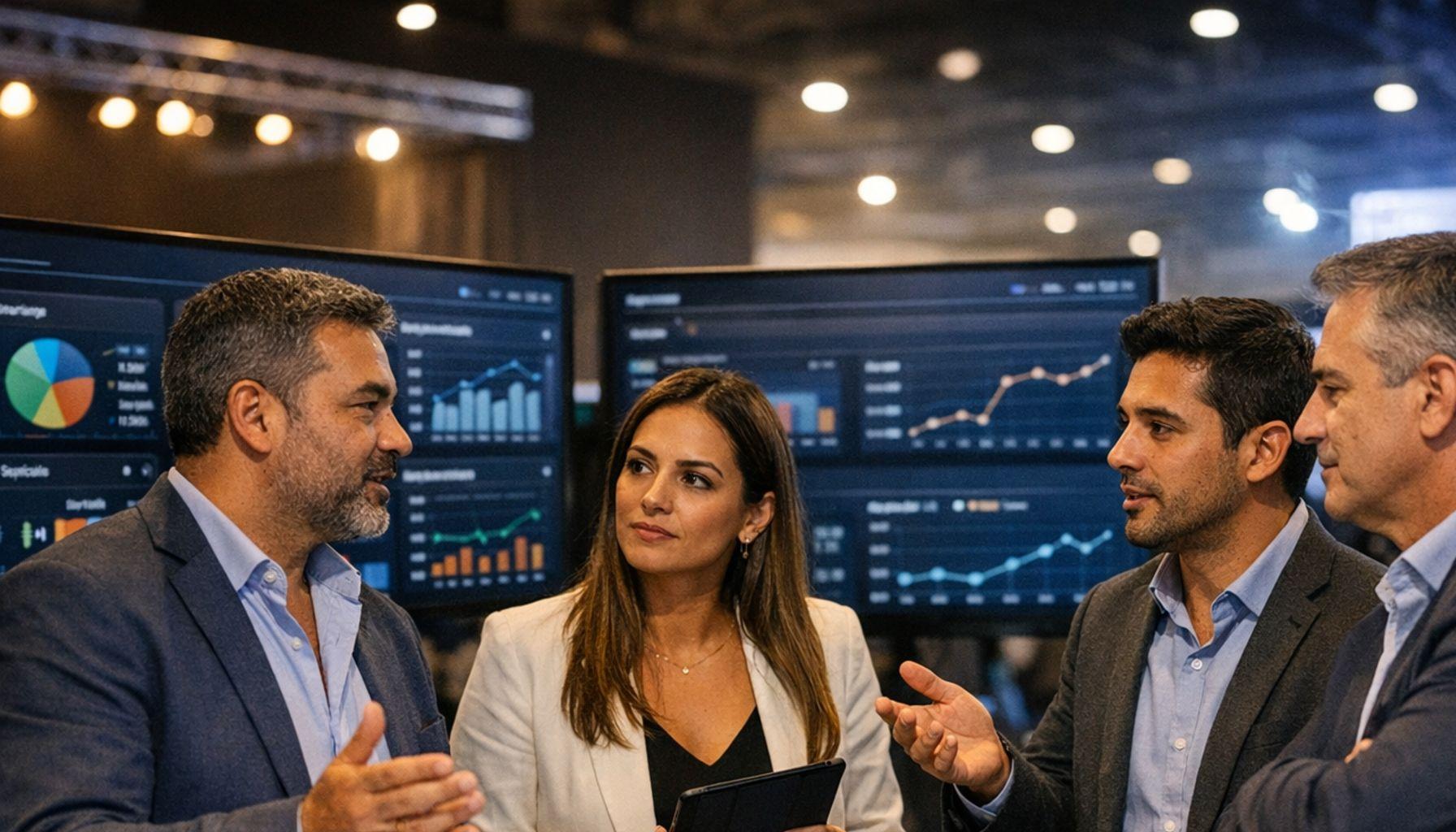
AI startups, infrastructure companies, and major tech conglomerates shared the same floor in Baghdad during ITEX 2026, Iraq’s International Information and Communications Technology Exhibition. The event brought together Iraqi, regional, and international companies, each showcasing solutions ranging from AI-powered media verification to ultra-high-performance network synchronization.
And the message was loud and clear: Iraq is no longer just about oil and reconstruction. The country is positioning itself as a real destination for tech expansion in the Middle East, attracting everyone from student-led startups to corporations with over 15,000 employees spread across the Persian Gulf. 🚀
Here you will find three stories that illustrate this movement well — and why it is worth keeping an eye on what is happening over there.
When AI joins the fight against misinformation
One of the most compelling stories from ITEX 2026 came from an Iraqi startup called Al-Burhan, which specializes in image and video recognition powered by artificial intelligence. According to its founder, Hassan Abdul-Baqi Khalaf, who spoke with the Iraqi News Agency (INA), the project grew out of registered patents focused on automated media verification and protection against digital tampering, forgery, and deepfakes. The concept is relatively simple to understand but technically quite sophisticated: the system analyzes videos and images to identify manipulated content before it has a chance to spread.
What makes this even more noteworthy is the profile of the person behind the solution. Khalaf is a computer science student at the American University of Iraq – Baghdad (AUIB) and works in partnership with a doctoral researcher in mathematics and physics. Despite being a relatively young venture, the platform already processes requests from more than
Another standout detail is accuracy. According to the founder, the system delivers up to 95% accuracy in identifying manipulated content. This was the company’s first appearance at an expo of this scale, and the startup took the opportunity to pursue operational partnerships with federal government entities, with a particular focus on the Ministry of Interior, aiming to detect fabricated media and strengthen sovereign cyber-verification tools.
This type of approach, often called AI localization, is exactly what sets apart startups that create real impact from those that simply slap a fresh coat of paint on existing products. The digital transformation Iraq is experiencing is driven largely by initiatives like this: young people who see real problems around them and decide to use technology to solve them. The country’s startup ecosystem is still young, but events like ITEX serve as an important catalyst, connecting these founders with regional investors, international partners, and potential clients from both the public and private sectors. 🧠
Network infrastructure as the foundation for transformation
No tech expansion happens in a vacuum. Behind every innovative startup, behind every AI platform running in real time, there is a network infrastructure that needs to be robust, stable, and high-performing. That was exactly the theme that brought international infrastructure providers to ITEX 2026, presenting solutions designed to support the digital growth Iraq is projecting for the coming years.
One of the names that made a strong showing was Al-Mamas, a Canadian company specializing in IT and network engineering. Engineer Ahmed Mustafa revealed that the company is looking to establish an operational base in Iraq, following successful deployments in the United Arab Emirates, Qatar, and Egypt. The message was straightforward: without a solid infrastructure foundation, any tech ambition is compromised before it even gets off the ground.
Al-Mamas holds exclusive distribution rights across the entire Middle East and North Africa for precision timing and synchronization equipment manufactured in Germany. This type of hardware is critical for maintaining ultra-low-latency architectures in telecommunications networks, industrial automation, data centers, and distributed artificial intelligence systems. In other words, it is the technology that ensures multiple systems operate in perfect coordination — something essential for applications that demand real-time processing, such as urban monitoring, digital health, and smart logistics.
What became evident during the conversations and presentations is that Iraq’s digital transformation is not an isolated project led by a handful of tech enthusiasts. It is part of a broader national strategy to diversify the economy and reduce dependence on the oil sector. Investing in digital infrastructure is, in that context, just as strategic as investing in highways or ports. And the companies that showed up at ITEX 2026 saw this as a concrete business opportunity, not just a potential market for the distant future. ⚡
Big players and corporate appetite for the Iraqi market
Alongside local startups and infrastructure companies, ITEX 2026 also welcomed major tech conglomerates with operations spread across the Persian Gulf. One of the highlights was Mannai Corporation, a conglomerate headquartered in Qatar with more than 15,000 employees distributed throughout the region. Samer Al-Yasin, the company’s sales director, stated that
This was Mannai’s second appearance at an exhibition in Baghdad, and the company revealed a concrete commitment to the local market: its Baghdad branch was formally established three months ago, and the company is already actively preparing to open regional offices in Erbil and Basra. The presence of a player of this caliber at an event like ITEX is an important signal: when companies of this size decide to show up and open operations, it is because they see real potential, not just curiosity.
According to Al-Yasin, the group is bringing enterprise digital transformation solutions, cloud integration, and custom system architecture to Iraq, tailored for federal ministries, banking institutions, and healthcare providers. The stated goal is to transfer the technical expertise accumulated across the region to drive national modernization and support the revenue streams of the country’s sovereign institutions.
The interest from large corporations in Iraq makes sense when you look at the bigger picture. The country has a young and growing population, high smartphone adoption, and internet access expanding rapidly. On top of that, the Iraqi government has shown openness to public-private partnerships in digitization projects. For Gulf corporations that already dominate mature markets like the United Arab Emirates, Iraq represents a new frontier — and one that is still relatively uncontested, which is a huge advantage in terms of strategic positioning.


What makes this movement even more interesting is the dynamic it creates between large companies and local startups. Rather than a scenario of direct competition, what emerged at ITEX 2026 was a trend of complementarity: corporations bring capital, scale, and distribution capabilities, while Iraqi startups bring deep knowledge of the local market, agility, and solutions built specifically for the region’s needs. 🤝
What Iraq is signaling to the tech world
ITEX 2026 was far more than a tech fair. It was a public declaration that Iraq is taking its digital transformation journey seriously — and that the country is willing to build that path with partners from inside and outside its borders. The variety of solutions presented, the diversity of participants, and the caliber of conversations that took place in the event’s corridors make it clear that Iraq’s tech ecosystem is maturing at an accelerated pace, driven by a combination of real-world needs, available local talent, and growing interest from regional and international investors.
For anyone following the global artificial intelligence and tech innovation landscape, Iraq is starting to appear on the radar as one of the most promising emerging markets in the Middle East. And it is not by accident — the conditions are being built deliberately, with events like ITEX serving as a showcase, with policies being adjusted to attract technology investments, and with a generation of young founders determined to prove that it is possible to build something meaningful from Baghdad. This is tech expansion happening in practice, not on paper. 🌍
If you follow the startup and tech market closely, it is well worth adding Iraq to your watchlist for the coming years. What is being built there has the potential to influence not just the region but also to serve as a model for other countries at similar stages of digital development. And stories like those from ITEX 2026 are the kind of early indicators that typically appear well before an ecosystem truly takes off. 📡