AI agents are changing the game for small businesses in ways few people anticipated.
Over the past two years, the conversation has mostly revolved around chatbots: those assistants that answer questions, generate text, and simulate human customer service. Most people still think of AI as an automated response tool, something that replaces a FAQ page or a basic support rep. That model worked well enough for a while, but it was far from representing the true potential of the technology.
Something much bigger is happening right now, though, and it’s well worth understanding what has actually changed. Microsoft recently announced a $2.5 billion initiative dedicated to helping companies implement AI systems tailored to their own operations, going far beyond relying on a single generic auto-response model. That level of financial commitment doesn’t happen by accident: it signals that the industry as a whole sees AI agents as a real, lasting driver of transformation for the business world.
And this movement is far from isolated. The entire enterprise tech industry is betting big on so-called agentic AI, meaning software capable of making decisions, executing complete multi-step workflows, and coordinating tasks with minimal human oversight. Tech companies of all sizes are racing to launch solutions in this direction, which means competition is accelerating development and, as a result, driving down the cost of accessing these tools.
And the most interesting part of all this? This capability, which used to be reserved for large corporations with massive automation budgets, is now reaching businesses with 5, 10, or 20 employees. Clinics, law firms, service providers, accountants, and small retailers can already operate with a level of efficiency that previously would have required hiring several full-time administrative staff. The playing field is being leveled in a way that few experts predicted would happen this fast.
In the next sections, you’ll understand exactly what sets an AI agent apart from a regular chatbot, why this represents a real turning point for smaller businesses, and how to figure out where to start in practice. 🚀
From tools to digital workers
The difference between a chatbot and an AI agent might seem technical at first glance, but it has a direct impact on what you can actually do with each one in the day-to-day of your business. Traditional AI behaves like software: it waits for instructions, reacts to commands, and doesn’t go beyond that. A chatbot looks up an answer within a predefined set of data and delivers that answer to the user. It doesn’t act, doesn’t decide, and doesn’t execute any task beyond responding. It’s a useful tool, but with a very clear ceiling on its usefulness.
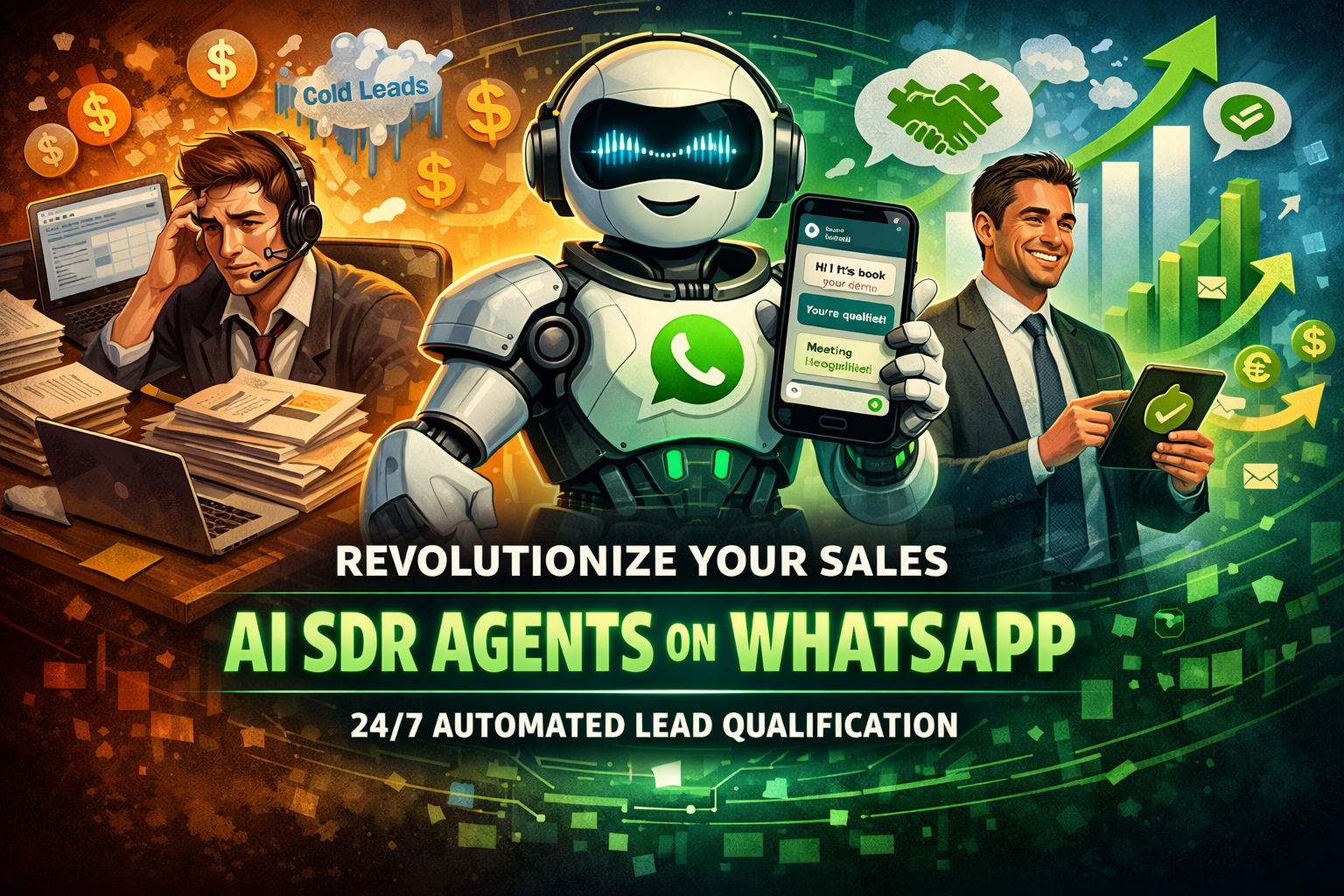
An AI agent, on the other hand, behaves more like a digital employee. Instead of simply answering questions, these systems can monitor new leads as they come in, follow up automatically, schedule appointments, generate proposals, research information about potential clients, update CRM records, escalate exceptions to humans when needed, and keep working 24 hours a day. This is what we call autonomous workflow execution, and that’s where the magic happens for small businesses.
Instead of automating individual, isolated tasks, companies are starting to automate entire workflows. While a chatbot wraps up its job when the conversation ends, an AI agent can maintain context over time, plan projects, use software tools, review its own work, and adjust its behavior to continuously improve results. Recent models can already handle massive volumes of information at once, thanks to context windows that reach up to one million tokens. It’s a difference in category, not just in degree.
Why small businesses come out ahead now
For a long time, advanced automation was synonymous with high investment and complex implementation. Large corporations spent years investing in automation platforms that smaller companies simply couldn’t afford. A mid-sized business needed an IT team, specialized consultants, custom integrations, and months of setup before seeing any results. For a business with 10 employees, that scenario was simply unfeasible, both financially and operationally. The technology existed, but real access to it was restricted.
What’s changing now is that cloud-based AI agent platforms are bringing similar capabilities to companies with five, ten, or twenty employees. A local HVAC company, a dental office, a law firm, or a real estate agency can already operate with resources that previously required multiple hires. This democratizes access to automation in a way that didn’t exist before, and the impact for small businesses is immediate and measurable.
Picture a dental clinic with five chairs and two front desk staff. Today, those staff members spend a good chunk of their time confirming appointments by phone, replying to messages, chasing overdue payments, and trying to fill last-minute cancellations. With a well-configured AI agent, all of those tasks can be handled automatically, freeing up the staff for functions that genuinely require a human presence, like greeting patients at reception or handling more sensitive situations. The efficiency gains aren’t theoretical: they show up directly in the ability to serve more patients with the same team, without growing the payroll at the same rate. 💡
The new competitive advantage
Here’s a detail that a lot of people still haven’t caught on to: the biggest competitive advantage over the next five years won’t necessarily belong to the company using the smartest AI model. It will belong to the company that redesigns its entire operation around AI-powered workflows.
Businesses that simply bolt AI onto their existing processes tend to see modest gains. It’s the classic case of layering a new tool on top of an old system and expecting miracles. Meanwhile, businesses that genuinely rethink how work gets done can drastically reduce operational costs, respond to customers much faster, and scale without needing to grow the team at the same pace. That’s the difference between using technology as a patch and using it as a foundation.
It’s worth reinforcing an important point here: none of this means employees are going to disappear. Quite the opposite. What changes is where people create value. Repetitive operational tasks go to AI, while human professionals shift their focus to relationships, strategy, complex decisions, and sales. Even the companies developing these systems acknowledge that more sensitive applications require human oversight, safety measures, and constant monitoring. AI eliminates repetitive work, but human judgment remains irreplaceable. 🎯
Identifying the right workflows to automate
One of the most common mistakes when companies start exploring AI agents is trying to automate everything at once. That creates confusion, rework, and a feeling that the technology didn’t deliver on its promise. The most effective path is different: it starts with identifying the processes that eat up the most time, have repetitive steps, and require little creativity or human judgment. Those are the ideal candidates for your first automated workflows.
To make this mapping easier, it helps to ask a few simple questions about your operation:
- Which tasks happen hundreds of times per month?
- Where do leads end up slipping through the cracks and getting forgotten?
- Which work follows the exact same sequence every single time?
- Which administrative activities don’t require human judgment?
Think about the tasks your team performs every day in an almost mechanical way. Sending follow-up emails to clients who haven’t responded, updating spreadsheets after every sale, generating weekly reports, triaging incoming messages, processing invoices, or confirming appointments. All of these activities have something in common: they follow a logical, predictable pattern, and that’s exactly the type of task AI agents were built to handle exceptionally well.


Once the first workflows are up and running and delivering results, it becomes much easier to expand automation to more complex processes. The team gains confidence in the tool, the business starts to feel the real impact on operational efficiency, and the business owner begins to see more clearly where the technology can make an even bigger difference. It’s a gradual process, but one with a cumulative effect that becomes quite significant over time.
The right time to act is now
There’s a window of competitive advantage that opens when a technology moves past the experimental stage and becomes accessible, but before it turns into an industry standard. AI agents are at exactly that point right now. The tools already work, the use cases are documented, and the cost of adoption has dropped significantly. Companies that start experimenting today will have a meaningful operational edge over competitors who sit back and wait for the technology to become common and mandatory.
The conversation around AI is moving well beyond content generation. The next wave is what’s being called operational intelligence. Companies aren’t just asking how can AI help my employees anymore. They’re starting to ask which parts of my business can AI handle on its own. That question may very well define who pulls ahead and who gets left behind over the next decade.
It’s important to be clear: this isn’t about replacing people. That’s a legitimate concern, but one that’s often misframed in the context of small businesses. The real goal of automation with AI agents is to amplify the capacity of the team you already have, allowing each person to do more, with less burnout, and with their focus on the activities that truly demand human intelligence, empathy, and creativity. A small team operating at maximized efficiency can compete on equal footing with much larger companies, and that completely changes the market dynamics for smaller businesses.
The technology is available, the use cases are proven, and the investment needed to get started is within reach for businesses of any size. The next step is straightforward: map out the repetitive processes in your operation and explore which AI agent platforms are the best fit for your situation. The transformation doesn’t have to be radical to be real, and the gains start showing up much sooner than most people expect.