Artificial intelligence is already on every company’s agenda, and figuring out how to implement the best AI tools has become the burning question for every manager out there.
The problem is that, in practice, most companies are still making poor decisions. They pick tools before understanding the impact, adopt solutions without proper integration, and invest without any clear return.
This article starts from a simple premise: AI only delivers results when it is properly implemented.
You will understand where companies go wrong, why it happens, and our proposed solution: the AI Implementation Matrix to streamline the decision-making process, reduce risks, and prioritize what truly moves your business forward.
The Real Problem: AI Is Everywhere, But Results Are Not
Artificial intelligence is no longer a trend — it has become a competitive necessity. Today, roughly 72% to 78% of companies have already adopted AI in some stage of their operations, according to a study by McKinsey.
The problem? Results have not kept up. Most companies are still capturing marginal gains, often below 5% in real business impact.
This reveals an uncomfortable truth: access is no longer an advantage.
AI has become the standard, but results have not.
And the issue is not the technology itself — it is the decision-making process and how it is being implemented.
The Mistake That Is Costing Money (and Time)
Just because the problem lies in implementation does not mean it is a technical error — because, in reality, the mistake is strategic.
Beyond the hype, companies are pursuing AI because they are pursuing results, or at least they should be.
Companies start with the wrong question: What is the best AI? when they should be asking: Where will implementing AI generate the biggest results?
Wrong questions lead to wrong diagnoses. In practice, this creates a dangerous pattern: rapid adoption, irrelevant impact, spending that does not pay off. Tools come in, processes change, results do not.
The key insight is that choosing based solely on which tool to use, in isolation, will not deliver the results you need. AI will just be a cost, not a competitive advantage.
How to Implement the Best AI Tools: Introducing the AI Implementation Matrix
According to McKinsey, only about one-third of companies actually manage to scale AI, and up to 60% of projects fail due to data and infrastructure limitations.
This exposes a real bottleneck in the decision-making process: implementation.
Implementation here also goes in a broader sense than just plugging API A into system B or the simple mantra that isolated tools do not scale, etc.
The chosen tool(s) need to integrate with processes and departments to actually make a difference — changing results, whether in productivity, revenue, or costs.
Without that, the promised gains disappear in the middle of the new technology adoption process.
The turning point for extracting real value from this technology is doing things differently — stop thinking about tools and start building systems.
Implementing AI in isolation = costs.
Implementing AI systemically = results.
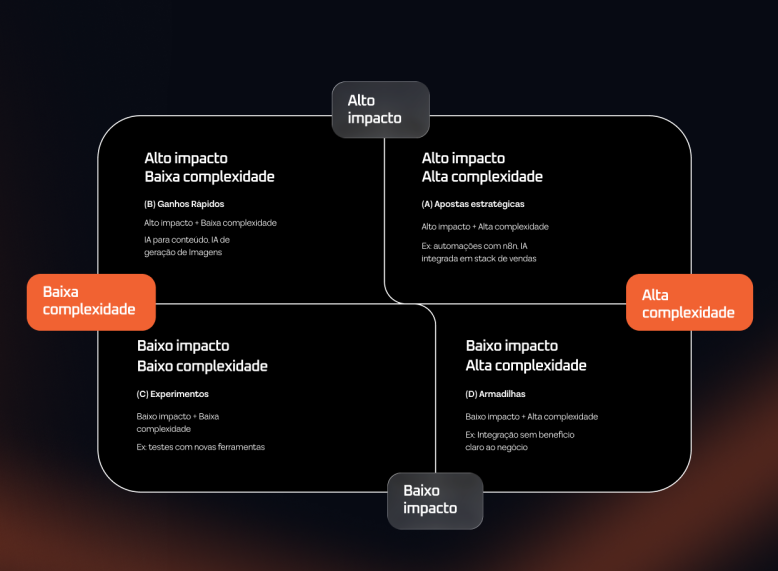
Our solution to this problem is the AI Implementation Matrix.
You can access the full content in the e-book How to Implement the Best AI Tools.
The proposed matrix helps you through the decision-making process of what to implement, helps you move past the hype, and start viewing AI systemically — integrated into your core business processes — avoiding the main implementation mistake, which is adopting a tool or technology that generates only costs, not results.
All adoption failures stem from a poorly structured decision-making process. Acting as a filter, the matrix simplifies decision-making in a straightforward way.
The goal is simple: eliminate superficial decisions and turn choices into strategy.
Instead of asking what tool to use, you start evaluating:
- real business impact
- implementation complexity
This solves critical problems:
- hype-driven decisions
- implementation issues
- internal adoption challenges
- spending without returns
- scaling problems
It might seem like a subtle shift, but it is actually a decisive change in perspective: you stop comparing tools and start prioritizing results.
Decisions become clear.
How the AI Implementation Matrix Works
The matrix boils a complex decision down to two objective axes.
The Business Impact axis answers the central question: does this move the needle on?
- revenue growth
- cost reduction
- efficiency improvement
It needs to impact at least one of these areas.
The Implementation Complexity axis measures the real cost of execution:
- human resources
- implementation timeline
- integration requirements
- ongoing operational effort
With this mental model and systemic view, you will be able to place the tools on your list into one of the quadrants and then make the decision on what to implement and when.
How to Make Decisions Using the AI Implementation Matrix

Quick Wins (high impact, low complexity)
Start here. Common implementation examples in this quadrant include: AI-powered content creation, website chatbots, or basic automations that deliver immediate ROI with minimal friction. Easy adoption and the potential for surprisingly strong results.
Strategic Bets (high impact, high complexity)
This is where the biggest results happen and, consequently, scale. Some examples in this quadrant are: AI-powered SDRs, CRM integrations, n8n workflows. They require a technical team and infrastructure depending on complexity, but they multiply results. Companies that redesign workflows are up to 3x more likely to succeed. (McKinsey).
Experiments (low impact, low complexity)
These are useful for exploring new tools, fast learning, and controlled testing — without integration into core business processes and without expectations of direct return.
Traps (low impact, high complexity)
Projects driven by hype, with no clear use case, no conscious systemic implementation, and no integration into business processes. They consume time, money, and energy.
The right decision is rarely about choosing a single quadrant — it is about combining them, capturing quick wins while preparing strategic bets.


FAQ
1. How do I choose the best AI tool for my company?
The best tool is not the most popular one — it is the one that generates real impact on your business. Always evaluate two factors: impact (revenue, cost, efficiency) and implementation complexity. Avoid hype-driven decisions.
2. Why do so many companies fail when implementing AI?
The main cause is not technical — it is strategic. Companies choose tools before defining the problem, ignore integration with existing processes, and underestimate the ongoing operational effort. This turns AI into a cost, not a result.
3. Where should I start implementing AI in practice?
Start with high-impact, low-complexity initiatives, such as simple automations or content generation. Then evolve toward more structured projects, like integrations and workflows, ensuring you scale with consistency.
Conclusion
AI adoption alone no longer sets companies apart. What makes the difference is how it is implemented.
Companies are not failing because of a lack of tools — they are failing because of superficial decisions, lack of integration, and absence of a systemic vision.
Throughout this article, the pattern became clear: successful implementation depends on a clear, objective, and assertive decision-making process, aligned with business goals to generate real results.
The AI Implementation Matrix is the right framework to streamline the decision-making process. It transforms choices into criteria, hype into strategy, and technology into results.
In the end, the question stops being what AI to use and becomes:
What actually generates impact on my business, and how do I implement it the right way?
If you want to move past trial and error and apply AI with clarity, predictability, and a focus on results, the next step is simple:
👉 Download the complete guide and see how to apply the matrix in practice, with real examples from those who have already done it and are generating results, along with criteria and real implementation paths.