What the Supreme Court decided about copyright and artificial intelligence
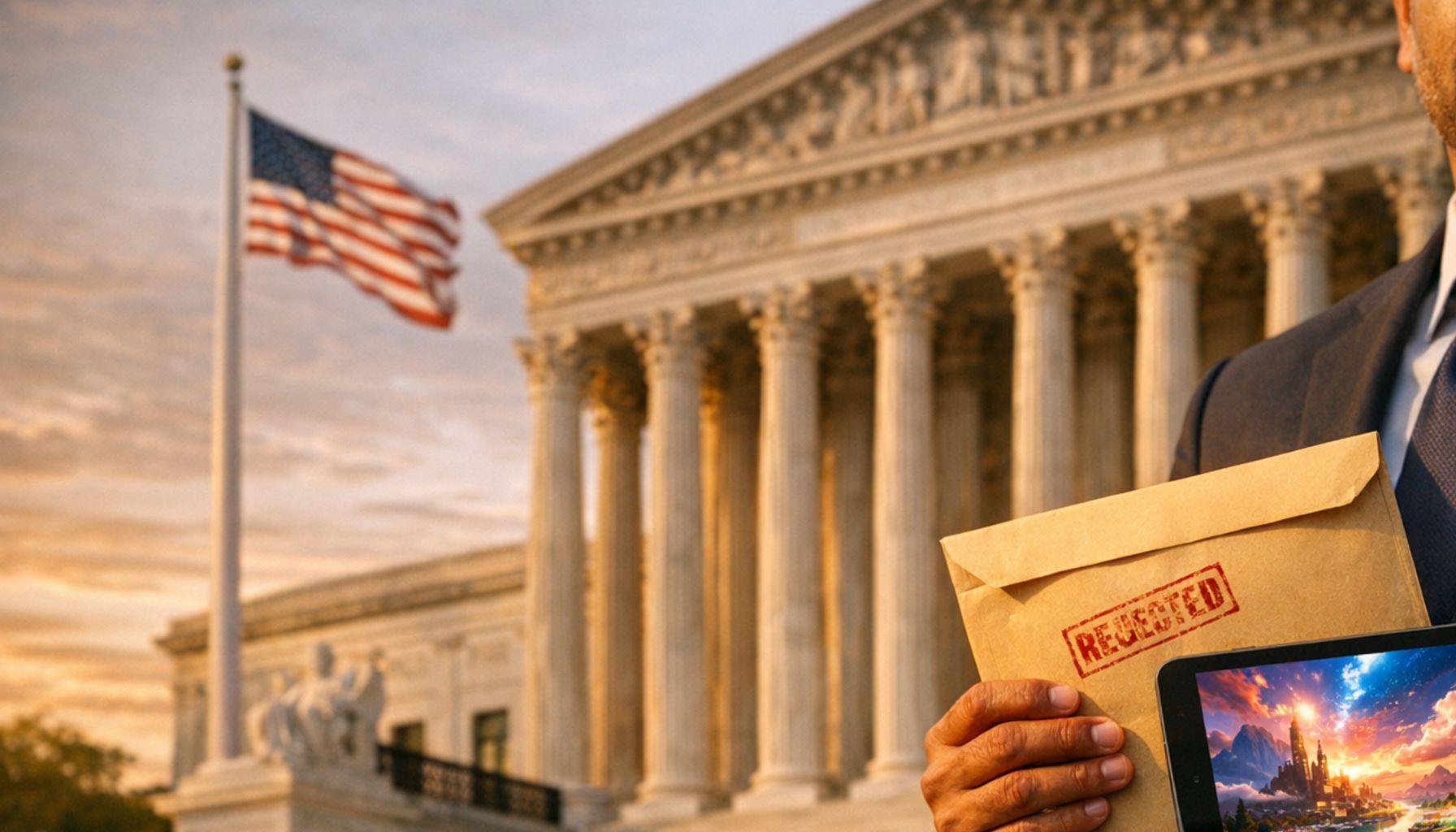
The discussion around copyright for works created by artificial intelligence just reached a decisive chapter in the United States. The Supreme Court, the most powerful court in the country, refused to hear a case questioning whether an artistic creation generated entirely by AI could receive copyright protection. In practical terms, by declining to take the case, the court upheld earlier rulings from lower courts that had already denied registration. The prevailing understanding is now clear: only human beings can be recognized as authors under American copyright law.
This position didn’t come out of nowhere — it confirms an interpretation that the U.S. Copyright Office had been upholding for several years, but it now carries far greater institutional weight after passing through the highest judicial authority in the country. The current presidential administration had actually urged the Supreme Court not to accept the case, arguing that although the Copyright Act doesn’t explicitly define the term author, multiple provisions within the legislation make it clear that the term refers to a human being, not a machine.
How the case made it to the Supreme Court
The case originated with a petition filed by a computer scientist from Missouri who attempted to register a visual work produced exclusively by his artificial intelligence system. He argued that the system had created the image autonomously and that he, as the owner of the machine, should be recognized as the rights holder over the work. The Copyright Office denied the request, stating that the law requires human authorship. The scientist appealed, took the case through federal courts, and lost at every level.
The arrival of the case at the Supreme Court was seen by many experts as the last chance to overturn this understanding, but the court chose to simply not accept the case for review. In American legal terms, this means the previous decisions remain intact and carry the force of precedent. It’s worth noting that this same scientist had faced similar rejections on another front: he also tried to register patents for inventions created by his AI system, including a prototype beverage container, and was likewise denied, according to Reuters.
The practical result of this move is pretty straightforward: at least for now, any work generated exclusively by artificial intelligence, without significant creative human participation, has no legal copyright protection in the United States. This applies to images, text, music, videos, and any other type of content produced autonomously by AI systems.
The size of the financial impact at stake
When you look at the size of the market involved, it’s easy to understand why this decision is generating so much buzz 💰. According to data from the Brookings Institution, the market for works created by artificial intelligence is expected to grow roughly 42% by 2029, reaching an estimated value of $2.5 billion. We’re talking about a decision that affects artists, tech companies, creative studios, and practically anyone who uses AI as a content production tool.
The financial question unfolds in several layers. If AI-generated works can’t be protected by copyright, companies investing heavily in automated production of visual, textual, or musical content are left without legal mechanisms to prevent competitors from copying and redistributing that material. On the other hand, human artists competing directly with AI generators might find some relief in this decision, since the market won’t create legal incentives for automated works to replace protected human creations.
For many creative professionals, there’s an additional layer of concern. Numerous artists have been accusing the AI industry of training its models using copyrighted works without permission and without financial compensation. This is a parallel discussion, but a deeply connected one, because it directly involves the relationship between what AI consumes to learn and what it produces as a result. If AI output doesn’t receive legal protection, but the data feeding those systems often involves protected works, the imbalance is obvious and will likely fuel even more lawsuits in the coming years.
Why this decision matters for the future of artistic creation
The impact of this Supreme Court refusal extends far beyond a single court case. It sends a clear signal to the entire artistic creation ecosystem involving artificial intelligence: if you want copyright protection, you need to demonstrate that there was creative human participation in the process.
This doesn’t mean AI tools can’t be used. The U.S. Copyright Office has already issued guidance explaining that works created with the assistance of AI can be registered, as long as the human element is substantial and identifiable. The difference lies between using AI as a digital paintbrush, where the artist directs, selects, edits, and makes creative decisions, versus simply typing a prompt into an image generator and accepting the result without any meaningful intervention.
That dividing line might seem subtle, but it’s exactly where the legal debate is focusing right now, and companies like OpenAI, Midjourney, Adobe, and Google are already paying close attention to how this could affect their products and their users.
The importance of documenting the creative process
For artists and content creators, the message is that documenting the creative process is becoming increasingly important. Anyone working with generative AI tools needs to think about how to record and prove their participation in the stages of conception, direction, selection, and refinement of the work. This applies to:
- Illustrators who use Midjourney or DALL-E as a starting point for their creations
- Musicians who use tools like Suno or Udio to generate sound bases
- Writers who employ language models as assistants in developing narratives
- Designers who combine AI-generated elements with manual compositions
- Video producers who use AI to generate scenes or visual effects and then edit the final material
The trend is for standards and best practices around this documentation to emerge, something already being discussed in professional associations and creative groups in the United States and Europe. The landscape also opens the door for AI platforms to implement features that help users automatically log their creative contributions throughout the content generation process.
Connection to the global debate on AI regulation
Another relevant point is how this decision connects to the global debate on artificial intelligence regulation. The European Union, for example, is moving forward with the AI Act, which addresses transparency and labeling of AI-generated content, but has not yet definitively determined how to handle the copyright question for autonomous machine creations.
The United Kingdom considered a specific exception for AI data mining but backed off under pressure from creative industries. In Brazil, the AI regulatory framework under discussion in Congress also touches on the topic, although without the same depth the American debate has reached. The fact is that the American Supreme Court position tends to influence lawmakers and courts around the world, since the United States is the largest intellectual property market on the planet, and its rulings often serve as an international reference for copyright issues.
What actually changes for people who use AI every day
If you use artificial intelligence to create images, text, code, or any other type of content, this Supreme Court decision has concrete implications worth understanding. The main one is that content generated purely by AI, without creative human intervention, essentially falls into the public domain in the United States. This means anyone can copy, reproduce, modify, and distribute that material without needing permission or paying royalties.
For companies building products and services based on AI-generated content, this represents a significant strategic risk, because the absence of copyright protection makes it much harder to defend exclusivity over those materials. On the flip side, it also creates interesting opportunities for those who work with content curation and remixing, since an enormous amount of potentially unprotected material is being produced daily by generative AI tools.


Cases already defining the limits of protection
For creative professionals who have already incorporated AI into their workflows, the safest path is to ensure the final result reflects identifiable human choices and decisions. This could involve carefully selecting prompts, manually editing generated results, combining AI-produced elements with manually created ones, or any other form of intervention that demonstrates human authorship in the process.
The U.S. Copyright Office has already reviewed specific cases where parts of a work created with AI were registered while others were excluded from protection, as happened with the graphic novel Zarya of the Dawn. In that case, the text and page composition received copyright, but the individual images generated by Midjourney were deemed unprotectable. This kind of case-by-case analysis is likely to become more common and more sophisticated as AI tools evolve and the lines between human contribution and automated generation grow increasingly blurry.
What to expect going forward
The debate over copyright and artistic creation with artificial intelligence is far from over. The Supreme Court refusing to hear the case doesn’t end the discussion — it simply confirms the current landscape and pushes the responsibility to create new rules onto the U.S. Congress, which may eventually legislate on the topic more comprehensively. With billions of dollars potentially on the line, American lawmakers will likely face pressure from both the tech industry and artist and creator associations to define clearer rules on the matter.
Meanwhile, the technology keeps advancing at a remarkable pace, with AI models increasingly capable of producing content that rivals human creations in quality and complexity. Tools like GPT, Claude, Gemini, Midjourney, and Stable Diffusion are evolving with every update, making the distinction between human content and machine-generated content harder and harder to spot with the naked eye.
The tension between technological innovation and intellectual property protection is one of the great regulatory challenges of our decade, and every new judicial or legislative decision in this space shapes the future of how we create, share, and monetize content worldwide 🌍. For anyone following the artificial intelligence space, this is a story worth keeping an eye on, because its ripple effects will impact everyone from major corporations to independent creators who use AI as part of their daily work.