The revenue machine that keeps picking up speed
Nvidia just delivered a quarter that left the market absolutely stunned. Fourth fiscal quarter revenue hit $68.13 billion, representing a jaw-dropping 73% jump compared to the same period last year. That kind of growth would already be remarkable for any tech company, but when you look at where that money is coming from, the picture gets even more interesting. The data center division accounted for $62.13 billion of that total, with a 75% year-over-year increase. We are talking about more than 91% of the entire company revenue coming from a single segment, which shows a strategic concentration that very few can replicate in today market.
This means Nvidia has stopped being just the maker of the most coveted graphics cards on the planet. It has become the backbone of all the infrastructure that supports the artificial intelligence economy. Every new language model trained, every generative AI application pushed to production, and every autonomous system that goes live depends, to some degree, on the hardware and software ecosystem the company has built over the past few years. And the most significant part is that this dependency shows no signs of slowing down — quite the opposite, demand keeps growing at a pace that surprises even the most optimistic analysts.
CEO Jensen Huang has repeated in virtually every public presentation that we are living through the beginning of a new computing era. And the numbers seem to prove him right. The company is not just riding a passing wave of AI hype. It is building, layer by layer, a complete platform that spans from chips to software frameworks, including interconnect networks and cooling solutions for next-generation data centers. It is a long-term bet that, so far, has proven to be extremely well-placed.
GB300 NVL72 and the revolution in performance per watt
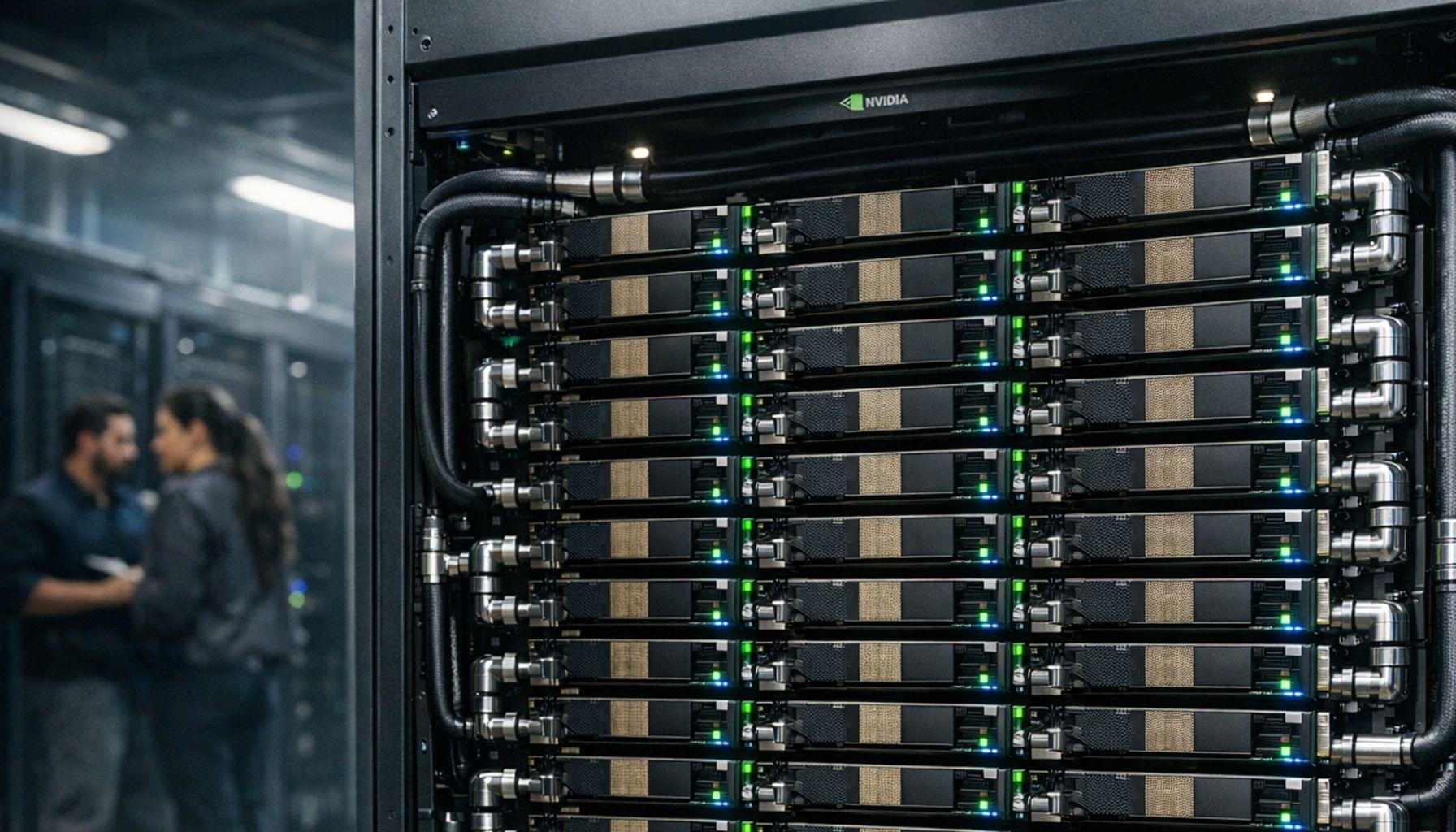
One of the most striking highlights from Nvidia recent results is the GB300 NVL72 system. This integrated rack, composed of 72 interconnected Blackwell GPUs, delivers up to 50 times more performance per watt compared to the previous generation based on the Hopper architecture. In practical terms, this means the same amount of electrical power can process a drastically larger volume of inference tasks — something critical for data centers facing growing energy capacity and cooling constraints around the world.
But the number that really grabs your attention is the up to 35x reduction in cost per inference token compared to Hopper. For anyone working with language models in production, this completely changes the economic equation. Services that were previously unviable due to computational cost now become accessible. Imagine a company running millions of daily queries on a generative AI model — with the GB300, the cost per query plummets, opening doors to applications at scale that simply did not make financial sense on the previous generation of hardware.
This advancement is not just an engineering exercise for the sake of innovation. It responds to real market demand. The major cloud providers and companies that operate their own data centers need ever-increasing processing capacity without necessarily being able to expand their physical or energy infrastructure at the same rate. The efficiency of the GB300 NVL72 solves that equation elegantly and is one of the main reasons why demand for Blackwell systems remains red hot months after launch.
AI Agents and the new frontier of computational demand
If training large language models was the first major driver of GPU demand, AI Agents represent the next wave — and possibly an even bigger one. These autonomous artificial intelligence agents are systems capable of executing complex tasks independently, making decisions, interacting with external tools, and adapting to dynamic contexts without constant human intervention. The fundamental difference from traditional chatbots is that AI Agents do not just answer questions — they plan, execute, and iterate on results. And each of those steps consumes a significant amount of computational power, both during inference and in real-time processing.
For Nvidia, this represents a massive opportunity. While model training is a process that happens periodically and in concentrated bursts, inference with autonomous agents is continuous and scalable. Imagine millions of AI Agents running simultaneously across companies around the world, each one consuming GPU cycles to process natural language, analyze data, generate code, and make real-time decisions. Inference performance demand explodes in this scenario, and that is exactly where the company new architectures come into play.
The practical impact is that companies across all sectors are rethinking their infrastructure strategies. It is no longer enough to have a few servers with GPUs to run one-off models. Large-scale adoption of AI Agents requires a robust data center foundation with low latency, high bandwidth, and the ability to scale quickly as demand grows. And Nvidia is not just offering the chip — it delivers the complete rack, orchestration software, optimized libraries, and even architecture consulting so its customers can squeeze every last drop of performance out of every dollar invested. This vertically integrated business model is one of the company biggest competitive advantages and explains why data center revenue continues on an accelerated growth trajectory.
Rubin platform and the roadmap that secures the future
One of the most impressive aspects of Nvidia strategy is the speed at which it refreshes its product portfolio. The Blackwell architecture barely started shipping in volume and the company has already announced the Rubin platform, scheduled for launch in the second half of 2026. This aggressive launch cadence is not accidental. Jensen Huang has publicly stated that the company intends to maintain an annual cycle of new architectures — something virtually unprecedented in the semiconductor industry, which has historically operated on two- to three-year cycles between generations.
What makes Rubin especially significant is the promise of reducing AI inference costs by up to 10x compared to Blackwell systems. If Blackwell already represents a monumental leap over Hopper, Rubin promises to push efficiency to a level where large-scale inference becomes accessible to an even wider universe of companies and applications. This is particularly important in the context of AI Agents, where continuous, massive inference is the determining factor for operational costs.
The Rubin platform is expected to incorporate advances in both chip design and packaging and interconnect technologies. Market indications suggest it will use next-generation HBM memory and an even faster NVLink bus, allowing hundreds of GPUs to work together as if they were a single massive processor. For workloads involving AI Agents, this is transformative because it enables larger, more sophisticated models to run with lower latencies, making real-time interactions possible that would have been out of reach before.
The combination of cutting-edge hardware with the CUDA ecosystem, which already boasts millions of developers around the world, creates a barrier to entry that competitors like AMD and Intel are still struggling to overcome. Each new generation of Nvidia GPUs hits the market with full support for libraries, frameworks, and development tools — something that takes years to build and simply cannot be copied overnight.
Sovereign AI and the demand coming from governments
A growth vector that a lot of people still underestimate is the so-called Sovereign AI movement. This refers to countries investing in building domestic AI infrastructure outside the ecosystems of the major American hyperscalers like AWS, Azure, and Google Cloud. The idea is to ensure technological sovereignty, protect sensitive data, and develop artificial intelligence capabilities aligned with local needs and regulations.
Nvidia reported that Sovereign AI demand surpassed $30 billion in fiscal year 2026, tripling compared to the previous year. That number is striking and reflects a global movement that goes well beyond the United States and China. Countries across Europe, the Middle East, Southeast Asia, and Latin America are allocating significant resources to build their own AI data centers, and Nvidia is positioned as the preferred supplier of hardware and software for these projects.
This market is particularly interesting because it represents a revenue source less dependent on the investment cycles of big tech. While hyperscaler spending can fluctuate from quarter to quarter based on their own strategic priorities, government investments in AI infrastructure tend to be more stable and long-term, driven by public policy and national strategies for technological competitiveness. For Nvidia, this functions as an additional revenue cushion that diversifies and strengthens the company client portfolio.
Capital efficiency that impresses Wall Street
Beyond the accelerated revenue growth, Nvidia financial efficiency metrics are at levels that would make any CFO on the planet jealous. The company generated $97 billion in free cash flow in fiscal year 2026, maintaining gross margins of 75.2%. These numbers are extraordinary for a company operating in the semiconductor industry, which is traditionally capital-intensive.
But the figure that truly stands out is the return on capital employed, or ROCE, which exceeded 101%. This means Nvidia is generating more than one dollar of operating profit for every dollar of capital invested in the business. In simple terms, the company value-generating machine is running with an efficiency that very few businesses in recent tech market history have managed to achieve. This robust financial performance gives the company enormous flexibility to invest in research and development, make strategic acquisitions, and return value to shareholders without compromising its balance sheet.
This combination of accelerated growth with high margins and abundant cash generation is what supports the premium valuation of Nvidia stock in the market. Even after the 4% decline recorded since the latest analyst coverage, the investment thesis remains solid, anchored in fundamentals that go far beyond optimistic projections — these are real numbers, delivered quarter after quarter 📈
The competitive landscape and the challenges ahead
Despite all the positive numbers, it would be naive to ignore the challenges Nvidia faces. The concentration of revenue in the data center segment is both a strength and a point of concern. Any slowdown in AI infrastructure investments by big tech — such as Google, Microsoft, Amazon, and Meta — would have a direct impact on the company results. Additionally, the geopolitical landscape remains an unpredictable variable. Export restrictions to China, which have already affected high-performance chip sales, could intensify depending on regulatory decisions in the coming months.


On the competitive front, AMD has been making significant progress with its Instinct MI300 lineup, and companies like Google and Amazon are developing custom AI chips to reduce their dependence on Nvidia. Google TPUs, for instance, are already widely used internally and are available as a service on Google Cloud. Still, Nvidia accumulated advantage in terms of software ecosystem and installed base is tough to overcome in the short and medium term. CUDA has become practically an industry standard for GPU computing, and migrating complex workloads to alternative platforms involves significant time and engineering costs that many companies simply are not willing to take on right now.
Beyond pure hardware, Nvidia has been investing heavily in software and services. The NIM platform, which simplifies deploying AI models in production, and Omniverse, focused on simulation and digital twins, are examples of how the company is expanding its revenue streams beyond chip sales. This complete ecosystem works as a flywheel: the more companies adopt Nvidia hardware, the more developers build solutions optimized for it, which attracts even more companies. It is a virtuous cycle that supports the thesis of sustained growth 🚀
What to expect going forward
Another point worth watching is the sustainability of the growth pace. Maintaining expansion rates of 70% or more on a revenue base that already exceeds tens of billions of dollars per quarter is mathematically challenging. The good news for Nvidia is that enterprise-scale adoption of AI Agents is still in its early stages. Sectors like healthcare, finance, manufacturing, and logistics are just beginning to explore the potential of these autonomous agents, and every new implementation means more demand for GPUs and data center infrastructure.
If the projection that the AI Agents economy will drive trillions of dollars in the coming years proves correct, Nvidia is positioned to capture a generous slice of that market. The combination of an aggressive technology roadmap with Blackwell and Rubin, a growing base of Sovereign AI projects, world-class financial efficiency, and a virtually unbeatable software ecosystem forms a thesis that is hard to argue against.
Nvidia is not just selling GPUs. It is creating the operating system of the artificial intelligence economy — and with each passing quarter, that vision becomes more concrete in the numbers. For anyone following the tech and artificial intelligence space, this is a story worth keeping a close eye on.