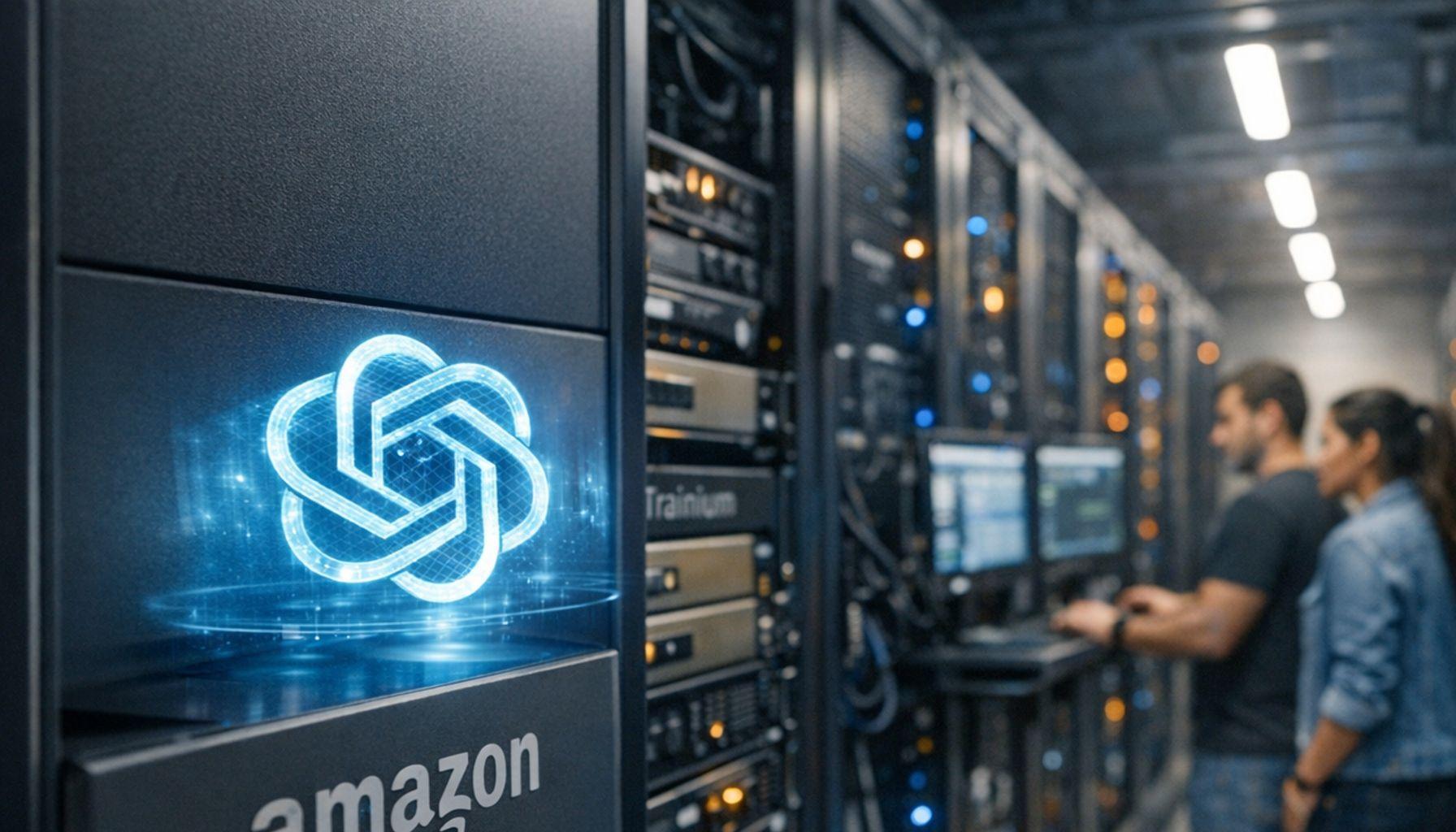
Amazon closes billion-dollar deal with Corning to power its AI data centers
Amazon just closed a billion-dollar deal with Corning that promises to be a game changer for artificial intelligence infrastructure in the United States. The deal, announced this Monday, involves the massive supply of fiber optic cables for the e-commerce and cloud computing giant’s American data centers and will unfold over several years.
The market reacted immediately: Corning shares jumped 4% right after the announcement, while Amazon stock remained largely flat.
But the impact goes far beyond the numbers on the stock exchange.
The contract also calls for the creation of 1,000 new jobs at Corning’s factories in North Carolina, further solidifying the company’s industrial footprint on American soil. In a joint statement, both companies emphasized that Amazon’s data centers power services that millions of people and businesses rely on every day, and that Corning’s fiber optics are a critical piece of that infrastructure.
And if you weren’t already familiar with Corning, here’s a quick rundown: the company has 175 years of history, invented fiber optics for long-distance communication back in 1970, and today sits at the absolute center of the AI infrastructure race. 🚀
In recent months, the company had already closed some jaw-dropping megadeals. In January, Meta announced it would spend up to $6 billion as the anchor client in the expansion of Corning’s optical cable factory in Hickory, North Carolina — an expansion expected to create around 1,000 jobs. In May, Nvidia committed to investing up to $3.2 billion in Corning as part of a deal that includes building three new advanced manufacturing facilities entirely dedicated to the chipmaker. And now Amazon joins that exclusive list.
The question is: what exactly is going on with Corning, and why has fiber optics become the most sought-after ingredient in the artificial intelligence recipe?
Corning and the most important moment in its history
Founded in 1851, Corning is one of those companies that has been around for so long it seems impossible they could still be relevant. But relevant barely begins to describe what’s happening with the company right now. Headquartered in Corning, New York, the company built its reputation over decades developing glass and ceramic materials for industrial, scientific and technological applications. It created the glass for the first televisions, the coating for NASA’s lunar modules and, of course, the Gorilla Glass that protects your smartphone screen. But none of those achievements come close to what fiber optics represents for the company’s business — and for the world — today.
In 1970, Corning researchers developed the first fiber optic cable capable of transmitting data over long distances with low signal loss, which basically opened the door to the modern internet as we know it. Back then, few could have imagined that invention would become the backbone of global communications decades later. Today, with the explosion of artificial intelligence and the massive demand for data transmission at blazing speeds, fiber optics has once again become the most coveted asset in the tech sector — and Corning is right at the eye of this perfect storm.
The company is widely known for manufacturing all the display glass for Apple‘s iPhones, but the optical communications division remains its largest and fastest-growing segment. Since inventing fiber optics, Corning has supplied millions of miles of cable to connect racks in AI data centers for all the major players in the market. And the stock market numbers back up this trajectory: Corning shares have more than doubled in value year to date and have risen nearly six-fold since the end of 2023.
What makes this moment even more interesting is the fact that Corning didn’t become the preferred supplier for the world’s biggest tech companies overnight. This is the result of decades of investment in research, manufacturing and production capacity. When Meta, Nvidia and now Amazon come knocking on Corning’s door to lock in long-term supply, they’re acknowledging that there is no easy, quick or cheap substitute for what this company delivers. AI infrastructure depends on ultrafast connectivity, and Corning’s fiber optics is, literally, the thread that ties it all together. 🔗
Why fiber optics is so critical for AI data centers
To understand why this deal with Amazon is so significant, you need to understand what goes on inside a modern data center built for artificial intelligence. These environments are not just big warehouses full of servers. They are massive, sophisticated facilities where thousands of high-performance chips — like Nvidia’s GPUs — need to communicate with each other in fractions of a millisecond. Every operation of a large language model requires a colossal amount of data exchange between processors, memory and storage systems. If there’s any bottleneck in that communication, performance tanks.
That’s where fiber optics steps in as the star of the show. Unlike traditional copper cables, fiber transmits data using light, which means much higher speeds, much lower latency and far less energy loss along the way. In an AI data center running 24 hours a day, 7 days a week, that energy efficiency isn’t just a technical footnote — it represents real savings of millions of dollars a year in electricity bills. On top of that, fiber optics supports much higher transmission densities, which allows engineers to build network architectures that are more compact and more powerful at the same time.
Amazon, through its cloud computing division AWS, operates one of the largest data center networks on the planet. With the accelerated expansion of generative AI services, the company needed to ensure its physical infrastructure could keep up with growing demand without compromising performance or reliability. Locking in a long-term contract with Corning is, in practice, securing priority access to a resource that is increasingly scarce on the market, since all the major tech companies are racing to expand their capabilities at the same time.
AWS CEO Matt Garman noted in the official statement that the company’s investments in North Carolina have already generated more than 26,000 jobs. Last year, Amazon had committed to investing $10 billion in new data centers in the state. Now, with the Corning deal, that ecosystem gains even more density and capacity, creating an industrial hub focused on AI infrastructure that few places in the world can replicate. 💡
The domino effect on AI infrastructure investment
The deal between Amazon and Corning doesn’t exist in a vacuum. It’s part of a much larger trend that is reshaping how tech companies think about physical infrastructure. For years, the tech industry focused almost exclusively on software, algorithms and models. The assumption was that hardware was a commodity — something you outsourced or bought from whoever offered the lowest price. The race for artificial intelligence shattered that logic completely, because it became clear that without quality hardware, in sufficient quantity and with adequate performance, no algorithm in the world delivers on its promise.
This shift explains why companies like Corning have suddenly become strategic partners for the Silicon Valley giants. Fiber optics, chips, cooling systems, power generators — everything that used to be treated as an operational detail is now on the agenda of CEOs and boards of directors at the world’s biggest companies. Investment in data centers in the United States has hit historic levels, and the trend is accelerating, not slowing down. Every dollar invested in computing capacity pulls along several more dollars in connectivity infrastructure, and fiber optics sits at the heart of all of it.
The creation of 1,000 new jobs at Corning’s factories in North Carolina is a direct reflection of this explosive demand. The company will need to ramp up its production capacity to fulfill the commitments made with Amazon, Meta, Nvidia and other partners that will certainly follow. This kind of industrial expansion takes time, requires heavy investment and a specialized workforce — which further reinforces Corning’s competitive advantage over potential competitors that might try to break into this market. The barrier to entry is extremely high, and companies already inside this AI infrastructure supply chain hold an enviable position for the years ahead. 🏭
The question of American manufacturing and the role of government
There’s an important geopolitical component to this story that can’t be overlooked. The U.S. government, under the Trump administration, has been pushing major tech companies to bring as many stages of the AI supply chain as possible onto American soil. In this context, Corning fits like a perfect puzzle piece. The company already has significant operations in the United States, especially in North Carolina, and deals like the one closed with Amazon reinforce the narrative that it is possible to build a resilient and competitive manufacturing base within the country.
At the same time, Corning CEO Wendell Weeks acknowledged that the majority of the company’s business still takes place overseas and that reality won’t change overnight. However, he pointed out that hyperscalers — the term for the big cloud companies like Amazon, Google and Microsoft — are becoming Corning’s largest customers. In Monday’s statement, Weeks said the Amazon deal represents a significant milestone for Corning and for American manufacturing, pointing toward a path for building a resilient industrial base in the United States.


The deal also expands a Corning training program for fiber optic technicians in North Carolina. That might seem like a minor detail inside a multibillion-dollar contract, but in practice it’s extremely relevant. The shortage of qualified professionals to install, maintain and operate fiber optic networks is one of the real bottlenecks that could slow down the expansion of AI infrastructure. Investing in workforce development is investing in the ability to execute the ambitious plans these companies are laying out.
What this means for the future of AI
When you look at the full picture — Amazon investing billions in fiber optics, Meta spending $6 billion, Nvidia putting in $3.2 billion — it’s clear we’re living through an inflection point in the tech industry. The race for artificial intelligence is no longer just about who has the best language model or the most sophisticated algorithm. It’s a race for the physical infrastructure that supports all of it, and fiber optics is one of the most critical pieces of that puzzle.
Corning, with its 175 years of history and an expertise that no startup can replicate in the short term, finds itself in a privileged position. The company doesn’t just supply an essential component — it also holds patents, technical knowledge and industrial capacity that make it virtually irreplaceable right now. The stock that has more than doubled in value in 2025 is just the financial reflection of a much deeper transformation happening in the global technology supply chain.
For Amazon, this deal is another layer of protection in a long-term strategy. The company doesn’t want to depend on the spot market for fiber optics when all of its competitors are also fighting over the same resource. Securing priority supply for several years is a move that could make the difference between leading the cloud AI market or falling behind.
What all of this tells us is that artificial intelligence is not just a software revolution. It’s a revolution in physical infrastructure, manufacturing and logistics. Companies like Corning, which dominate critical parts of this supply chain, are becoming just as important as the AI model developers themselves. The fiber optics coming out of those North Carolina factories will, literally, connect the digital future being built at this very moment. And given the dollar amounts involved in these contracts, that future is closer than most people think. ⚡