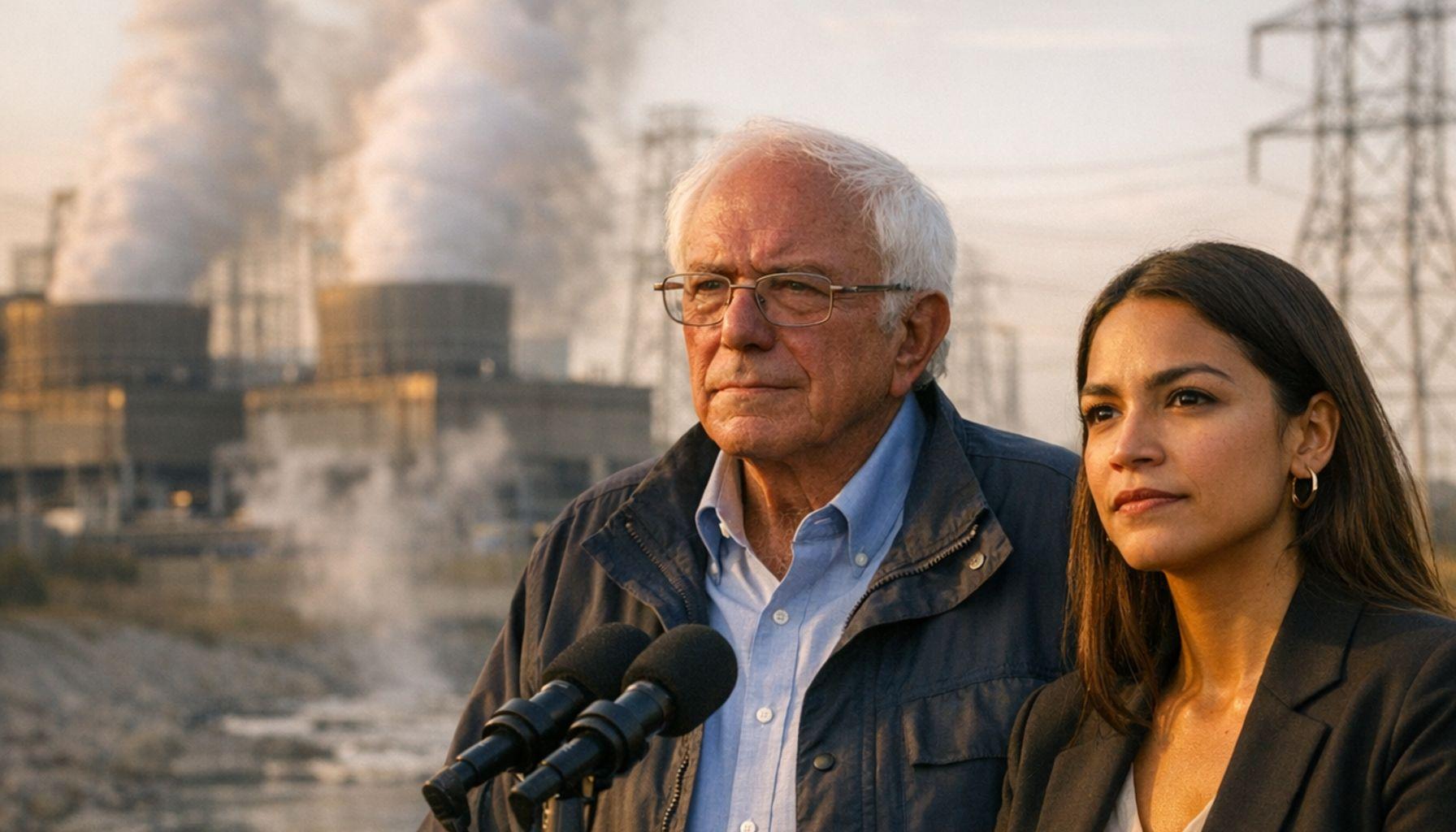
Bernie Sanders and AOC want to pause construction of new AI data centers in the United States
Artificial intelligence has become the center of one of the hottest discussions in the United States right now.
And we are not just talking about technology, innovation, or market competition.
The debate now involves skyrocketing energy bills, rivers and aquifers being drained, and entire communities feeling the financial burden of infrastructure growing at a breakneck pace.
In the middle of all this, two of the most recognizable names from the American progressive wing have stepped up with a proposal that is splitting opinions:
Bernie Sanders, independent senator from Vermont, and Alexandria Ocasio-Cortez, Democratic representative from New York, introduced a bill to pause the construction of new AI data centers in the United States. 🚨
The idea is simple in form but complex in its consequences.
A temporary moratorium that would give the federal government enough time to create clear rules about how this industry should operate — without devastating the environment, without pushing costs onto the public, and without letting the benefits stay concentrated in the hands of a few.
According to Sanders, in a statement sent via email, AI and robotics are creating the broadest technological revolution in human history, and Congress is way behind where it should be in terms of understanding the nature of this revolution and its impacts.
Sounds radical?
A few months ago, Sanders himself admitted the proposal was being treated as a fringe idea, outside the mainstream, almost Luddite. Today, the landscape looks very different. 👇
What the bill actually proposes
The bill introduced by Sanders in the Senate calls for the moratorium to take effect immediately upon approval. The pause would remain in place until specific laws are enacted to curb the harmful effects of data centers. That includes reducing their climate and environmental impacts, ensuring they do not cause increases in public utility energy costs, preventing job losses from automation, and making sure the wealth generated by AI companies is shared with the American people.
Ocasio-Cortez was responsible for introducing a companion bill in the House of Representatives.
The text of the bill is sweeping and touches on issues that go far beyond energy concerns. It addresses the impact of artificial intelligence on the economy, social well-being, democracy, warfare, and even children’s education. It is a clear signal that progressive lawmakers see regulating the physical infrastructure of AI as inseparable from regulating the technology itself.
What changed to give the moratorium momentum
Over the past two years, the growth of data centers built for artificial intelligence has been so rapid that it started leaving visible, tangible marks on people’s daily lives. This is no longer an abstract question about environmental impact or a technical report circulating among specialists. It is the electricity bill going up, the pressure on local power grids, the water that is no longer available for other uses because it is being consumed on a massive scale to cool servers running increasingly heavy language models.
This combination of real-world effects moved the issue out of climate activism circles and onto dinner tables, into city council chambers, and now into the U.S. Congress with a force it never had before.
The movement has not been limited to Washington. Since August 2025, cities and counties across several American states have started approving their own temporary bans on data center construction. Missouri, Indiana, Georgia, and North Carolina are among the places where this has already happened. According to the watchdog group Good Jobs First, at least 11 states are now considering similar policies.
In December 2025, more than 200 advocacy groups, led by the environmental organization Food and Water Watch, sent a letter to House and Senate leaders calling for a federal moratorium on data centers. The concerns cited included impacts on electricity bills and on the climate crisis. Sanders was the first lawmaker to publicly support the demand, and since then it has gained backing from other progressive legislators, including Maxwell Frost, representative from Florida, and Pramila Jayapal, representative from Washington.
Public opinion is shifting
Survey data shows that Americans are increasingly concerned about the impacts of artificial intelligence. A Pew Research Center survey from June 2025 found that half of U.S. adults are more worried than excited about the growing use of AI in everyday life. In December of the same year, another survey showed that 60% of Americans believe the industry should be better regulated to limit its potential negative effects on society.
Energy costs are an especially sensitive point. When a February 2026 survey asked participants to select the most concerning topic from randomized comparisons involving data center-related issues, public utility energy costs were chosen 64% of the time and energy consumption was chosen 59% of the time.
In other words, people are feeling it in their wallets, and they are not happy with what they see. This public perception is one of the most important political drivers behind the Sanders and AOC proposal.
Energy and sustainability: the numbers that raise concerns
When it comes to sustainability in the context of artificial intelligence data centers, the numbers are hard to ignore. Just training a single large-scale language model, like the ones behind widely used tools today, can consume energy equivalent to what hundreds of homes use over an entire year. And that is just the training phase. Inference — when the model answers your questions throughout the day — also consumes energy continuously and at an increasing rate.
A report published in October by the Center for Biological Diversity estimated that if current trends continue, data centers could account for nearly half of all American emissions from the electricity sector under existing national climate targets. That is a number that puts the tech industry on a direct collision course with the country’s environmental commitments.
Electricity demand from data centers is already driving up energy prices in some regions. A Bloomberg analysis found that areas with especially high concentrations of data centers have seen energy costs spike by as much as 267% over the past five years. That kind of data turns the debate from something theoretical into something very real for people living in those areas.
Water is another resource that has entered this equation in a very serious way. The cooling systems for data centers, especially those running high-performance processors like the GPUs used for AI, depend on large volumes of water to keep temperatures under control. In regions already experiencing water stress, such as parts of the American Southwest, the installation of new data centers has created direct conflicts with local communities and farmers who depend on the same aquifers. 🌱
The bill introduced by Sanders and AOC takes these points into explicit consideration. The proposal calls not only for a temporary pause on new data center construction but also for the creation of federal energy and water efficiency standards for the sector, along with transparency requirements about where consumed energy comes from and how environmental impacts are mitigated.
The response from the Trump administration and the industry
On the side of major tech companies, the reaction to the moratorium proposal has been, unsurprisingly, quite negative. The most common arguments revolve around American competitiveness against China, the risk of slowing innovation at a moment considered critical for artificial intelligence development, and the claim that companies are already investing in renewable sources and energy efficiency without needing regulatory mandates.
The Trump administration, for its part, has been working to promote unrestricted AI growth. This March, the government held an event at the White House with tech executives, where companies pledged to protect Americans from energy bill increases linked to the growing demand from their data centers. The problem is that these commitments have no legal force. They are voluntary promises that nobody is required to keep.
And Americans seem to know it. A March survey showed that the majority of the population is skeptical of these pledges made by tech companies.
There is also the economic argument that circulates heavily within the industry: the construction and operation of data centers creates jobs, boosts local economies, and attracts investment. That is true, but the question critics are raising is about the quality and distribution of those benefits:
- How many of those jobs are local and long-term?
- Who actually benefits from the real estate appreciation that comes with the arrival of a massive server campus?
- The infrastructure costs left for local governments and residents — how are those distributed?
These are legitimate questions that the industry has yet to answer satisfactorily, and that the legislative proposal is at least trying to put officially on the table.
What supporters of the proposal are saying
Mitch Jones, managing director of policy and litigation at Food and Water Watch, praised the proposal and was blunt in his assessment. According to him, political and community leaders across the country were caught completely off guard by an aggressive, profit-driven industry. He also emphasized that it still needs to be determined whether, not how, the industry can operate in a way that sufficiently protects people and society from the inherent dangers that data centers bring wherever they show up.


Camden Weber, senior policy specialist at the Center for Biological Diversity, was even more emphatic. In his view, the big tech data center boom is an ecological disaster in the making that is choking neighborhoods with diesel fumes, draining drinking water, and driving up electricity bills with fossil fuel-powered projects.
Sanders, speaking on the Senate floor Tuesday evening, reinforced the urgency of the situation by stating that it is not possible to stand by and allow a handful of billionaire big tech oligarchs to make decisions that will reshape the economy, democracy, and the future of humanity. In his view, a serious public debate and democratic oversight over this enormously consequential issue are essential.
A moratorium is not a ban: understanding the difference
It is worth remembering that the proposed moratorium is not a permanent ban. It is a pause. The difference is enormous, and that detail often gets lost in the heat of the debate. The stated goal is to create a regulatory window so federal agencies can establish minimum standards for operations, energy consumption, and environmental impact before new projects get approved.
In practice, it would be similar to what happens in other industrial sectors that experience rapid and disorderly growth: first comes the expansion, then comes regulation trying to catch up. The Sanders and AOC proposal is trying to flip that order. 🔄
Despite the relevance of the debate, the bill itself acknowledges that its chances of passing the Senate are low, especially considering that the Trump administration has been working to promote deregulated AI growth. Still, the proposal serves an important political role by formalizing demands that are growing across multiple layers of American society and by forcing the topic into the official legislative debate.
What is at stake going forward
The discussion around AI data centers in the United States is not going to stay within American borders for long. Countries around the world are on the expansion route of major tech companies looking to diversify their infrastructure and get closer to emerging markets. That means the issues raised by this debate — about energy consumption, water use, impact on local communities, and distribution of economic benefits — are questions that will arrive with full force everywhere, whether in one year or five.
How the United States decides to handle this standoff will set important precedents. If the moratorium moves forward and results in a more robust regulatory framework for the sector, it could influence policies in other countries and even establish minimum standards that companies would need to follow globally in order to operate. If, on the other hand, the bill gets blocked and expansion continues at its current pace without significant regulation, the accumulation of impacts could force a much more drastic reaction down the road, when the room for gradual adjustments is smaller.
What is clear right now is that artificial intelligence has reached a point where its physical consequences — concrete and measurable — can no longer be treated as secondary externalities of technological progress. The infrastructure that supports AI models has weight, generates heat, consumes water and electricity, and is connected to power grids that also supply hospitals, schools, and homes.
That is the debate Bernie Sanders and AOC have put on the table, and regardless of what you think about their proposal, it is a debate that needed to happen. ⚡