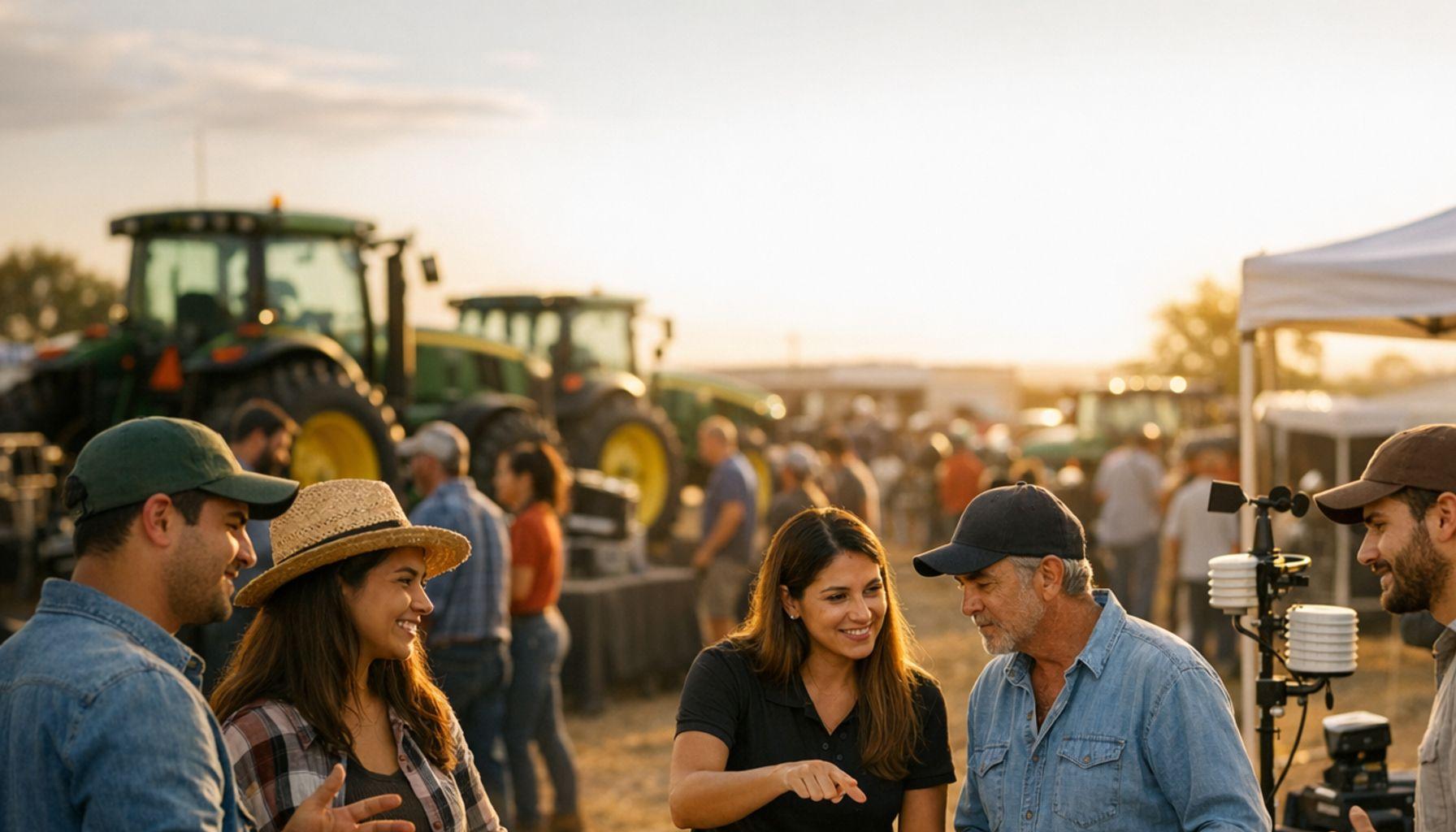
This year’s Husker Harvest Days arrived with something new that’s drawing serious attention from folks who work the land and those building solutions for them.
At booth 145, set up under a large tent on the north side of the event in Hall County, Nebraska, the Ag Tech Pavilion was born — a space created specifically to bring Nebraska startups closer to farmers looking for smarter ways to run their operations.
The idea is simple but powerful: put the people with real problems side by side with the people building solutions for them.
And the best part? As Brennan Costello, director of The Combine, put it, this isn’t Silicon Valley pushing something in from the outside. It’s technology that grew up here and works for our farmers right here. These are solutions designed by people who understand the realities of local agriculture up close — and who are using technology to transform the industry from the inside out. 🌾
A pavilion built for people who live agriculture every day
The Ag Tech Pavilion didn’t come out of nowhere. It’s the result of a partnership between Husker Harvest Days and The Combine, an agricultural technology incubator based in Nebraska. The organization’s mission, according to Costello, is to help startups founded in the state bring their products to market. The pavilion’s goal was to gather in a single space companies developing tools, platforms, and devices aimed specifically at the needs of Nebraska’s farmers — a state with one of the most robust agricultural economies in the United States.
The result was an environment of genuine exchange, where technical conversations blended with stories from people who had tried everything before finding a solution that actually works. And the mix of exhibitors was pretty interesting: it ranged from early-stage startups still looking for farmer feedback to refine their ideas, all the way to fully commercialized companies selling ready-made products already up and running in the market.
During the event, the pavilion saw a steady flow of curious farmers open to understanding how technology can simplify — not complicate — life on the farm. Many showed up with the natural skepticism of people who have seen tech promises fall flat in practice. But what they found were startup founders willing to listen before presenting, understand the context before selling, and adapt solutions before pushing a finished product. That kind of approach changed the dynamic of the conversations and created a far more productive atmosphere than your typical trade show booth.
The Ag Tech Pavilion format was also designed to make that direct contact easier. Instead of formal, distant presentations, meetings happened organically, with room for straightforward questions. That kind of interaction carries a value far beyond what any brochure or corporate video can deliver — and the farmers who attended left the event with a much more concrete picture of what Ag Tech can offer their operations.
Local startups with solutions that actually make sense for farming
One of the pavilion’s biggest bets was its focus on Nebraska startups. That choice was no accident. There’s a huge difference between a solution developed in a faraway office with zero contact with daily farm life and a tool created by someone who knows firsthand what it means to lose productivity because of a decision made with bad or late information.
Costello himself carries that lived experience. He grew up working at Anderson Farms in Gothenburg, Nebraska, and his father was a grain merchandiser at the local co-op. In other words, he understands the challenges of people who make their living from the land — and that shows directly in how the pavilion was put together.
According to Costello, the technologies on display covered a pretty wide range of areas within Ag Tech. There were solutions focused on cattle and crops, technologies related to water, management software, and even robotics technology. The central idea behind these tools is to give producers greater visibility into their own operations.
A lot of these startups are focused on helping farmers better monitor what they’re doing, whether it’s nitrogen management or cattle biology, Costello explained. And the practical benefit is direct: with more information in hand, producers can use fewer inputs while also finding opportunities to save on labor — something Costello describes as one of the biggest challenges in agriculture today.
What caught many visitors’ attention was how willing these companies were to co-create with farmers. This collaborative development model is exactly the kind of approach that accelerates technology adoption in agriculture because it eliminates the gap between what was designed and what’s actually useful in practice. 🚜
Ag Tech as a driver of transformation for Nebraska agriculture
The Husker Harvest Days has been around for decades and has established itself as one of the largest agricultural demonstration events in the world. But including the Ag Tech Pavilion in this edition marked an important symbolic turning point: the recognition that technological innovation is no longer a side topic in agriculture but has become a central part of the conversation about the sector’s future. It’s no longer about debating whether technology will reach the farm — it already has. The question now is how to accelerate adoption in ways that make sense for each type of producer.
Nebraska plays a major role in this transformation. The state is one of the largest producers of grain and beef cattle in the United States, and its economy depends deeply on the efficiency of the agricultural sector. That means any productivity improvement or cost reduction generated by Ag Tech has an impact that goes well beyond the individual farm — it ripples through the entire supply chain, into local jobs, and into the food security of an entire region. The startups at the pavilion understand that weight and work with it in mind.
That’s why Costello’s message resonated so strongly with visitors. When he emphasized that this isn’t Silicon Valley trying to push something in from the outside, but rather technology that was born and raised locally to serve regional farmers, he captured the spirit of the pavilion. That closeness to local realities is precisely what increases the chances of technology actually being adopted and delivering results in the field. 🌽
How to visit and what to expect from the pavilion
The Ag Tech Pavilion was open during all operating hours of Husker Harvest Days at booth 145, located on the north side of the event under a large tent. The approach is pretty inclusive: whether you have a general interest in agricultural technology and startups or you’re a farmer looking for a tech solution to a specific problem, everyone was invited to stop by and get connected directly with the entrepreneurs.


That direct-connection dynamic is the heart of the pavilion. Instead of leaving producers on their own trying to figure out which tool makes sense for their operation, the space works as a bridge, bringing together those with challenges and those with solutions. And it works both ways: for early-stage startups, it’s a valuable opportunity to collect feedback from people who truly understand farming.
What this gathering reveals about the future of agricultural innovation
More than just an exhibition space, the Ag Tech Pavilion served as a living laboratory for how agricultural innovation can — and should — happen. The model of bringing technology developers closer to the people who’ll use it every day isn’t new, but it’s still surprisingly rare in agriculture, where the adoption cycle for new tools tends to be long and full of barriers. When that process is accelerated by an environment of trust and real dialogue, results show up faster and with far greater impact.
The farmers who visited the pavilion left with something valuable: the understanding that Ag Tech startups aren’t trying to replace the knowledge they’ve accumulated over generations, but rather amplify that knowledge with data, automation, and intelligence. That shift in perspective is fundamental for technology adoption on the farm to stop being seen as a threat and start being embraced as an ally. And when farmers begin to see technology that way, the pace of transformation across the sector picks up a completely different speed.
For the startups, the payoff was significant too. Being at Husker Harvest Days meant exposure to a qualified audience with real demands and a willingness to test new solutions. That kind of contact shows that the path to growth in the Ag Tech market runs, in large part, through being present where farmers are — and through having solutions that speak their language. 💡