Artificial Intelligence has become the new geopolitical battleground on the planet, and few places are playing this game as cleverly as the Gulf countries. While the rest of the world assumes the AI race will split into two major blocs, Saudi Arabia simply decided to bet on both at the same time.
Sounds contradictory, right? But when you look closely, you realize it is not chaos — it is pure strategy 🌍
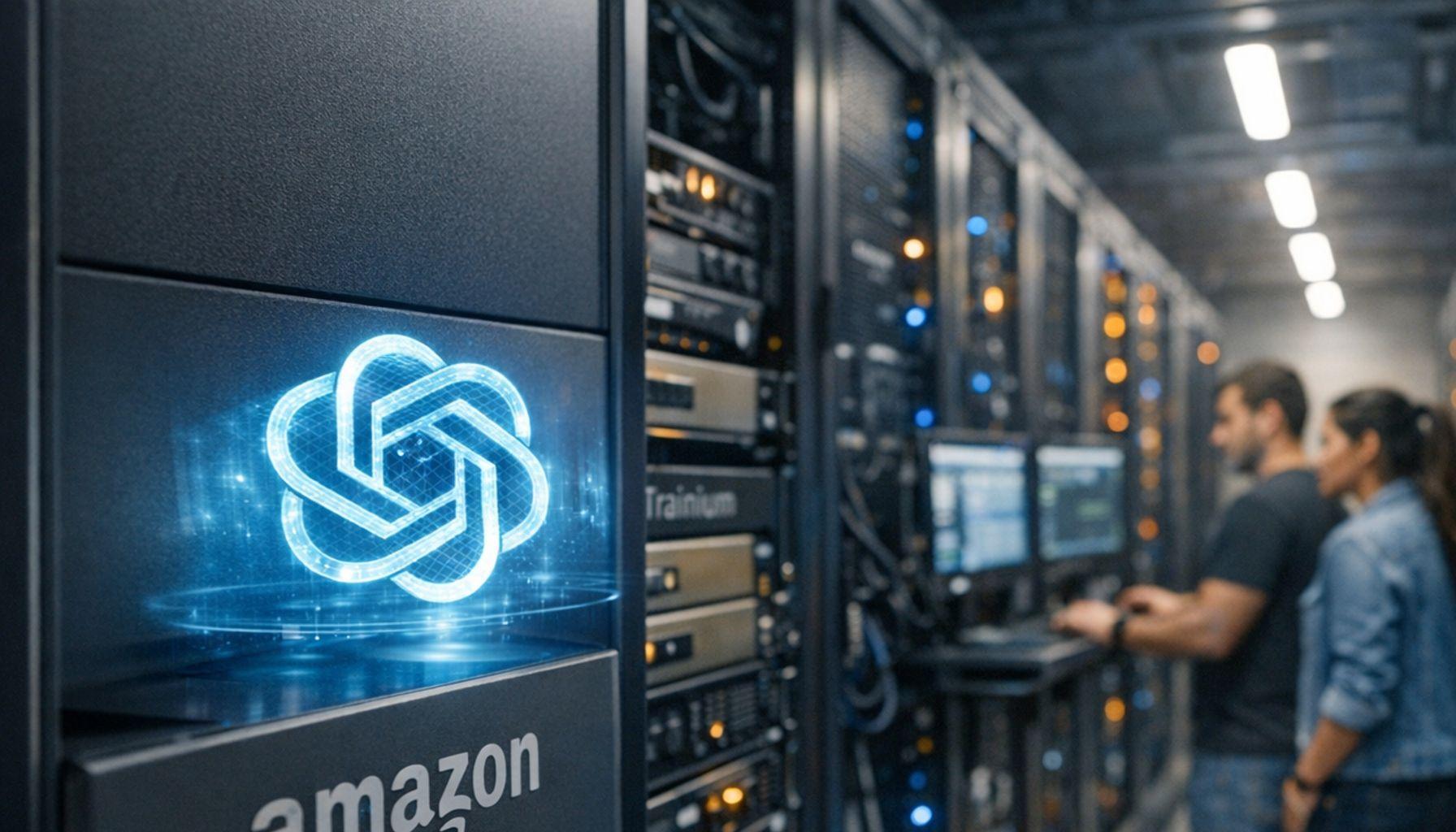
Recently, at the LEAP conference in Riyadh, something curious happened. The state-owned company HUMAIN unveiled an Arabic-language AI technology built on top of a model from Chinese firm MiniMax. But at the same time, Saudi Arabia is building a massive AI infrastructure in partnership with American companies and using U.S. chips. AWS alone has committed a staggering $5.3 billion in data centers across the kingdom.
At first glance, you want to ask: whose side are they on, exactly? The answer is simple and brilliant all at once — they are on both sides, and that is precisely where the real play lives.
Everyone Expects Two Blocs. The Gulf Is Betting on Both
The conventional view of the AI race splits the world into two well-defined teams. On one side, the United States, with NVIDIA, the major cloud companies, and most of the cutting-edge labs creating the most advanced models on the planet. On the other, China, with its own models, its massive engineering capacity, and an increasingly competitive tech stack.
Now, here is the key insight: Saudi Arabia, the United Arab Emirates, and other Gulf countries realized they do not need to copy either ecosystem. Their real value lies in being one of the few places on Earth where both sides can operate simultaneously, without friction. While the major players are locked in their rivalries, the Gulf has become neutral ground — and profitable ground at that.
The Gulf already has obvious advantages everyone can see: plenty of capital, abundant energy, and vast amounts of available land. But the less obvious advantage, and possibly the most powerful one of all, is geopolitical flexibility. And Saudi Arabia is showing in practice how that plays out in the real world.
How the Strategy of Not Picking Sides Actually Works
HUMAIN is building its infrastructure with American technology and has agreed that cutting-edge Chinese models will not be trained on the compute capacity obtained through U.S. export approvals. In other words, the kingdom respects the rules imposed by Washington to gain access to the most advanced chips.
But at the same time, it keeps the doors wide open for the Chinese. Beyond the MiniMax deal, ByteDance’s cloud division — the parent company behind TikTok — is building infrastructure in Riyadh. Tencent Cloud has secured a license to operate in the country. And Lenovo has already launched its first laptop bearing the Made in Saudi Arabia label, manufactured on Saudi soil.
The logic behind all of this comes down to a pretty straightforward calculation. American restrictions push Riyadh toward Chinese alternatives. Meanwhile, China’s limitations in top-tier performance push the kingdom right back into Washington’s arms. At the end of the day, both sides end up competing for something the Gulf increasingly controls: AI infrastructure. It is like watching two giants fighting for the attention of the person holding the key to the vault 🔑
AI Infrastructure: More Like Heavy Industry Than Software
Artificial Intelligence may look like software on the surface, but in practice it operates much more like heavy industry. We are talking about enormous data centers, massive electricity consumption, industrial cooling systems, plenty of available land, and of course, mountains of capital to fund it all. And guess who has every single one of those ingredients on the table? Saudi Arabia.
DataVolt is already building a roughly $1 billion, 100-megawatt facility at the NEOM project, designed specifically to export computational power. And the ambition does not stop there — the plan is to expand that capacity to 360 megawatts. That means the kingdom does not just want to use AI internally — it wants to sell processing power to the entire world.
That detail completely changes the game. Saudi Arabia figured out that it does not need to invent the best chip on the planet or train the smartest AI model on the market to compete globally. The kingdom can simply own an ever-growing slice of the infrastructure that everyone else’s models run on. And with that control, it can negotiate investments, demand localization commitments, and secure technology transfer. That is raw bargaining power in its purest form.
NEOM: Saudi Arabia’s Living AI Laboratory
The NEOM project deserves special attention in this story. Far beyond being a futuristic city built to grab headlines, it functions as a living laboratory for testing AI technologies applied to urban environments. The infrastructure was planned from scratch to handle computational loads that most existing cities simply cannot support. It is like building a house already thinking about the appliances that will not even exist for another ten years.
That long-term vision is what separates the Saudi strategy from simple opportunism. The country is not just reacting to the trends of the moment — it is laying the foundations to dominate a sector that is still in its infancy globally.
The New Cold War of Artificial Intelligence
If Washington insists on treating chip access as a foreign policy tool, and Beijing uses open-source models to penetrate markets where its hardware cannot reach, then Saudi Arabia and the Gulf countries will simply follow their own interests. And their interest is crystal clear: do not pick either side.
With that approach, the competition over AI may end up looking a lot more like the Cold War than most analysts expected. Instead of two completely sealed and isolated blocs, what may emerge is a handful of pivot countries — the so-called swing states — capable of playing both sides at once. These countries would be able to extract economic and strategic benefits while Washington and Beijing compete for their allegiance. It is an extremely comfortable position to be in, let’s be honest.


The most interesting part is that the Gulf spent decades learning how to turn control over energy into geopolitical leverage. They mastered the art of using oil as a tool of power and global influence. Now, they are applying the exact same playbook to computational power. The raw material has changed, but the game plan remains the same — and it works incredibly well.
Chinese Chips Are Starting to Challenge NVIDIA
While the Gulf makes its moves, it is worth keeping an eye on a major development on the other side of the board. Chinese chipmakers are beginning to genuinely challenge NVIDIA’s absolute dominance in the AI processor market.
One example that turned heads was the initial public offering of Shanghai Enflame Technology, which according to Nikkei was 6,000 times oversubscribed compared to the number of shares available. That shows there is enormous appetite for alternatives to American chips, especially in a context where export restrictions keep getting tighter. And the more competitive the Chinese become in this space, the more valuable the neutral position that Saudi Arabia and the Gulf have built becomes.
At the end of the day, what we are watching is a complete reorganization of global power around technology. And curiously, the ones who seem to be playing the smartest game are not the giants creating the chips or the models — they are the countries that recognized the value of controlling the terrain where this entire battle takes place. Saudi Arabia understood that before most others did, and it is reaping the rewards of a bet that, at first glance, seemed impossible to pull off 🚀