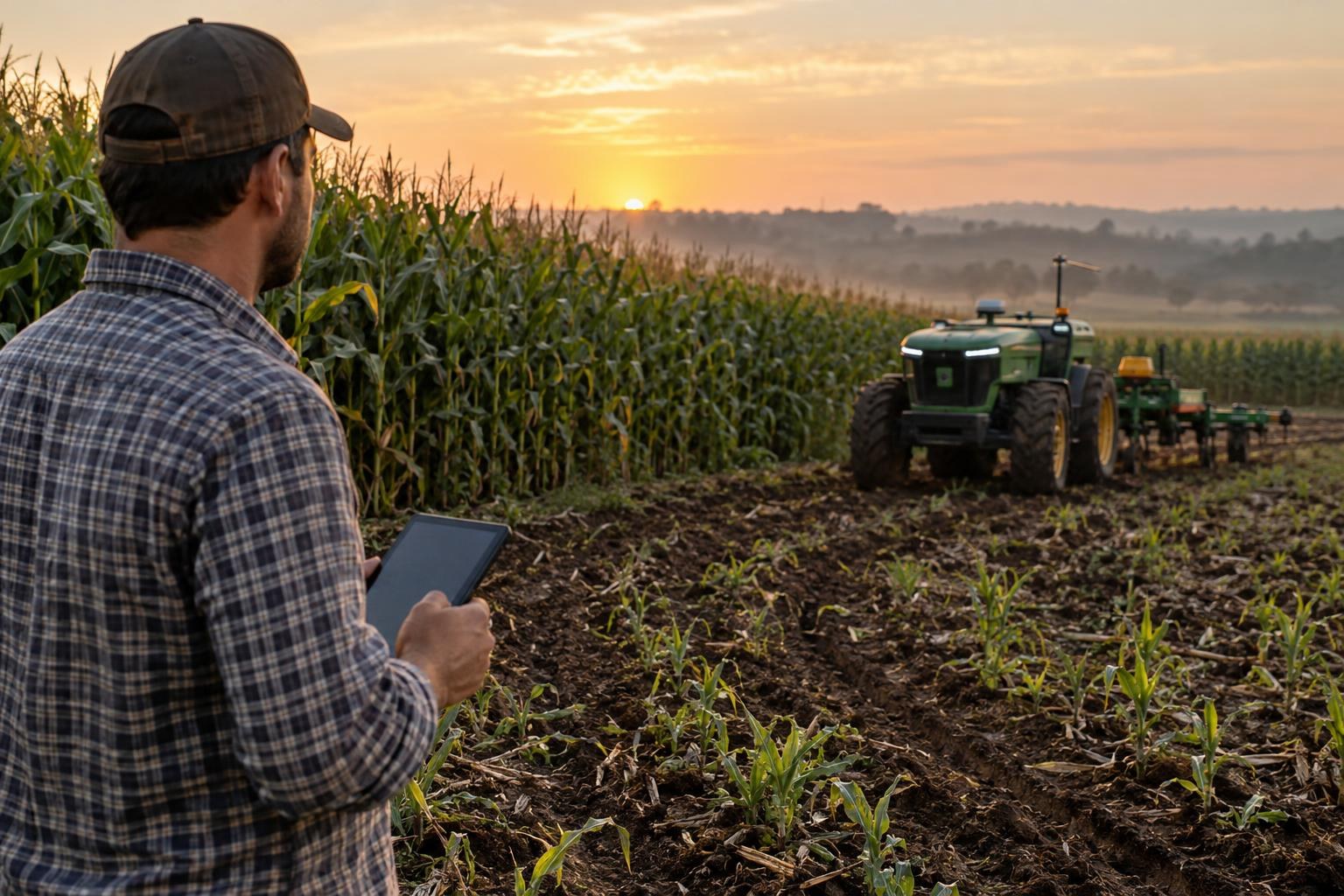
Tech startups focused on agriculture live with a curious paradox. Sensors, robots, apps and biotech keep coming out of the lab, and yet a lot of it never makes it past the farm gate. The reason is not always technical. In many cases, what is missing is a real conversation with the people who will use it, the people who will pay for it and the people who could invest in it.
That is the gap Spur Ventures, an initiative of the University of Nebraska-Lincoln, set out to fill. According to a report from the Tri-State Livestock News, the agtech ecosystem in Nebraska has clear strengths, but until recently it lacked one basic piece: an institution to bridge producers, engineers, investors and students. It also needed one that would teach entrepreneurship and help prove what new technologies actually deliver.
In the next few sections, you will learn about the role of connector institutions, why they matter so much for agtech investment and what Brazil can take from this experience, even without a big budget.
What Spur Ventures is and why it was created
Spur Ventures launched in May 2025, inside the Department of Biological Systems Engineering and the Institute of Agriculture and Natural Resources at the university. The project is led by Ankit Chandra, director and entrepreneurship faculty member in the department, according to the Tri-State Livestock News. The outlet also points out that he has broad experience with agtech startups in the United States and abroad.
The mission is straightforward. The initiative wants to bring together producers, startups, industry, investors and students to speed up the development, validation and market launch of farm technologies. Chandra describes the project as a bridge, a platform that links partners and resources through the university. The list of connections even includes regional innovation hubs funded by the NSF AgTech Engine, a program tied to the U.S. National Science Foundation.
It all started with a diagnosis. A multidisciplinary team put together by Spur Ventures prepared a report on the strengths and challenges of the sector in the state. Among the problems, one stood out: how hard it is to get early-stage funding. The report itself notes that this is not just a Midwest issue. Any Brazilian founder who has tried to raise a first round knows the feeling.
Chandra tells the outlet that the initiative stays in touch with accelerators in Nebraska and across the region. So when it works with a startup, it can introduce that company to partners and investors who actually fit the business. It sounds small. It is not.
Connector institutions: the link that is usually missing
The name sounds fancy, but the idea is simple. A connector institution introduces the right people to each other. It puts the engineer in front of the farmer, takes the startup to the investor and opens doors for the student who does not even know yet that they want to start a business.
Together with the incubator The Combine, Spur Ventures built a visual map of the Nebraska ecosystem, according to the outlet. It shows startups in robotics, precision agriculture, ag biotech, animal health monitoring and marketing tools. It also includes agribusiness companies, investors, incubators, support organizations, commodity groups and university programs.
Seeing everything in one place changes the conversation. The map shows who is out there, who already talks to whom and where the gaps are. Picture a livestock monitoring startup that thinks it is alone in its niche. By looking at a map like this, it might find a research group in the same region studying the exact same problem, or a ranchers association willing to test new solutions. A connection like that can cut the road ahead quite a bit.
Brazil has no shortage of pieces. There are universities with a long tradition in agricultural sciences, research centers, innovation hubs in rural regions and accelerators focused on agribusiness, with plenty of innovative agtech startups already up and running. The challenge is that these pieces sometimes work like islands. Each one does its own job, but few people are dedicated to stitching the whole thing together.
Co-creating with farmers, not for farmers
Chandra makes a blunt point, reported by the Tri-State Livestock News: a lot of interesting technology never gets adopted on the farm because it was not built together with the farmer. In his view, engineers have not always understood the challenges faced by people who grow crops and raise animals. It sounds obvious. Even so, the mistake keeps happening.
Think about a hypothetical case. A team builds a farm management app loaded with features, but it needs a stable internet connection all the time. In the office, everything works beautifully. Out in the field, where the signal drops, the farmer gives up in the first week. A half-hour chat with that farmer would have revealed the problem before a single line of code was written.
How the farmer panel challenge works
To close this gap, Spur Ventures will host the Farm Tech Adoption Challenge during AgConverge, a conference set for November 17 and 18 in Grand Island, with support from the North Dakota NSF AgTech Engine. According to the outlet, online registration is already open.
The format flips the usual script. Volunteer panels of farmers and ranchers watch startup pitches and give detailed feedback over several rounds. They judge whether each solution fits the soil type and the agroclimatic zone of their operation, and whether the price makes sense. Chandra sums it up as a way to give producers an active voice.
One detail stands out. The prizes, which total US$ 6,000 according to the outlet, go to the top three farmer panels, not to the startups. The people rewarded are the ones giving the feedback. For Brazilian tech startups, the lesson is valuable: validating with real users before the product is finished tends to cost a lot less than finding the flaw later. The same logic shows up in the case of Agtech Mach and the lessons from customer pain points.
Training entrepreneurs from the classroom up
Chandra describes the initiative as focused on producers, but on students too. One of its fronts is the course Engineering Entrepreneurship for Ag and Biotech, which blends agricultural engineering with entrepreneurship. According to the report, a farmer visits the class, presents a problem they are dealing with, and the students work on a solution from there.
At AgConverge, students also get the spotlight. The event will feature an agtech poster competition for undergraduate and graduate students, with US$ 1,000 in prizes, judged by a panel. There will also be networking opportunities with industry professionals. Students show what they are working on and start building contacts that could turn into internships, partnerships or investment down the road.
The agenda, according to the outlet, also includes a panel on women in agtech, another on how the NSF innovation engines are coming together, an ag robotics demo, a discussion on industry and academic collaboration and a talk about the forces shaping the Midwest bioeconomy.
None of this requires a huge budget. A Brazilian university can invite local farmers to bring real problems into the classroom. An extension program can put together a project showcase with guests from the industry. What really counts is organization and a willingness to open the classroom door.
Agtech investment starts with trust
Investors like to lower their risk. When a startup shows up with structured feedback from farmers and is introduced by a respected institution, the conversation tends to start on a higher level. The Tri-State Livestock News mentions that one of the ongoing efforts at Spur Ventures is to offer independent, third-party validation for startups.
That outside validation makes a difference. It is one thing for a founder to say the product works. It is something else entirely for a neutral party to show that it works in the field, with real soil and real weather. In agriculture this matters even more, because the cycles are long and a technology that fails can put a whole harvest at risk.
In Brazil, some early-stage startups still lean on pitch decks packed with rosy projections. That might open a door, but it rarely keeps the conversation going. Picture two founders in the same meeting: one brings charts of imagined growth, the other brings stories from farmers who tested the solution for a full season. The second one has something concrete to talk about. It is worth following how technology and investment are driving agtech startups to understand what investors have been valuing.


Lessons for startup founders in Brazil
The first is to listen to farmers early. Before writing the first line of code, sit down with the people who will use the solution and learn about their routine, their costs and their doubts. That step usually saves a lot of rework.
The second is to look for local connectors. Universities, regional hubs, cooperatives and associations can play this role, even if they do not use that name. If nobody does it in your region, it might be worth building your own ecosystem map, even if it is just a spreadsheet listing who does research, who funds and who buys.
The third is to treat validation as a fundraising argument. Documented feedback from farmers and field trials say more than promises. For founders working in sustainability, it also helps to know the options for funding for climate and tech startups in Brazil.
Bridges are worth more than new players
The Nebraska experience shows that a strong ecosystem does not depend only on more startups, more funds or more events. It depends on bridges between the people who are already there. Without them, each part ends up talking to itself.
Spur Ventures did not invent anything wild. It brought people together, listened to the field and created incentives so farmers would have a voice in the process. That simplicity is exactly what makes the model easy to adapt.
If you are building something in agriculture, a good way to start is to pick one of these ideas and test it at your own pace. And if you want to go further, here at Método Viral you will find more content on product validation and fundraising.