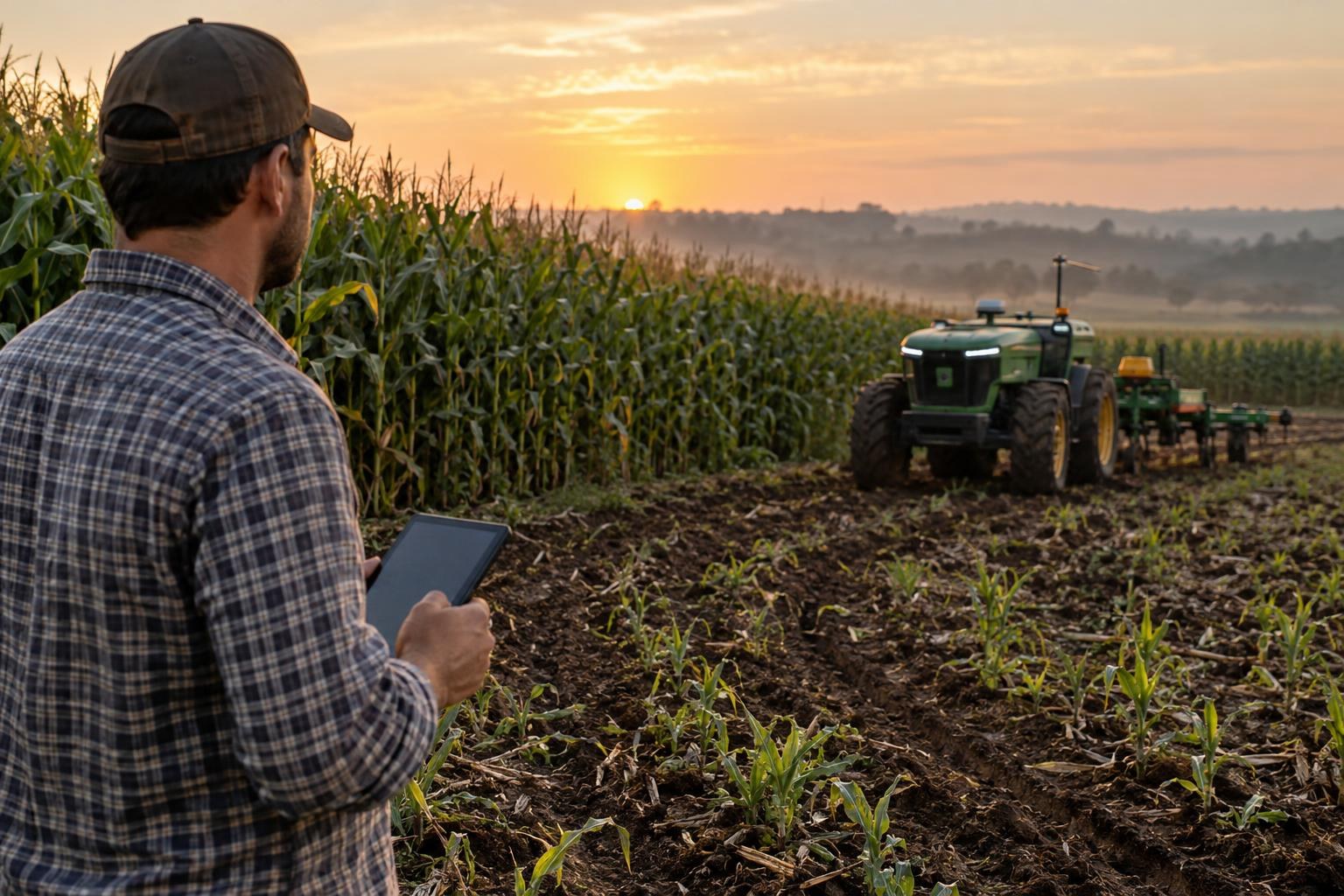
Some agtech companies are born from a spreadsheet, a brainstorming session or a trend that looks great on paper. Mach took a different path. The company, based in Iowa, in the United States, started to take shape right in the middle of the field, among tractors, harvests and the kind of problems that only show up for people who spend the whole day out there.
Behind it is Colin Hurd, CEO of Mach. According to a report by Business Record, he grew up surrounded by farm machinery and spent years trying to solve problems he saw up close before landing on the autonomy technology the company builds today. Along the way, he had a patented product, lukewarm financial results, a company that got sold and a lot of conversations with farmers.
This journey offers good lessons for Brazilian startups. The biggest one is that customer pain is not always the pain that shows up first, and it took Hurd years to figure that out. Paying close attention to this point can change the direction of any product development effort.
Who Mach is and what it does
According to Business Record, Mach develops hardware and software that allow off-road vehicles to run on their own. The list of uses is wide, ranging from lawn mowers to heavy vehicles used in the defense sector.
In other words, this is not a phone app. This is technology that has to work on rough ground, with dust, mud and very little room for error. Products like this tend to punish anyone who designs a solution without understanding the place where it will actually run.
The report, published on October 22, 2026, kicks off a series by the outlet on startups and agricultural technology companies based in Iowa. Starting with Mach makes sense. Its story shows clearly how agribusiness innovation can come from people who have lived the problem firsthand.
The farm first, the startup later
Hurd grew up near Story City, Iowa. As he told Business Record, his fascination with farm machines started early. So early that, as soon as his foot could reach the clutch pedal of a tractor, he talked a neighboring farmer into letting him work on the farm.
There is a fun detail in the story. Hurd says he never even tried out for the football team, because he wanted to be free to work during harvest. Plenty of kids his age would have made the opposite choice. For him, the decision felt natural.
It sounds like just a sweet story from his youth, but there is a hidden lesson in it. Hurd did not need market research to know what daily life looked like for a farmer. He lived that life. That inside knowledge, full of details no survey can capture, helped lay the groundwork for everything he built later.
Think about how many solutions are designed by people who have never spent a full day next to the people who will use them. The result is often a product that makes sense in a pitch deck and falls apart in real use. People who know the routine from the inside can spot the small points of friction, the ones nobody mentions because they have simply become part of the day.
TrackTill: the first problem and the first stumble
The first big problem came up after his freshman year at Iowa State University, where he studied agriculture with a minor in business. According to the outlet, Hurd spent a summer working on a farm and saw the effects of soil compaction up close. Compaction happens when heavy machines damage the structure of the soil and make it harder for roots to take hold.
While still in college, in his junior year, he founded his first company. The idea was a tillage attachment that fit onto the planter and broke up the compaction left by tire tracks. The product, called TrackTill, was patented and, in the words Hurd shared with Business Record, it worked pretty well.
But working well is not the same as succeeding as a business.
The company did not lose money, but it did not make any either. In the end, the technology was licensed to a larger manufacturer. Hurd describes the experience as a crash course in entrepreneurship, with plenty of failure and a lot of learning along the way. And here is the point: failing early, with little at stake, is a fairly cheap way to learn about product development.
Picture, just as an example, a student who builds a tool to manage scheduling for small clinics. He sells it to a few of them, makes changes, realizes the model does not hold up and ends up handing the code over to a bigger company. From the outside, it looks like a project that never took off. From the inside, it is someone who learned how to sell, how to listen to complaints and how to cut what does not work. That kind of experience is worth a lot on the next try.
When the real pain is something else
The turning point came from simple math. According to Business Record, even with the TrackTill system in place, farmers got back about 80% of the yield in the compacted area. The other 20% was still lost. After four years focused on the issue, Hurd reached a somewhat unsettling conclusion: the best way to solve compaction was to never cause it in the first place.
That led to the next question. What if, instead of huge, heavy machines, farmers used several smaller, lighter ones? The idea made sense. According to Hurd, buying several small machines costs less than buying big, heavy ones, and the farmers he talked to saw advantages in that.
But the conversation always got stuck in the same spot. Who is going to drive all of them?
Farmers already did not have enough people to help run their operations. Hiring twice as many workers was out of the question. Every benefit fell apart in the face of the labor shortage. This may be the most valuable lesson in the whole story: the problem a customer describes first is not always the one blocking the decision. Compaction was real. But the barrier keeping farmers from changing was something else.
If you work in product or marketing, this probably sounds familiar. A lot of the time, the customer agrees with everything in the meeting, praises the proposal and then disappears when it is time to close. It is rarely bad faith. There is almost always an obstacle they did not mention, either because it seems too obvious or because nobody asked.
From auto-steer to full autonomy
According to the outlet, this realization came between 2015 and 2016. At the time, tractors already had auto-steer to drive in straight lines across the field, and Hurd considered that technology extremely reliable. What was missing was the ability for the tractor to turn around on its own at the end of the row. Someone still had to sit in the cab all day.
Hurd wondered why nobody had taken the next step, since the technology seemed to be right there. The answer, as he told Business Record, was surprisingly simple: nobody had seriously pursued it from a commercial point of view. And there was a concrete obstacle. The sensors that allowed a machine to perceive its surroundings cost 10,000 dollars, which made the move to autonomy hard to justify financially.
That was the context in which he founded Smart Ag, focused on a kit that could be installed on regular tractors to make them autonomous. Hurd believes the company was the first to sell this kind of retrofit for large farm tractors. Smart Ag had just started selling when it was acquired by Raven Industries.
After some time at Raven, Hurd came across GUSS Automation, a California company that builds autonomous sprayers for orchards and, according to the report, has already sold hundreds of machines. That is exactly what caught his eye. In his view, almost nothing in this market had managed to scale, and here was something that had.
Behind GUSS was LSA Autonomy, a supplier of navigation systems, vehicle control and hardware. This was field-tested technology that had proven it worked. The question became how to bring it to many more machines. Sometimes innovation is less about inventing from scratch and more about scaling what has already been proven.


What Brazilian startups can take from this story
The first lesson is almost physical: go to the field before you write the first line of code. Hurd only understood how much compaction mattered because he spent a summer working on a farm. For founders in Brazil, this might mean visiting farms, following a full growing season and talking to the machine operator, not just the owner. If the topic interests you, check out this overview of innovative agtech startups and technology in agriculture.
The second is knowing how to ask the right questions. Farmers agreed that smaller machines made sense. If Hurd had stopped there, he might have built something few people would buy. It was by digging into why the idea never got off the ground that he found the labor shortage.
Picture a startup that offers a pest monitoring system and hears from customers that they love the idea, but it cannot close any deals. Maybe the real pain is not having anyone available to act when the alert comes in. In that case, improving the alert will not help. The product would also need to solve the action part. Finding the pain behind the pain changes everything.
The third is giving cost and commercial viability the same attention you give the technology. Autonomy seemed technically within reach in the mid-2010s, but expensive sensors kept it out of the budget. A great product the customer cannot afford does not solve any problem at all. This balance between technology and market also shows up in analyses of how technology and investment are driving agtech startups.
There is also a fourth, quieter lesson. Hurd did not lock himself into a single company or a single idea. He went from a farm attachment to an autonomy kit, through an acquisition and on to studying technology built by others. The thread tying it all together was the problem, not the solution. People who fall in love with the problem have more freedom to switch paths when the facts call for it.
Brazilian agribusiness has its own bottlenecks, and anyone who lives in the countryside knows several of them: trouble finding skilled labor in certain regions, tricky logistics, expensive machinery, spotty connectivity. Hardly any of them will be solved by an idea dreamed up far from the field. The story of Mach shows that good products come from well-understood problems, and that understanding a problem well can sometimes take years, a few stumbles and lots of conversations.
A practical tip: before you invest in the next feature of your product, talk to a few customers and ask what is actually stopping them from deciding. The answers might surprise you. And if you want to keep exploring the topic, Método Viral also has content on startup incubators and technology, helpful for turning these discoveries into innovation the market truly adopts.