AgTech has always been about solving real problems with creative solutions.
Even before that fancy name existed, a farmer named Frank Zybach was watching a neighbor drag irrigation pipes across a field and thinking: there has to be a better way to do this. In 1949, he invented the center pivot irrigation system, that circular piece of equipment you can still spot today when flying over farmland on Google Maps. What started as a one-man startup became essential infrastructure for global agriculture, now operating across millions of acres around the world.
That story says a lot about how agriculture evolves: always with someone, somewhere, building something the rest of the world has not seen yet. And now, with technology advancing at breakneck speed, that cycle has gotten much faster. 🚀 What used to take decades to reach the field can now be available in a matter of months, sometimes right in the farmer’s pocket through an app or a sensor small enough to fit in the palm of a hand. And the most interesting part is that farmers might not even need to imagine what the next big thing will be, because it has probably already been invented and could be right there among the startups showcasing their products today.
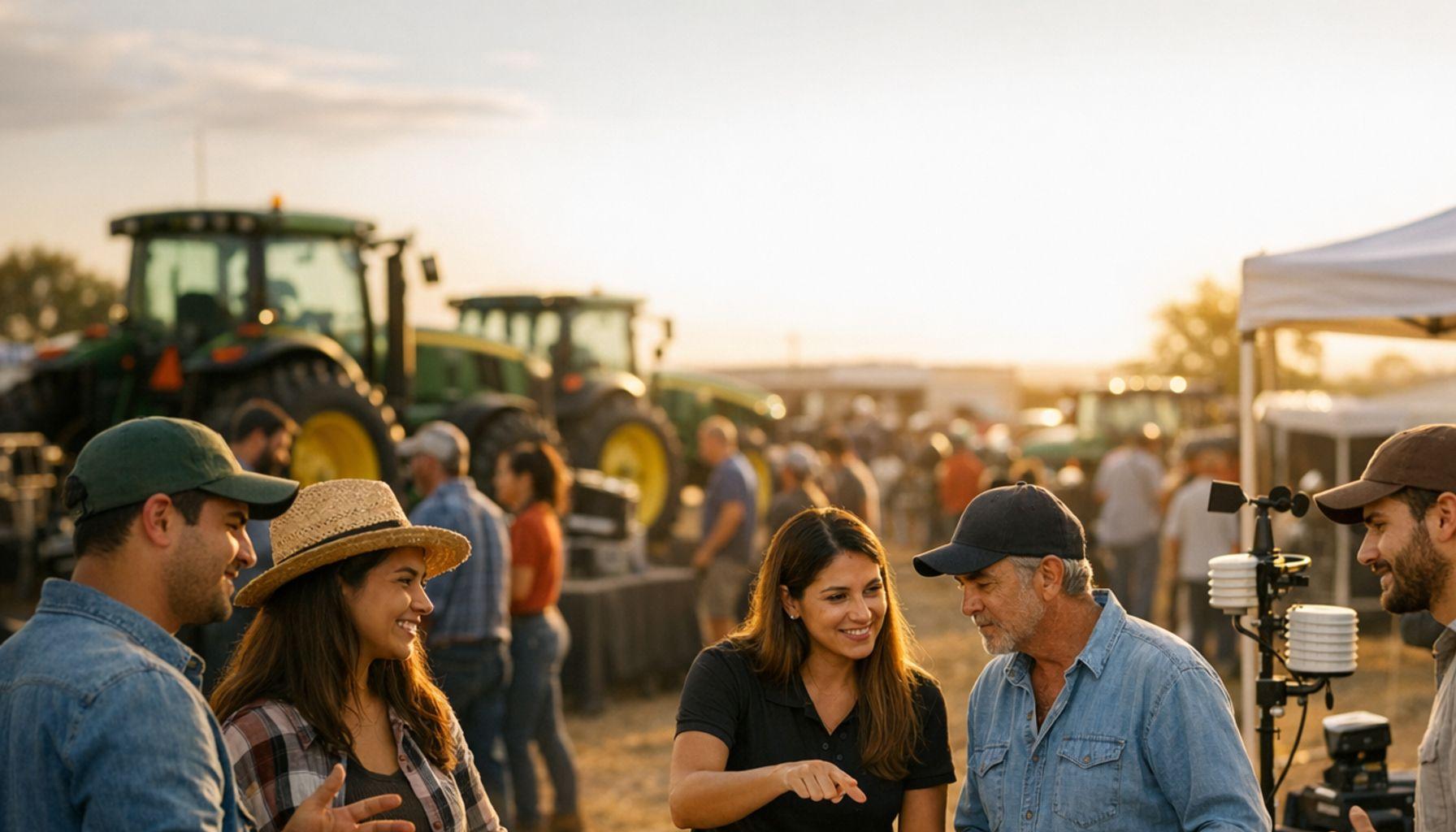
That is the context in which Husker Harvest Days carved out a space dedicated exclusively to innovative startups: the Ag Tech Pavilion, the result of a partnership between Farm Progress and The Combine, a Nebraska state initiative focused on high-growth agricultural entrepreneurs. At booth 145 of the event, which runs September 15 through 17 near Grand Island, Nebraska, several startups are presenting their technologies for the first time to farmers curious about the future of agriculture, learning from those who visit the show and sharing concepts, ideas and inventions with anyone who wants to know what is coming next. We picked 5 AgTech startups that deserve special attention and could soon become household names in farming. 👇
The 5 AgTech Startups That Are Changing the Game
1. Cattler: Cloud-Based Cattle Management, From the Office to the Pen
Cattler showed up at the Ag Tech Pavilion with a cloud-based platform built to help feedlots and cattle producers streamline day-to-day operations, improve decision-making and squeeze more value out of their own data. According to Ryan Bruchou, the company’s chief operating officer, Cattler is headquartered in Nebraska and already operates in ten countries, with the United States as its primary market and a growing presence in key livestock regions like Argentina, Uruguay, Paraguay, Canada and Bolivia.
The platform’s goal is to replace those paper records, scattered spreadsheets and disconnected systems with a single centralized environment. Within it, the producer can manage feeding, animal health, herd movement, inventory, performance, costs, billing and closeouts, all in one place. And because it is a cloud system, teams can access and update information directly from a phone, tablet or computer, whether the employee is in the office, at the pens or inside a feed truck. 🐄
The real differentiator is turning raw information into practical decisions. Feed teams can manage rations, deliveries and bunk reads in real time, while managers get a quick view of animal performance, inventory levels, cost of gain and other critical operational and financial metrics. Bruchou also points out that Cattler was designed to be open and flexible, allowing integration with other data sources and evolving alongside the real needs of cattle operations, with customer feedback shaping new features and improvements.
2. Senseen: A Plant Lab in the Palm of Your Hand
Plants do not speak our language, but Senseen developed a way to translate what they are feeling. The company’s flagship product is the Nutriscope, a handheld plant scanner that combines advanced photonics with artificial intelligence to deliver rapid readings on crop health, nutrition and stress. Instead of relying solely on visible symptoms or waiting days for lab results, the farmer clips the Nutriscope onto a leaf and gets a non-destructive reading in seconds.
The way it works is pretty clever: the device emits selected wavelengths of ultraviolet, visible and near-infrared light onto the leaf and analyzes the resulting spectral fingerprint using machine learning models calibrated in the field. According to Olivier Ceberio, CEO of Senseen, the Nutriscope already supports nine crops, including corn, wheat, canola, tomato and grape, with new crops and measurements being added continuously through field calibration. 🌿
Depending on the crop and available calibration, the device provides information on nutrients and health indicators such as pH, redox potential, Brix, electrical conductivity, chlorophyll and plant stress. Ceberio makes a point of emphasizing that the goal is not to replace the farmer, the agronomist or the lab, but to put useful information in the hands of those who need to make decisions about fertilization, irrigation and crop protection. The company’s vision is summed up in one simple and powerful phrase: a lab and an agronomic consultant right in your pocket.
3. AgSolaire: Renewable Energy to Analyze Grain Right in the Field
Founded in 2023 and also based in Nebraska, AgSolaire is dedicated to manufacturing small, renewable-energy-powered equipment for agriculture. Its main product, still in the prototype stage, is the Smart Seed Thresher and Grain Analyzer System, an intelligent threshing and grain analysis system that promises to change the way farmers evaluate harvest quality before they even fire up the big machines.
According to Bill Berzonsky, founder of AgSolaire, the system is a portable, solar-battery-powered device that threshes, cleans and analyzes seeds using machine vision, near-infrared imaging and an AI-powered software model. It can be used both in the field and indoors, delivering real-time data on yield and quality. The goal is to help farmers and researchers make better marketing and research decisions before harvest, without needing to immediately rely on large, expensive equipment. The idea, once the system is finalized, is for both components to be small enough to fit in the back of a pickup truck or on an ATV. 🌞
As a member of The Combine and an exhibitor at the Ag Tech Pavilion, Berzonsky plans to conduct discovery interviews with grain farmers and researchers from Nebraska and the surrounding region during the event, to gauge interest and potential use cases for this new technology. Anyone curious about participating in a brief conversation, around ten to fifteen minutes, can reach out ahead of time, and he guarantees there will be no sales pitch or purchase commitment involved. It is pure research, exactly the way a good startup should operate before scaling.
4. Nave Analytics: The End of Guesswork in Irrigation
Nave Analytics, also from Nebraska, tackles one of the biggest challenges in crop production: knowing exactly when and how much to irrigate. The company uses remote sensing and modeling to monitor soil moisture, crop water use, leaching potential, drought risk and overall crop health. According to Jessica Korinek, co-founder and CEO, Nave’s mission is to literally end the era of guessing when it comes to irrigation.
The major technological advantage is the use of continuous SAR satellite radar, weather data and proprietary hydrological modeling. This combination delivers uninterrupted root zone readings even through clouds and crop canopy, eliminating the need for expensive, labor-intensive sensors installed in the field. For farmers and agronomists, that means a complete, gap-free view of soil moisture and water demand across one hundred percent of the acreage, not just a single isolated point. 💧
The results are very tangible. Korinek says Nave users save time, cut input costs and can reduce up to two irrigation passes per season, conserving both water and pumping fuel while also improving fertilizer efficiency and boosting yields. And since the solution requires no hardware, there are no supply delays, installation hassles or equipment to pull out at harvest time. Fields can be enrolled at any point during the season and still receive full-season analytics, whether through the web platform, integrated into existing farm management software or through the company’s network of agronomic dealers.
5. Helical Solar: Solar Energy Without Taking Acres Out of Production
Helical Solar, based in Texas, is perhaps the boldest of the five. The company develops custom agrivoltaic infrastructure to generate clean energy at scale over cropland, pastures and commercial livestock facilities, without taking a single productive acre out of operation. And for anyone who makes a living off every foot of land, that is a big deal.
The flagship product is the DERSonne Agrivoltaic System, an elevated solar panel array with dual-axis tracking, designed specifically for agricultural environments. According to James McKinion, founder and CEO of Helical Solar, the structure sits about thirteen feet high to accommodate tall, full-sun crops like corn, sorghum and sunflower, while also allowing farm equipment to pass underneath. The system uses patented helical pile foundations that require no concrete, with a pre-assembled modular design that installs in about an hour using standard equipment, eliminating heavy excavation and protecting the soil structure from compaction. ☀️
In feedlots and livestock facilities, the DERSonne operates as the world’s first agrivoltaic platform installed inside cattle pens. The articulated dual-axis tracking projects a dynamic shadow that moves across the pens like a sundial, reducing heat stress in animals, improving average daily weight gain and helping prevent heat-related deaths, all while capturing significantly more energy than traditional fixed or single-axis solar panels.


To make this technology accessible to small and mid-size operations, Helical uses an innovative shared equity ownership model that does not encumber the land or create liens on the property. Project ownership is divided among the agricultural cooperative, the farmer or landowner and Helical Solar itself. According to McKinion, this financial structure eliminates the prohibitive upfront costs for individual producers, keeps energy revenue and capital within the agricultural community and strengthens farmers’ balance sheets while protecting their working land.
Why These Startups Matter Right Now
The Ag Tech Pavilion at Husker Harvest Days is not just another exhibition area at a farm show. It represents something bigger: the recognition that innovation in agriculture is increasingly happening outside of large corporations and inside lean startups with small teams and big ideas. These five companies are examples of how technology and agriculture can combine in unexpected and powerful ways, ranging from cloud-based herd management to solar energy generation right over the cattle pens.
What connects all of them is a focus on real problems. None of these startups exist because of a passing trend or market hype. Each one identified a concrete pain point in the daily life of a farmer and built a solution around it. This kind of problem-driven innovation, rather than technology for the sake of technology, is what tends to last and scale in agriculture, a sector that has no patience for solutions that do not work in practice.
The cycle that Frank Zybach started alone in a Nebraska field back in 1949 is still happening. The difference is that today there are entire pavilions dedicated to accelerating that process, connecting inventors with farmers and turning ideas into infrastructure faster than ever. And if any of these five startups becomes the next center pivot irrigation system, we will be able to say we saw it first. 🌾
The future of agriculture is being built right now, startup by startup, season by season.