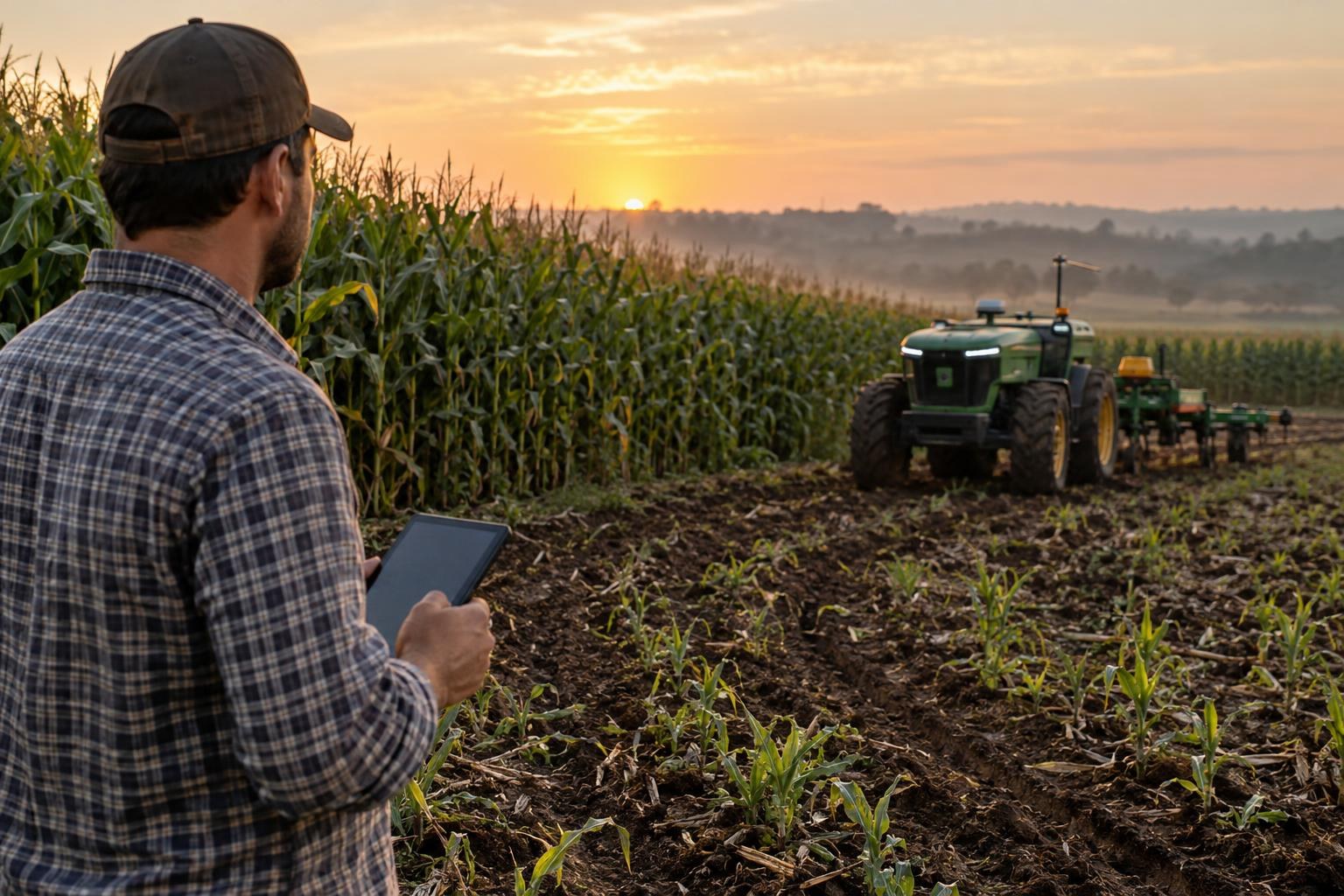
Agtech startups tend to live in short cycles: the next quarter, the next funding round, the next customer. On the other side of the scale, some agribusiness companies make plans that span generations. According to Florida Trend magazine, Ken McDuffie, president and CEO of U.S. Sugar, talked about the sustainability mission of the company, the economic impact it generates and the arrival of autonomous farming technology in its operations.
It sounds like a far-off topic, something about farms in Florida. But that is not quite the case. When a giant of American agribusiness puts the idea of feeding families for the next 100 years right in the headline, it signals that it sees sustainable food and farm automation as part of a long-term plan, not a passing trend. That kind of signal matters a lot to anyone building an agtech or foodtech business here in Brazil.
In the lines ahead, we look at what was published and pull out practical lessons: how to turn sustainability into a business model, where automation opens the door for software and artificial intelligence, and why a digital product needs to fit into the daily routine of the people working in the field.
What Florida Trend reported about U.S. Sugar
The piece published by Florida Trend has a headline that already says a lot: sustainably feeding American families for the next 100 years. In it, according to the magazine, Ken McDuffie covers three fronts at U.S. Sugar, which the outlet describes as a Florida agricultural giant.
The first is a broader sustainability mission, treated as something bigger than a one-off initiative. The second is the economic impact of the company. The third, and maybe the most interesting for people who work in tech, is the rollout of autonomous farming technology.
The available material does not include numbers, and it does not explain in detail how each front works day to day. So the honest move is to stick to what was said and look at the big picture.
And the big picture already tells a story. Sustainability, economics and automation show up side by side, in the same message, as pieces of one strategy. For anyone building technology, understanding how this kind of company ties these themes together is almost like reading the priority list of a future customer.
Thinking in 100 years changes the game
Startups are in a hurry. They need to show traction before the money runs out, prove growth for the next round and tweak the product with every bit of feedback. Nothing wrong with that. That is how the model works.
Agriculture, though, usually plays a different game. A company that thinks in decades sees soil, water, climate and community relationships as assets that need to last. Anyone selling to this kind of customer will, sooner or later, run into a simple question: will this solution still make sense ten or twenty years from now?
Picture, for example, a startup offering a monitoring tool with a contract of just a few months and no clear plan for how it will evolve. To a grower who plans harvests years ahead, that can sound risky. Now picture another company that shows up explaining how the tool will grow alongside the operation, how the data is stored and what happens if the technology changes. The second conversation tends to go a lot more smoothly.
Sustainable food does not fit into a quarterly target. Restoring land, cutting waste or changing a farming practice takes time to pay off. The startup that understands this pace, and can deliver value in the short term without losing sight of the long term, speaks the language of the customer.
That balance is hard. Still, that is exactly where the advantage lies.
Autonomous farming and technology in food production
Autonomous farming sounds like science fiction, but the idea is pretty down to earth. We are talking about machines, sensors and systems that collect data and make some decisions with less hands-on work. A tractor that follows a route on its own, a sensor that alerts you when the soil is dry, a system that suggests the right time to apply an input.
Florida Trend does not describe which equipment U.S. Sugar is using, so we cannot claim anything beyond the fact that the company talks about rolling out this technology. The interesting part, for us, is something else: behind every autonomous machine there is a layer that does not always show.
That layer is software. This is where technology in food production opens up room for people who do not build tractors. Data analysis, artificial intelligence models that read images of crops, platforms that pull information from multiple sources and turn it all into recommendations. Then there is system integration, predictive maintenance, traceability. Each of these pieces can become a business.
Imagine, just as an illustration, a farm that already has connected machines but has no idea what to do with all the data they produce. The information sits scattered across different systems, nobody has time to cross-check everything and decisions are still made on gut feeling. A startup that organizes this data and shows what really matters solves a real problem. If you want to see how this movement attracts capital, you can read about how technology and investment are driving agtech startups.
What this teaches agtech and foodtech startups in Brazil
The words of an American CEO are not an instruction manual. But the way he frames the conversation helps show what a large agribusiness company chooses to highlight when it talks about the future.
That matters for anyone building a solution who needs to win over this type of customer. Understanding how the buyer thinks saves a lot of trial and error.
There are at least four lessons to take from it. Each one connects to a challenge that founders in the sector here know well.
Sustainability as a business strategy
Plenty of startups put sustainability on their website, in their pitch and in their LinkedIn posts, but not in their revenue model. That is where the problem starts.
If the solution cuts waste, for example, that needs to turn into savings the customer can actually see. Picture a tool that helps apply inputs only where they are needed. The environmental benefit is real, but what gets the grower to sign the contract is realizing they spend less on those inputs. When both gains go hand in hand, sustainability stops looking like a cost and becomes a selling point.
Based on what Florida Trend presents, U.S. Sugar treats sustainability as a company mission. For a startup, the equivalent is putting that value at the core of the product, not on a separate page of the website that nobody visits.
Economic and environmental impact side by side
Notice that the published conversation pairs sustainability with economic impact. That does not seem like a coincidence. Big buyers and many investors want to see both at the same time.
For a startup, this means measuring and communicating both sides. How much did the customer save? What changed in resource use? A nice-looking report with no financial results tends not to convince anyone. And financial results without environmental care have been losing ground at a lot of negotiating tables.
A practical approach, thinking about a hypothetical scenario: before starting a project, agree with the customer on which metrics will be tracked. That way, at the end of the period, nobody is arguing over impressions. Both sides look at the same criteria.
This balance also counts when it is time to raise money. It is worth getting to know the paths for funding for climate and tech startups in Brazil, which often look for exactly this combination.
Large growers as a way in
Established agribusiness companies have scale, data and land for testing. A pilot with one of them can deliver learning that is hard to get any other way.
A well-run pilot becomes proof. It shows the solution works in real conditions, creates its own evidence and helps open doors with other customers of the same size. Imagine a startup that tests its system on a large operation for an entire growing season. Even if problems come up, it walks away knowing its own product much better.
The catch is not becoming dependent on a single partner. The goal is to validate, learn fast and use what you learned to grow. If you want to understand how funds and ecosystems build this bridge, take a look at what the Spur Ventures agtech ecosystem teaches Brazil.
Automation designed for the Brazilian reality
Rural Brazil is incredibly diverse. There are huge farms in the Center-West and small family properties in the South. There are regions with good connectivity and regions where the signal vanishes as soon as you leave the main house.
Copying an American solution without adapting it usually ends in frustration. The agribusiness innovation that works here takes into account the size of the property, the profile of the grower and the infrastructure available. A system built to run on a stable internet connection all the time may simply not work for a large part of the country.


The same goes for foodtech in Brazil. From processing to distribution, solutions need to work with cooperatives, small growers and big manufacturers. Whoever designs with this variety in mind from day one greatly expands the potential market.
Agribusiness innovation is also a digital product
The best algorithm in the world is useless if the grower cannot use the app. UX and UI in the field have their own rules, and many startups stumble right here.
People out in the crops are usually in a rush, under the sun, sometimes wearing gloves, often with no internet. A few choices make a big difference:
- simple screens, with big buttons and little information at a time;
- offline mode, with syncing once the signal comes back;
- plain language, without technical terms nobody uses day to day.
Good data is only worth something if the grower understands it and can act on it. Instead of a dashboard packed with charts, sometimes a clear notification does the job: no need to irrigate today. Artificial intelligence may be working hard behind the scenes, but what reaches the user has to be simple.
A good practice is to go into the field before designing the first screen. Following a grower through a full day teaches things no remote meeting will show, like the time of day they actually check their phone or who really makes the decisions on the property. If you want to dig deeper into the link between AI and product, there is more on innovation and AI in startups accelerated by technology.
The long term starts on day one
What McDuffie said, as Florida Trend presented it, shows a traditional company putting sustainability, economics and automation on the same level, with its eyes on the decades ahead. You do not need to be a giant to think this way.
A startup born with this mindset tends to pick better customers, design more durable products and connect better with decision makers in agribusiness. It can grow fast without building something that stops making sense in a few years.
The agtech startups most likely to leave a mark are the ones that understand the pace of the field, not just the pace of the market.
If you are building something in the sector, it might be worth looking at your pitch and your product through this lens. Here at Método Viral, we keep following the investment, automation and artificial intelligence moves shaping this ecosystem.