AI Agent is no longer just conference talk or academic paper material.
Andrej Karpathy — one of the biggest names in artificial intelligence worldwide — built an AI agent called Dobby the Elf Claw to manage his own home, and the system goes way beyond turning on the living room lights.
We are talking about pool control, spa, security cameras, lighting, blinds, HVAC, and even package tracking via WhatsApp.
All of it running autonomously, without Karpathy needing to open a single app.
If you think AI-powered home automation is still in its infancy, this project will make you rethink that idea real quick. 🏠🤖
Who is Andrej Karpathy and why does this matter?
If you follow the world of artificial intelligence, the name Andrej Karpathy has probably shown up in your feed more than once. Former AI director at Tesla, co-founder of OpenAI, and currently founder of Eureka Labs, Karpathy is the kind of person who, when he builds something, the entire industry stops and pays attention. He is also the engineer who coined the term vibe coding, which quickly spread through the developer community as a new way of thinking about the relationship between programmers and language models.
Karpathy is not just a brilliant theorist — he builds real things, documents the process, and shares it with the community in an accessible way, which makes him one of the most influential and respected voices in the field. So when he announces that he created an AI Agent to manage his own home, it goes far beyond a personal curiosity.
What makes the project even more interesting is the context in which it emerges. Over the past few months, the conversation around autonomous AI agents has picked up incredible speed within the industry. Companies like Anthropic, OpenAI, and Google are racing to launch their own agent frameworks, and researchers around the world are exploring how these systems can execute complex tasks with minimal human intervention. Open-source frameworks like OpenClaw helped popularize this approach, and OpenAI itself acquired OpenClaw and its creator, Peter Steinberger, back in February — a clear sign that the race for autonomous agents is in full swing.
But while most demos are limited to controlled environments or enterprise use cases, Karpathy went in the opposite direction: he brought the concept inside his home — literally.
That carries enormous symbolic weight. When someone with Karpathy’s resume decides to dedicate time and effort to building a functional home agent, he is signaling that this technology is no longer futurism. It is the present. It is viable. And it is more accessible than most people realize. The implicit message behind the Dobby the Elf Claw project is clear: if this can be done in a regular home, imagine what is coming at industrial and enterprise scale. 🚀
What is Dobby the Elf Claw and how does it work?
The Dobby the Elf Claw is an AI Agent developed by Karpathy to autonomously manage the devices and systems in his home. The name is a playful reference to the house elf from the Harry Potter saga — that dedicated, helpful creature who lives to serve the house where it resides. And the analogy is perfect: the system was designed to work behind the scenes, without being intrusive, without needing constant commands, simply doing what needs to be done.
In an interview on the No Priors podcast, released on Friday, Karpathy detailed how the system works. According to him, Dobby controls all the lights in the house, the HVAC system, the blinds, the pool, the spa, and also the security system. The agent integrates different data sources and home systems, processes that information in real time, and makes decisions based on rules and contexts defined beforehand.
One of the coolest features is the smart package tracking. Karpathy shared that Dobby sends messages directly to his WhatsApp. The system captures an image from the outdoor camera, analyzes what is happening, and sends a contextual notification — something like letting him know that a FedEx truck just pulled up in front of the house and there might be a new package waiting. All without him needing to open any separate tracking app or camera feed.
Actually, that is one of the most practical outcomes of the project: Karpathy said that Dobby replaced six different apps on his phone. Instead of switching between lighting, security, HVAC, pool, and delivery apps, everything now runs through a single intelligent control point. That alone is a massive improvement in daily user experience.
The architecture behind the system combines large-scale language models, known as large language models, with specific logic layers for each type of device and integration with external APIs. This allows the agent not only to execute pre-programmed commands but also to make contextual decisions — like identifying that a delivery arrived, notifying the owner via WhatsApp, and if necessary, activating the front door camera for visual confirmation. This level of chained reasoning is exactly what sets a real AI Agent apart from simple automation with fixed triggers and actions. 🤯
The hardware upgrade courtesy of Jensen Huang
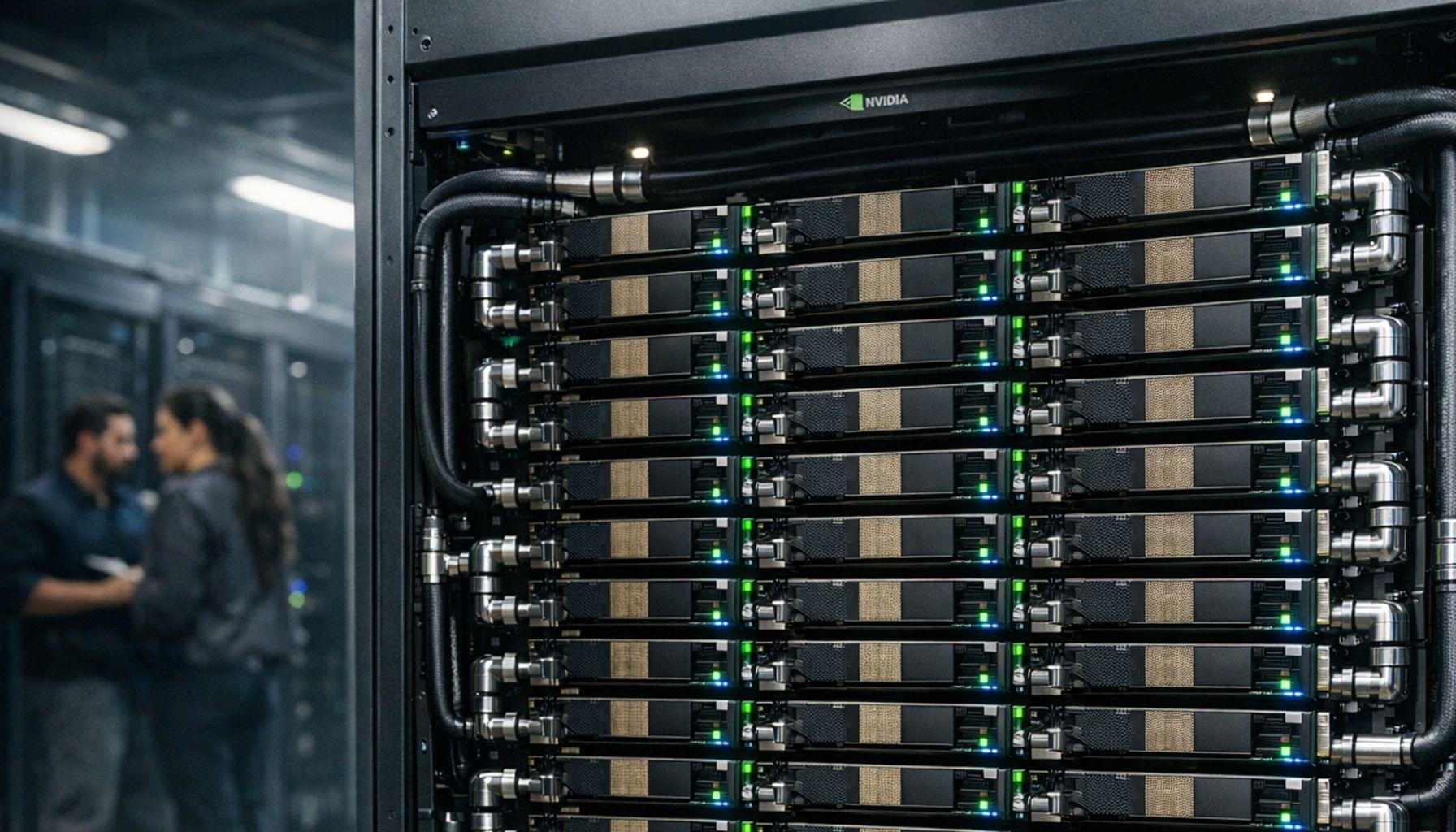
As if the project were not impressive enough already, Dobby received a massive upgrade just days before the interview. Karpathy posted on X that Nvidia CEO Jensen Huang gifted him a DGX Station equipped with the GB300 superchip — hardware designed specifically for agentic AI workloads.
In the post, made the Wednesday before the interview, Karpathy said the machine would be a spacious and beautiful home for his Dobby the House Elf Claw, as well as serving for many other experiments and projects. A gift of that caliber coming directly from Jensen Huang is not something trivial — it is a recognition of the potential that projects like this represent for the future of AI computing and, at the same time, a show of strength from Nvidia in the hardware segment for autonomous agents.
AI-powered home automation: what changes with autonomous agents?
For years, home automation was synonymous with scripts and fixed routines. You would program: if it is 10 PM, turn off the hallway lights. If the temperature goes above 77°F, turn on the air conditioning. It was useful, but limited. The system did exactly what you told it to do, nothing more. And if the situation strayed even slightly from the script — a party that ran until midnight, a night colder than expected — you had to step in manually or accept the failure. The intelligence was entirely human, and the automation was just the mechanical execution of instructions.
With the arrival of AI agents, that logic is starting to flip in a pretty significant way.
An AI Agent like Dobby does not work with fixed scripts — it works with context. It understands what is happening, evaluates the available variables, and decides what the best action is at that specific moment. This means the system can handle situations that were never explicitly anticipated during setup. If a camera detects unusual movement in the middle of the night, the agent does not just log the event — it can cross-reference other information, like whether someone is expected at that time, and decide whether it is worth generating an alert or not. That kind of situational judgment is what transforms automation from something mechanical into something that genuinely resembles an intelligent assistant.
The impact of this on residential device control is huge. The user experience changes completely when you no longer need to open five or six different apps to manage your home. When the system understands your preferences, learns from your behavior, and anticipates needs, technology finally gets out of the way — and that is exactly the goal of any good interface: to stop being an obstacle and start being invisible.
A simple but revealing example that Karpathy shared on the podcast illustrates this naturalness well. At bedtime, he simply says: Dobby, it is bedtime. And that is it — all the lights in the house turn off, without him needing to get up, open an app, or configure anything. It is the kind of interaction that seems trivial, but in practice represents a complete shift in how we relate to technology inside our homes. 🏡✨
Security and privacy: how does Dobby handle that?
When you are talking about an AI agent controlling security cameras, lights, a pool, and the HVAC system of an entire house, the natural question that comes up is: what about the security of all that?
Karpathy addressed this directly. He said he does not lose sleep over the system controlling his devices, and he explained the technical reason behind that peace of mind. Dobby connects to devices through the home’s local network, which means those systems are not directly accessible from the internet. This is an important architectural decision because it drastically reduces the attack surface — an intruder would first need to access the internal network just to attempt to interact with the agent or the devices it controls.
This approach of keeping processing and connections within a local network is a well-established security practice in the world of the Internet of Things (IoT), and it shows that Karpathy is not just experimenting carelessly — he thought about the infrastructure with the care the project demands. In a landscape where AI Claws and autonomous agents are multiplying rapidly, researchers have already raised concerns about the cybersecurity risks of these tools. Having a layer of network isolation is the bare minimum expected, and it is good to see that even in a personal project, this practice is being followed.
AI Claws: the new wave of autonomous agents
The term AI Claw might sound new to a lot of people, but it describes a category of AI agents that is growing at an accelerated pace. Unlike traditional language models that only respond to questions in blocks of text, AI Claws are autonomous systems capable of taking concrete actions on behalf of the user. They can operate applications, interact with internet-connected devices, schedule tasks, conduct research, and execute complete workflows without constant human intervention.


Over the past few months, this category has gained massive traction. Silicon Valley giants and startups are in a real race to build competitors in this space. The open-source OpenClaw framework was one of the catalysts for this movement, and its acquisition by OpenAI in February reinforced the strategic importance of this technology. The demand for tokens and computational power to run these agents has skyrocketed, and even Nvidia hardware prices have climbed along with this trend.
Karpathy’s project with Dobby is a practical and well-documented example of how this technology can be applied outside the corporate environment. While many companies focus on agents for business process automation, customer service, or data analysis, Karpathy shows that the potential of AI Claws in the home environment is equally relevant — and perhaps even more transformative in the long run, because it directly touches people’s daily routines and quality of life.
What Dobby reveals about the future of AI Agents
Karpathy’s project is much more than a creative personal solution — it works as a concrete case study of what AI Agents are capable of when placed in environments with multiple variables and real-world needs. One of the most relevant points that emerges from this experiment is the ability to integrate systems that normally do not communicate with each other. Pool, spa, cameras, HVAC, blinds, WhatsApp — each of these elements has its own logic, its own API, its own data. Getting an AI agent to act as the intelligent layer that ties all of it together is a considerable technical achievement, and it shows just how much modern language models have evolved in terms of multi-step reasoning and external tool use.
Another point that stands out is the real autonomy of the system. Many automation solutions that market themselves as intelligent still require human approval for any slightly sensitive action. Dobby the Elf Claw, based on what Karpathy shared, operates with a fairly high degree of autonomy — which raises interesting questions about trust, security, and even how to define the boundaries of what an agent can or cannot do without consulting the human. These are discussions the AI industry will need to face head-on in the coming years, and projects like this help make that conversation more concrete and less abstract.
And there is more: the fact that Karpathy chose the home environment as his testing ground is no accident. Homes are chaotic, unpredictable environments full of exceptions — exactly the kind of scenario that challenges rigid systems and reveals the limitations of purely rule-based approaches. If an AI Agent can perform well in this context, that says a lot about its ability to generalize. And that ability to generalize is the key to enabling these systems to be applied in even more complex contexts, like healthcare, logistics, manufacturing, and education.
Dobby might look like a home project — but what it represents is much bigger than that. 💡
The Dobby the Elf Claw project by Andrej Karpathy is one of the most concrete and inspiring examples of how AI Agents can transform home automation into something truly intelligent — with device control that goes far beyond traditional scripts and places AI at the center of the living experience.