Alphabet surges 160% in one year and proves the value of dominating nearly the entire AI chain
The tech market is living through a moment few predicted just a year ago. Alphabet, Google’s parent company, went from playing second fiddle in the artificial intelligence race to claiming one of the most coveted spots in the industry — and the numbers leave no room for doubt.
The company’s stock climbed roughly 160% over the past 12 months. To put that in perspective, Broadcom, the second-best performer among trillion-dollar U.S. tech giants over the same period, rose 107%. That is no small feat, and the contrast helps explain why so many investors are revisiting their positions and rethinking how much weight they give Alphabet in their portfolios.
What pushed Alphabet to this level goes beyond a single strong quarter or a shiny new product. Wall Street is eyeing something more structural: the company controls nearly the entire artificial intelligence chain — from chips to models, from infrastructure to distribution. And Google Cloud, which plenty of people underestimated, has become one of the most important pieces on this board, with a contract backlog that nearly doubled to $462 billion. 📈
But it is not all euphoria. Some analysts are asking uncomfortable questions about what is actually driving that growth — and the recent track record of other companies in the sector suggests it is worth hearing those concerns before jumping to conclusions.
Google Cloud: from supporting act to lead player in the AI game
For years, Google Cloud was treated as the third wheel in a race dominated by Amazon Web Services and Microsoft Azure. The narrative was almost always the same: solid product, solid technology, but lacking the commercial muscle to go toe-to-toe with the leaders. That story shifted in a pretty dramatic way over the past few quarters, and the $462 billion backlog is the most compelling proof of that transformation. That number represents contracts already signed that have yet to be fulfilled — in other words, it is guaranteed revenue, not some rosy analyst projection.
What drove this turnaround was, in large part, the explosive demand for artificial intelligence infrastructure. Companies of every size need computing power to train models, process data at scale, and deliver AI-based products to their end users. Google Cloud rode that wave with a distinctly differentiated pitch: beyond offering raw infrastructure, Alphabet brought its own AI models to the table, like Gemini and DeepMind, along with its proprietary chips, the TPUs (tensor processing units), creating an ecosystem that goes well beyond simple server rentals.
That created a value proposition that is hard to ignore for anyone who needs to scale AI operations quickly without juggling multiple vendors. Analysts at JPMorgan named Alphabet their top pick in the tech sector after the latest quarterly earnings report, pointing to an exceptional quarter and accelerating growth. Meanwhile, Mizuho analysts raised their price target, arguing that the market’s consensus estimates still significantly underestimate Google Cloud’s revenue and operating profit over the next two years.
Another point worth paying attention to is the commercial strategy Google Cloud adopted to land bigger contracts. The division invested heavily in partnerships with consulting firms and systems integrators, while also expanding its enterprise sales team — an area where it historically trailed the competition. The results showed up in the numbers: Google Cloud’s revenue growth has consistently beaten market expectations, and the division’s operating margin has been improving too, which signals that this growth is not being bought at any cost.
The vertical control Wall Street learned to love
One of the most powerful narratives around Alphabet right now is the idea of vertical integration within the artificial intelligence ecosystem. The company does not rely on third parties for any critical piece of the chain. It develops its own chips, trains its own models, runs its own cloud infrastructure, and distributes everything through products with billions of users, like Google Search, Gmail, YouTube, and Android.
Gene Munster, managing partner at Deepwater Asset Management, summed up this position well when he said that Google is one of the two best-positioned companies in the AI landscape precisely because it controls most of the stack — chips, models, infrastructure, and distribution. And on top of all that, the company is highly profitable. The other company he placed in that same category is Elon Musk’s SpaceX, which merged with xAI in February in a deal valued at $1.75 trillion.
Institutional investors, who tend to think long-term, realized that this structure puts Alphabet in a different position from most companies riding the AI wave. While many companies depend on Nvidia chips, third-party models, or rented infrastructure to build their products, Alphabet has control over every layer of the process. That means potentially better margins down the road, less dependence on suppliers, and a greater ability to innovate without waiting for others to move first.
Alphabet closed the week with a market cap of $4.8 trillion, trailing only Nvidia at $5.2 trillion. The two companies actually swapped positions briefly in after-hours trading on Tuesday, after a report revealed that Anthropic committed to spending $200 billion on Google Cloud over five years, contracting 5 gigawatts of computing power. For the market, it was yet another sign that Google has multiple ways to generate revenue and compete on the technological frontier. 🚀
Proprietary chips as a competitive edge
Where Google holds a clear and increasingly obvious advantage is in custom silicon. The company’s TPUs have become a real alternative to Nvidia chips for artificial intelligence workloads, and the market is starting to price in that differentiator more aggressively.
Mizuho estimates that roughly $61 billion of Google Cloud’s backlog through 2027 could come from TPU sales, and most of that revenue will likely be recognized next year. That gives investors looking for an alternative to Nvidia another way to participate in the AI hardware trade — a trend that has been spreading across Wall Street recently, with shares of Advanced Micro Devices, Intel, and Micron more than doubling in value this year.
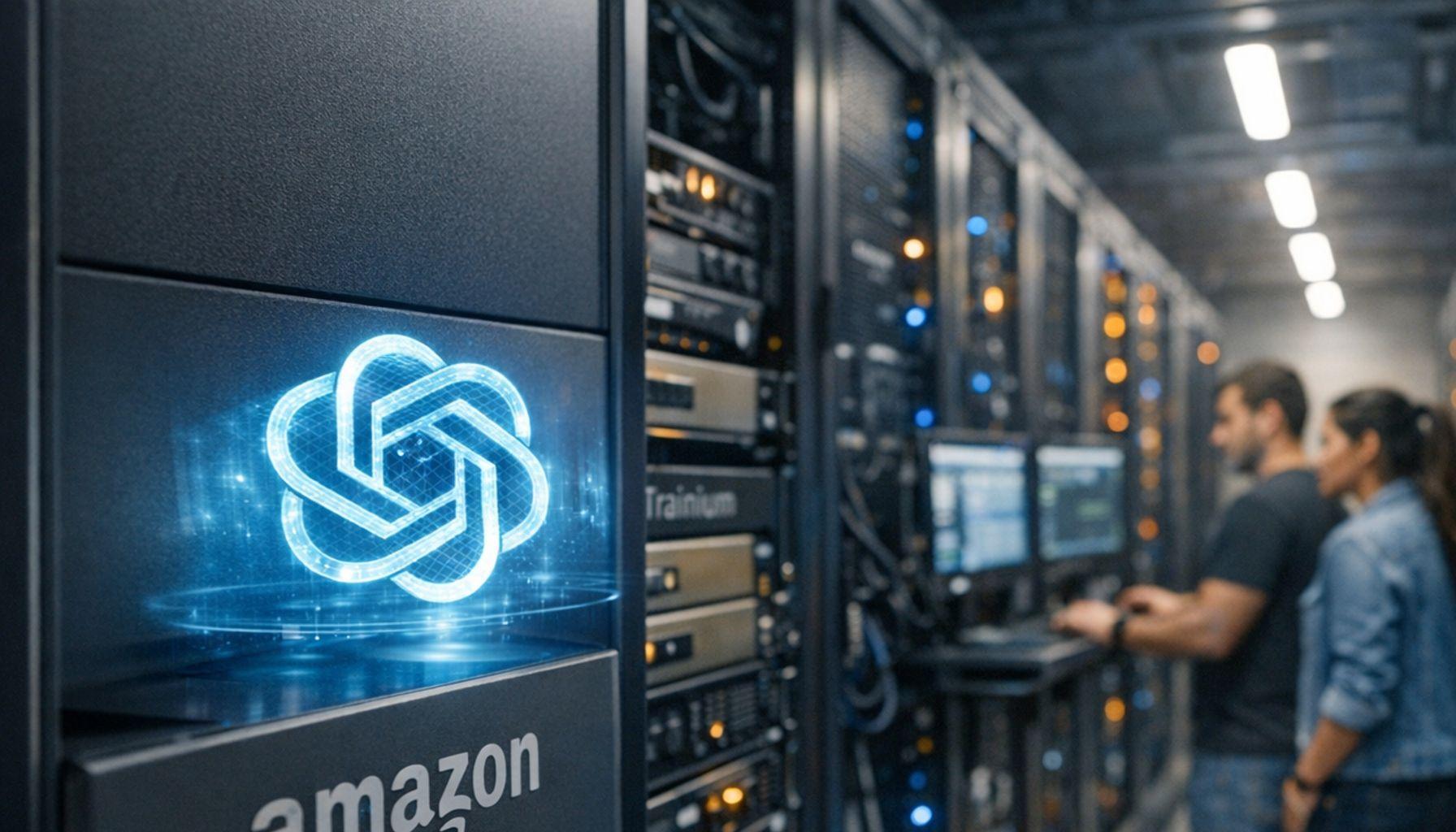
However, part of the demand that Google and Amazon — which makes the Trainium chips — are seeing for their proprietary silicon comes from companies in their own investment portfolios. Gil Luria, an analyst at D.A. Davidson, raised an important flag on this point: when Google and Amazon talk about strong demand for their proprietary chips, a significant chunk of that is captive demand, not organic demand. It is a detail that could make a real difference when assessing the sustainability of this growth over the long run.
The Anthropic deal and the ghost of Oracle
With all this positive momentum, it would be easy to brush off the warning signs — but some analysts have been pretty vocal about the doubts still hanging over Alphabet’s growth story. One of the most recurring questions concerns the makeup of Google Cloud’s backlog.
The central concern revolves around Anthropic, a cash-burning startup with a massive valuation that is raising tens of billions of dollars — including from Google itself — only to spend a big chunk of that money right back with Google on cloud services and TPUs. If Anthropic’s reported $200 billion commitment is compared to Google Cloud’s total backlog, it could represent more than 40% of all contracted future revenue.
Gil Luria, from D.A. Davidson, drew a comparison that caught the market’s attention. He said the situation is reminiscent of what happened with Oracle, whose stock soared in September after the company reported a nearly 360% jump in its backlog. Shortly after, it became clear that most of that growth came from a single customer: OpenAI. Oracle ended up getting punished by investors once that concentration became obvious, with the stock losing about half its value in five months.
According to Luria, Alphabet did something similar — it reported that the backlog nearly doubled without disclosing that almost all of the increase came from a single deal with Anthropic. Microsoft also faced similar scrutiny regarding its exposure to OpenAI.
Luria sees a concentration risk spread across the major cloud providers. Microsoft, Oracle, Amazon, and Google together have close to $2 trillion in reported cloud services backlog. Nearly half of that, according to him, traces back to commitments from OpenAI and Anthropic — companies that are raising capital from this very same group of corporations.
Munster, from Deepwater Asset Management, understands the concern but does not share the same level of alarm — at least when it comes to the relationship between Google and Anthropic. In his view, the deal reinforces how we are still in the early innings of artificial intelligence. Even if use cases are limited today, the need for computing capacity is exponential, and Google is positioned to ride that wave. If Anthropic stumbles, other AI companies will eventually take its place. The headlines about the size and risk of any individual customer, according to Munster, miss the main point — if one of those customers goes under, dozens will eventually fill the gap.


Capital spending and the execution risk
Google is not just harvesting results; it is planting at a scale that also raises eyebrows. The company projects capital expenditures of up to $190 billion this year, more than double the capex recorded in 2025. That is a colossal investment, and for investors to see a return on that capital, Google simply cannot afford to miss on its bets. Analysts at Argus noted in a post-earnings report that Alphabet’s capital spending risks are significant, but they maintained a buy recommendation, arguing that the company’s ability to fund these investments — unlike startups such as OpenAI — is itself a competitive advantage.
There is also the question of the investor narrative. Munster points out that the biggest threat to Alphabet’s continued stock rally is that the current price already bakes in a good portion of future gains. He compares the situation to what is happening with Nvidia today, which keeps delivering enormous growth — analysts expect 78% revenue growth in the next earnings report — but whose stock is up only 15% this year, barely edging out the Nasdaq. If Google cannot shift the narrative with investors by showcasing new growth avenues and concrete progress, the risk is stagnation even with solid results.
What to expect from Google I/O and what comes next
With Google I/O kicking off in less than two weeks, the pressure is on for the company to impress. The event is a critical showcase for demonstrating the agent strategy with Gemini and proving that the company can find sustainable revenue within the broader artificial intelligence ecosystem. It is not just about unveiling new technology — it is about convincing investors and analysts that Google has a clear plan to monetize what it is building.
The company went from latecomer in the AI race to infrastructure winner in a remarkably short span. It added artificial intelligence features to Search, YouTube, and Android, developed competitive models with Gemini and DeepMind, offered its TPUs as a viable alternative to Nvidia chips, and turned Google Cloud into a machine that churns out billion-dollar contracts.
Finally, there is the regulatory question, which has become a constant backdrop for any analysis of the big tech players. Alphabet is involved in antitrust proceedings across multiple jurisdictions, both in the United States and Europe, and some of those cases have the potential to force structural changes to the company’s business model. The combination of accelerating growth, elevated valuations, and mounting regulatory pressure is exactly the kind of scenario that tends to create volatility in stocks — even when the business fundamentals remain solid.
Alphabet’s trajectory over the past 12 months is, without question, one of the most impressive stories in the tech market. The company proved that controlling the full artificial intelligence chain has real, measurable value. But the next chapters will demand something beyond strong quarterly results: Google needs to show it can turn this massive investment into long-term returns without tripping over client concentration risks, regulatory pressure, and the ever-rising expectations the market itself has created. 🎯