How Eli Lilly Used Artificial Intelligence to Speed Up Production of Its Most Popular GLP-1 Drugs
Forget for a moment all the hype about AI in new drug discovery. The world’s largest pharmaceutical company is already seeing real results with artificial intelligence, and the place where it’s happening isn’t the research lab. It’s the factory floor. Eli Lilly found an AI use case that caught a lot of people off guard, radically transforming how it manufactures its most popular GLP-1 drugs: Zepbound, prescribed for weight loss, and Mounjaro, used to treat type 2 diabetes.
While much of the pharmaceutical industry pours billions into using artificial intelligence to discover new molecules and speed up clinical trials, Eli Lilly decided to focus on a more immediate and urgent problem. Demand for its GLP-1 drugs was through the roof, and the company simply couldn’t make enough. The strategy shows that sometimes the most transformative innovation isn’t where everyone expects it to be — it’s in the processes that keep the operation running day to day.
The Problem: Explosive Demand and Factories at Their Limit
To understand the scale of the challenge, just look at the numbers. Together, Zepbound and Mounjaro accounted for more than half of the $65 billion in revenue Eli Lilly reported last year. Mounjaro sales hit $23 billion, double the $11.5 billion reported the year before. Zepbound revenue soared to $13.5 billion, up from $4.9 billion in the prior period. That growth helped Eli Lilly become the first healthcare company to reach a $1 trillion market cap late last year, though it currently trades slightly below that level.
The pressure to meet that demand was enormous, and the situation was critical. Between late 2022 and 2024, the FDA determined that there was a shortage of these drugs on the market. That shortage designation allowed compounding pharmacies to produce versions of the medications under certain conditions, even with patent protections still in place. For Eli Lilly, getting off that shortage list was an absolute strategic priority.
Diogo Rau, Eli Lilly’s chief information and digital technology officer, laid out the situation clearly. He said getting off the shortage list was a top priority for the company. Lilly believed it already had a manufacturing process optimized to the max, but the risk of staying on the shortage list pushed them to take another hard look at everything, even though they thought the process was already as good as it could get. Rau joined Lilly in 2021 after a decade at Apple and reports directly to CEO David Ricks.
The Solution: Digital Twin and Artificial Intelligence on the Factory Floor
To supercharge production of its GLP-1 drugs, Eli Lilly turned to a technology called a digital twin. The idea behind a digital twin is relatively simple to grasp, even if the execution is extremely sophisticated. It’s a complete virtual representation of a factory, fed by real-time data, that shows precisely what’s happening in the actual operation. This digital replica lets engineers and scientists simulate scenarios, identify bottlenecks, and test improvements in the virtual environment before rolling them out in the physical world.
In practice, it’s like having an entire factory inside a computer, responding in real time to everything happening in the real factory. Artificial intelligence analyzes the data generated by this replica and suggests optimizations that would be impossible to identify through human analysis alone. Digital twins are increasingly used to optimize manufacturing processes in sectors like aviation, energy, and automotive, but adoption in the pharmaceutical industry was still in relatively early stages.
Eli Lilly modeled everything about its factory in the digital environment — from the machines and raw materials to the complete production processes. This allowed the digital twin to simulate different configurations and find the ideal combination to maximize output. The result was impressive. The company managed to make its manufacturing process more efficient, producing the drugs in higher volumes than would have been possible otherwise.
Rau summed up the impact with a direct statement: the company literally manufactured more product last year than would have been physically possible without artificial intelligence. And when the team first saw the simulation results, their initial reaction was disbelief. Rau said the team thought it looked too good to be true, but the physical world still matched what the digital twin had predicted. 🏭
Defect Detection With Pinpoint Precision
Beyond optimizing the production line, Eli Lilly also used artificial intelligence to improve defect detection in the autoinjectors — the devices patients use to administer GLP-1 medications. The technology is capable of taking dozens of photographs of each autoinjector from multiple angles in intervals of just a few hundred milliseconds. This automated visual inspection process monitors for any type of crack or defect that could compromise the safety or effectiveness of the product.
That level of quality control would be humanly impossible to maintain on a high-speed production line. The speed and precision with which AI can analyze images far exceed the capability of human inspectors, who naturally get tired and can miss subtle defects after hours of repetitive work. The combination of computer vision and artificial intelligence ensures that every unit leaving the factory has been checked with a level of rigor that simply didn’t exist before.
The Numbers That Stood Out in Financial Reports
The impact of artificial intelligence on production was so significant that it showed up in Eli Lilly’s financial reports. While Rau didn’t specify exact figures, he stated the gain was significant enough to be material in the company’s earnings reports. That’s something that rarely happens with operational technology projects at pharmaceutical companies. Typically, factory improvements stay buried in internal metrics that only production engineers track.
In this case, the efficiency gain was large enough to move the needle for the company’s overall results. Considering that GLP-1 drugs face demand that consistently outstrips global supply, every additional batch produced translates directly into revenue and, more importantly, into patients served. The shortage of these drugs has been a real problem across multiple markets, and any gain in production capacity makes a tangible difference in the lives of millions of people.
A Virtuous Cycle of Data and Continuous Optimization
Another point worth highlighting is how Eli Lilly implemented this technology in an integrated way. The digital twin doesn’t function in isolation as a fancy piece of software on a screen. It’s connected to sensors spread throughout the entire manufacturing plant, feeding artificial intelligence models that continuously learn from operational data. This means the system gets smarter over time, finding increasingly refined optimizations as it accumulates information about how machines behave under different conditions.
It’s a virtuous cycle where:
- Factory data feeds the AI
- The AI identifies improvements and suggests new configurations
- Improvements are implemented in production
- Optimized production generates more data that feeds back into the model
This kind of approach represents the cutting edge of smart manufacturing today. And unlike many AI implementations that stay in the realm of projections and promises, the results here are already being measured and publicly reported.
AI in Drug Discovery: A Long-Term Bet
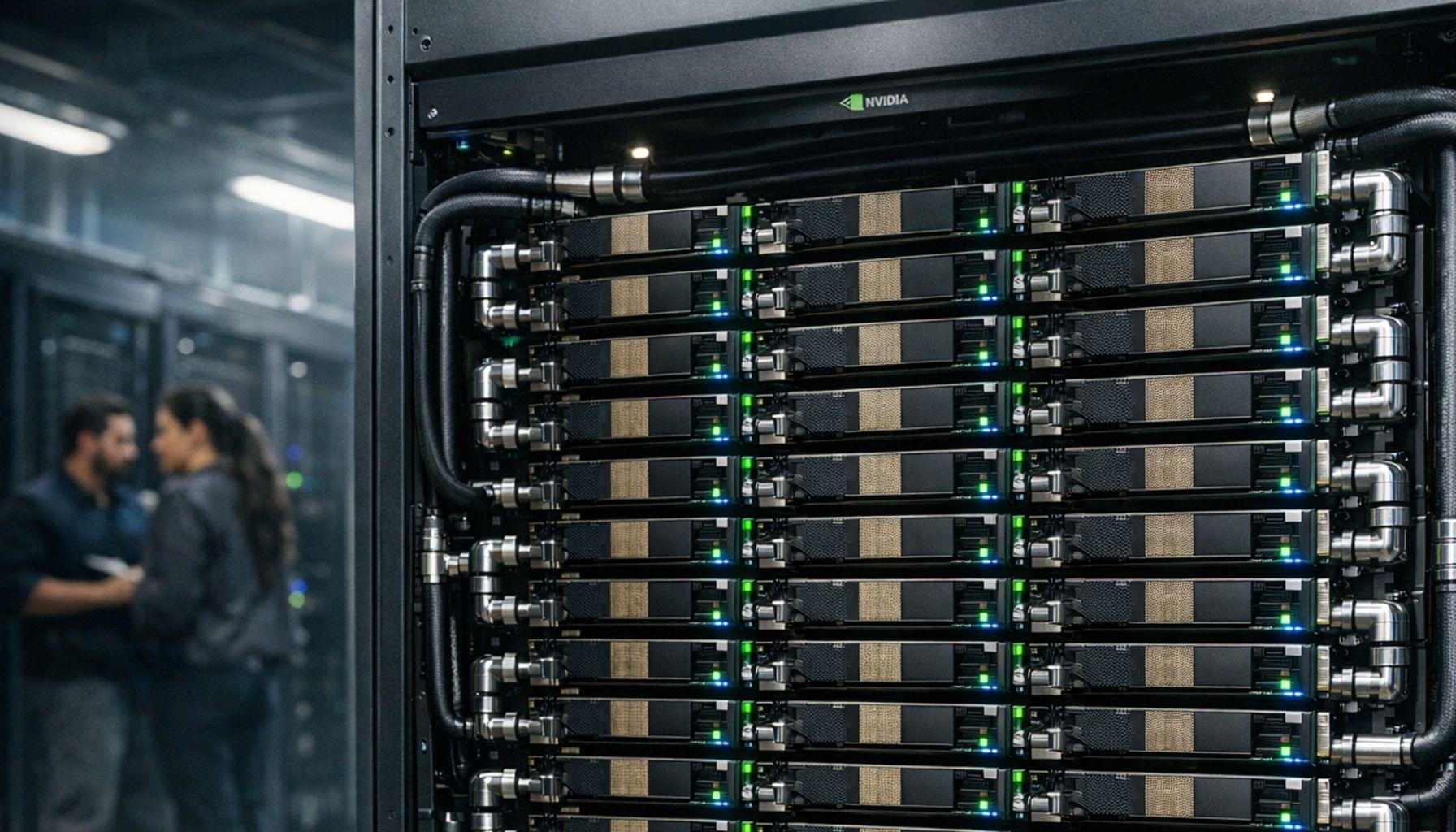
Eli Lilly hasn’t abandoned its investments in AI for new drug discovery, but the company acknowledges that’s a completely different game in terms of timeline. In January, the company and Nvidia announced a partnership with a $1 billion investment in an innovation lab to tackle pharmaceutical industry challenges, powered by a high-performance supercomputer.
That same month, Lilly also signed a collaboration deal with Chai Discovery, an AI startup that raised $230 million at a $1.3 billion valuation. The goal is to build an artificial intelligence model capable of accelerating the discovery of biologic drugs, which are derived from natural sources like proteins or cells rather than being chemically synthesized in a lab.
But Rau makes a point of tempering expectations. He says any return in the drug development space probably won’t show up until the mid-2030s, if not the end of the decade, when those drugs are actually on the market. It’s a big bet on the future, in his words.
And when asked about the speed at which new drugs could be developed — whether it will be possible to launch drugs in six or eighteen months — Rau is blunt in saying that’s the most overhyped aspect of AI in the pharmaceutical industry, and that it carries a critical risk of undermining AI’s credibility in the sector, because that simply shouldn’t be the expectation.


Why AI’s Fastest Return in Healthcare Is in Processes
There’s a dominant narrative in the market that artificial intelligence will revolutionize the pharmaceutical industry through new drug discovery. And it probably will, but that’s a long game. Developing a new drug from scratch, even with AI assistance, still takes years between molecule identification, preclinical testing, clinical trial phases, and regulatory approval.
The Eli Lilly case shows there’s a much more immediate and measurable return when AI is applied to processes that already exist and already generate revenue. Optimizing the production of GLP-1 drugs that are already approved and already have massive demand is a strategic decision that makes complete sense, because the payoff shows up the following quarter, not a decade from now. 🚀
This logic extends well beyond Eli Lilly and well beyond the pharmaceutical sector. Digital twin technology combined with artificial intelligence can be adapted to virtually any large-scale industrial operation. What Lilly did was demonstrate, with real and publicly auditable numbers, that this technology works at scale and that the investment pays for itself quickly. This should accelerate adoption by other major pharmaceutical companies also facing production capacity challenges, especially in the biologics and peptides space like GLP-1 receptor agonists, which are complex molecules to manufacture and require extremely controlled production processes.
What to Expect in the Coming Years
The outlook ahead is pretty clear. Companies that manage to integrate artificial intelligence and digital twin technology into their manufacturing operations will have a competitive advantage that’s hard to match for those who don’t make the move. It’s not just about producing more — it’s about producing better, with less waste, less downtime, and more predictability.
Eli Lilly got out ahead of the pack and is already showing what that means in terms of financial results and the ability to serve a market that keeps growing. The company has invested more than $20 billion in manufacturing capacity expansion in recent years, and artificial intelligence is becoming a multiplier for that investment, squeezing more value out of every dollar spent on physical infrastructure.
For anyone following technology and healthcare, this is one of the most concrete and well-documented cases of AI already generating real value in the corporate world. No reliance on future promises or optimistic projections. No need to wait a decade to see results. The numbers are in the reports, and they speak for themselves. While the world debates the potential of artificial intelligence to reinvent drug discovery, Eli Lilly is already using that same technology to make sure the medications people need right now reach the shelves faster. And at the end of the day, that’s what really matters. 💊