Why Artificial Intelligence Is Driving a Massive Reshuffling Across Dallas-Fort Worth Companies
Artificial Intelligence is no longer just a hype topic at tech conferences. It is already shaking up the stock market, reshaping corporate structures, and redefining which jobs actually make sense going forward. In the Dallas-Fort Worth (D-FW) region, this shift earned a blunt label straight from Bill Adams, chief economist at Comerica Bank: a massive reshuffling across the market, affecting everything from major corporations to smaller businesses that rely on technology to operate.
During a Tech Titans event held at the Prestonwood Country Club and sponsored by the University of Texas at Dallas (UTD), Adams made the case that AI has already created a kind of two-speed economy. On one side, sectors directly tied to AI technology — like research and development, data center construction, and advanced cloud services — are growing at a fast clip. On the other, the rest of the economy is moving at a much more uneven pace, reflecting what he calls the classic K-shaped economy, where one segment rises while another stalls or falls.
This scenario is especially visible in D-FW, a hub that blends banking, healthcare, telecom, logistics, energy, and a strong base of software and IT services companies. AI has become the centerpiece of all of it, creating an environment where professionals who can keep up with the technological frontier are in high demand, while those stuck on older technologies face a tighter market.
What Bill Adams Sees: New Skills Demand and a Transition Cycle
Bill Adams, one of the most well-known macroeconomists in the country, got straight to the point during his talk: AI is not just another software wave — it demands an entirely new set of skills. According to him, people who have stayed at the cutting edge of technology are seeing demand grow, with more opportunities and better salaries. On the flip side, more traditional roles in tech and administrative sectors are starting to feel the impact of automation.
In a conversation with Kris Fitzgerald — a seasoned IT veteran, visiting professor, and chair of the executive board at UTD’s Erik Jonsson School of Engineering and Computer Science — Adams compared the current moment to major technological shifts of the past. He pointed out that in the 19th century, agriculture employed the majority of Americans. Today, the sector accounts for roughly 1% of the workforce, yet agricultural output is higher than ever thanks to technical advances and heavy automation.
His read is that AI could repeat this pattern on a much broader scale:
- Productivity goes up: companies can do more with fewer resources, in less time;
- Traditional jobs shrink: especially in repetitive activities or those based on fixed rules;
- New types of work emerge: roles that do not even have defined names yet and that grow as the technology matures.
Adams made a clear prediction: we are entering a tougher stretch for anyone working in sectors where AI applications are the most obvious and quickest to implement. That includes a significant chunk of the tech industry, administrative areas, customer service operations, and even some support functions in finance, healthcare, and education.
<highlight>
In Bill Adams' view, AI does not eliminate jobs out of thin air.
It pushes the market toward a new kind of employment while putting
pressure on roles that fail to evolve.
</highlight>
A Luncheon, an Avatar, and a Clear Message About the Cost of Technology
The tone of the Dallas event blended a hands-on AI demonstration with an economic wake-up call. Before stepping onto the stage, Kris Fitzgerald appeared on the ballroom screens as an AI avatar, speaking for several minutes in a realistic fashion with synchronized voice and visuals. When he walked out in person, he revealed that the tool used to create that avatar costs around 20 dollars a year.
The message was simple and powerful: if a relatively basic, cheap, and accessible solution can already create a convincing avatar, what can companies accomplish with more robust tools, bigger budgets, and specialized teams? This kind of capability opens the door to:
- Automating internal training with custom avatars;
- Creating more natural virtual agents across digital channels;
- Producing multimedia content at scale without needing full studio setups;
- Rethinking corporate communication and customer support workflows.
This seemingly simple example helps illustrate what Adams later describes as sectors going full throttle thanks to AI. Affordable tools with a low barrier to entry allow everyone from startups to large corporations to experiment, iterate, and launch AI-driven products and services at a pace that is hard to match for anyone not in the game.
The K-Shaped Economy Takes Form in the AI Era Across D-FW
One of the strongest points in Adams’ talk was the idea that AI is deepening the well-known K-shaped economy. In this model, after economic shocks or technological shifts, some people, companies, and sectors accelerate while others struggle. The two legs of the K represent those very different trajectories.
In the D-FW context, this shows up in a few key ways:
- AI-linked sectors: research, model development, cloud infrastructure, data center construction, and advanced services are growing strong and are expected to keep that momentum through 2026;
- The rest of the economy: shows a more mixed pace, with job insecurity in less-skilled positions and a widening gap between higher-income households and everyone else;
- Top-tier professionals: those at the frontier of technology — development, data, systems architecture, applied AI — land on the upward leg of the K;
- Vulnerable workers: administrative, repetitive, and support roles, along with parts of the service sector, are more exposed to automation and end up on the downward leg.
Adams made it clear that this divide is not unique to D-FW, but the region functions almost as a showcase for this dynamic. The weight of tech companies, banks, insurers, hospitals, top-tier universities, and a hot real estate market amplifies the contrast between those who directly benefit from the AI wave and those who feel its side effects the most.
<highlight>
The K-shaped economy is not just a nice-looking chart on a slide.
In D-FW, it shows up in the differences between neighborhoods,
types of employment, and even in how companies recruit and
compensate their teams.
</highlight>
AI as a Productivity Engine and a Source of Labor Market Tension
Another important comparison Adams drew was with major productivity leaps throughout history. He pointed to agriculture to show that even when a sector loses jobs, it can gain in total output and efficiency. With AI, that logic is likely to spread across multiple segments at once.
Behind the scenes, here is roughly what is happening:
- Companies are automating tasks: from preliminary data analysis to document screening, first-level support, draft code generation, and report writing;
- Smaller teams are doing more: lean teams with higher-skilled professionals deliver the work that previously required entire departments handling repetitive tasks;
- New services are emerging: personalization at scale, real-time monitoring, smart recommendations, AI-assisted diagnostics, and more;
- The transition is painful: people in roles threatened by automation face uncertainty, the need for reskilling, and in many cases, short-term income loss.
Adams was careful not to paint a purely pessimistic picture. He emphasized that AI is already boosting productivity and has the potential to create a wave of professions that do not even exist yet. But he did not sugarcoat it either: the transition is going to be rough for people working in areas where automation is easiest to deploy.
D-FW’s Role as a Living Lab for AI-Driven Transformation
Dallas-Fort Worth has always had an interesting mix of technology-intensive sectors and traditional services. Now, with AI expanding rapidly, the region is turning into a kind of open-air laboratory for how this technology reshapes the real economy.
A few examples of movements already visible in the region:


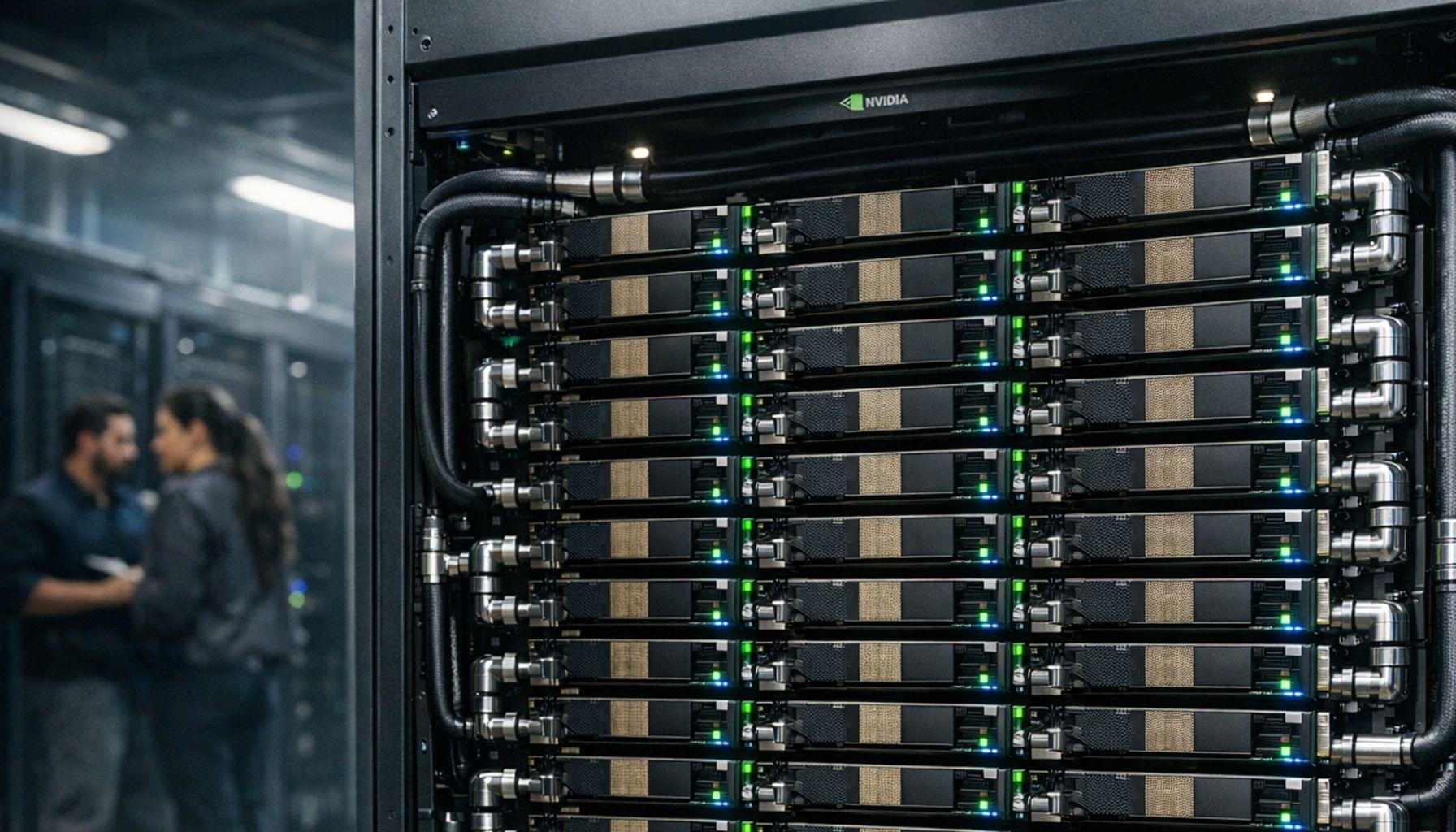
- Digital infrastructure: a surge in data center construction and investments in high-capacity networks to support the training and deployment of AI models;
- Healthcare and medical research: AI being used in diagnostics, imaging analysis, patient triage, and drug discovery, speeding up processes that used to take years;
- Finance and banking: models for risk assessment, fraud detection, automated customer service, and predictive market analysis;
- Education and universities: a stronger focus on data science, software engineering, and applied AI programs, along with joint projects between schools and regional companies;
- Logistics and retail: route optimization, demand forecasting, distribution center automation, and personalized offers.
Across all of these cases, the logic is similar: AI becomes a layer that makes decisions, prevents problems, and generates recommendations, rather than simply executing predefined tasks. This changes how products are conceived, how teams are assembled, and how long-term strategies are built.
New Roles, Reskilling, and the Future of Work in D-FW
Even with the pressure on certain types of jobs, the picture described by Adams and reinforced by Fitzgerald’s hands-on experience shows that there is plenty of room for new work. The difference is that these new roles call for a blend of:
- A basic understanding of Artificial Intelligence and data;
- Knowledge of the business where AI is being applied;
- The ability to solve real problems with the tools available.
It is not just about being a data scientist or a machine learning engineer. In D-FW, more openings and roles are starting to appear, such as:
- Product managers focused on AI-driven solutions;
- Specialists in integrating models with legacy systems;
- Professionals in AI governance, risk, and compliance;
- Experience designers for conversational interfaces;
- Analysts who combine deep process knowledge with practical automation skills.
This trend reinforces the takeaway that AI is not just here to replace people — it is here to change who does what inside organizations. For anyone in D-FW working in tech, business, operations, or analytics, understanding the basics of AI and how it is applied has gone from a nice-to-have to nearly a requirement.
<highlight>
In the short term, the impact may look uneven. In the long run,
how D-FW handles education, reskilling, and strategic AI
adoption will determine whether the region turns this massive
reshuffling into a competitive advantage or a structural problem.
</highlight>
At the end of the day, the message coming out of this Dallas gathering is pretty straightforward: AI is already rearranging the board for D-FW companies. Some sectors and professionals are rising fast, while others are fighting not to lose ground. The region shows, in real time, that technology can drive strong growth — but it also deepens divides if it is not paired with preparation, public policy, and clear strategies for inclusion and professional development.