What to expect from GTC 2026 and its direct impact on tech stocks
Nvidia is about to shake up the artificial intelligence market with the arrival of GTC 2026, one of the most anticipated events on the global tech calendar. Led by CEO Jensen Huang, the conference serves as a true barometer for the entire technology ecosystem — and this time the ripple effects promise to reach far beyond the company’s own chips. The timing is especially sensitive because investors worldwide are trying to figure out the next chapter in the AI growth cycle and, more importantly, who is actually going to profit from it. In an environment where volatility in AI-related stocks has become the norm, every word from Jensen Huang can move billions of dollars in market capitalization within minutes.
2026 has brought an interesting twist compared to what we saw in 2025. Several big tech names that led the massive rallies last year are now sitting on significant losses, while data center infrastructure companies like Lumentum, Ciena, and Vertiv have surged during the same period. This capital rotation shows the market is recalibrating its bets, shifting from companies that develop AI models to those building the physical infrastructure that powers this entire revolution. It is a subtle shift, but one that carries enormous implications for anyone following the sector closely. GTC 2026 arrives right at this inflection point, with the potential to either confirm or dismantle investment theses that move trillions of dollars globally.
Names like Broadcom, Dell, CoreWeave, Arista Networks, and Lumentum are among the companies that could feel the direct effects of announcements scheduled for the event. From new chips focused on inference — the stage where AI models actually generate responses and content — to the launch of an open-source AI agent called NemoClaw, the GTC topics promise to redefine priorities within the sector. For anyone investing in technology stocks, it is practically impossible to ignore what is about to unfold in the coming days. 🤔
Jensen Huang’s keynote and the most anticipated announcements
Jensen Huang, Nvidia CEO, will take the stage on Monday at 11 a.m. Pacific Time for the traditional GTC opening keynote. Beyond updates on the company’s own technology, the expectation is that he will highlight advances across the broader artificial intelligence ecosystem, including open software models and so-called agentic systems. One of the standout reveals could be OpenClaw, an open-source AI agent capable of writing code and browsing the web to complete tasks on behalf of users. According to analysts, this tool has the potential to be as transformative as ChatGPT was at launch.
According to a UBS report, Nvidia is also expected to introduce NemoClaw, an open-source AI agent aimed at the enterprise market. The company has been pursuing partnerships with software developers, and NemoClaw is expected to include AI agents alongside security and privacy tools. This kind of offering is strategic because it positions Nvidia as far more than a GPU manufacturer — it wants to be a complete platform for developing and deploying artificial intelligence solutions for businesses of all sizes.
Another hot topic is the $20 billion technology licensing deal with Groq, announced in December. With market demand shifting from training to inference of AI models, Nvidia is expected to unveil a new inference chip developed using Groq’s technology. This move is particularly significant because inference — the process of running AI applications in the real world — represents a potentially even larger market than training, since it involves continuous and massive use of computing power.
On Tuesday, the event continues with a Q&A session geared toward financial analysts, again with Jensen Huang at the helm. This format tends to yield valuable information about revenue projections, margins, and the company’s long-term strategies.
Hyperscaler spending spree and the race for AI infrastructure
One of the central themes of GTC 2026 is the staggering scale of investment that so-called hyperscalers — companies like Microsoft, Google, Amazon, and Meta — are pouring into AI-focused data center infrastructure. The numbers are jaw-dropping: together, these four giants are expected to spend around $645 billion in 2026, a 56% increase over the prior year, representing roughly $230 billion more in absolute terms. This avalanche of capital creates insatiable demand for Nvidia GPUs, but it also benefits an entire supply chain that includes networking equipment manufacturers, cooling systems, optical connectivity, and custom servers.
Despite these monumental investments, hyperscaler stocks are not having a stellar 2026. Google is down 3%, Meta has dropped 7%, Amazon has fallen 10%, and Microsoft leads the losses with an 18% decline. The investor concern is clear: are these companies building AI infrastructure too fast, without any guarantee that demand will keep up? It is the classic dilemma of racing to capture a massive opportunity while potentially getting ahead of actual market demand.
Data center infrastructure has become, without exaggeration, the backbone of the AI revolution. Without powerful servers, high-speed networks, and reliable energy systems, no language model or artificial intelligence tool can operate at scale. And that is exactly why companies like Vertiv, which provides power and cooling solutions for data centers, have seen their stocks skyrocket in recent months — up 59% in 2026. The same goes for Ciena and Lumentum, which operate in the optical connectivity segment and have posted gains of 44% and an impressive 69%, respectively. GTC 2026 should reinforce this narrative and possibly introduce new partners and suppliers that will directly benefit from the next generation of Nvidia hardware.
Another point worth watching is the impact of these investments on traditional software companies. While the infrastructure layer is enjoying a moment of euphoria, many software companies that promised to monetize AI quickly are facing growing pressure to show concrete results. The market is becoming more demanding and less tolerant of vague promises. This creates an interesting dynamic: the money flowing into the data center supply chain does not necessarily translate into immediate revenue for those developing end-user applications.
The ripple effect on server manufacturers and cloud providers
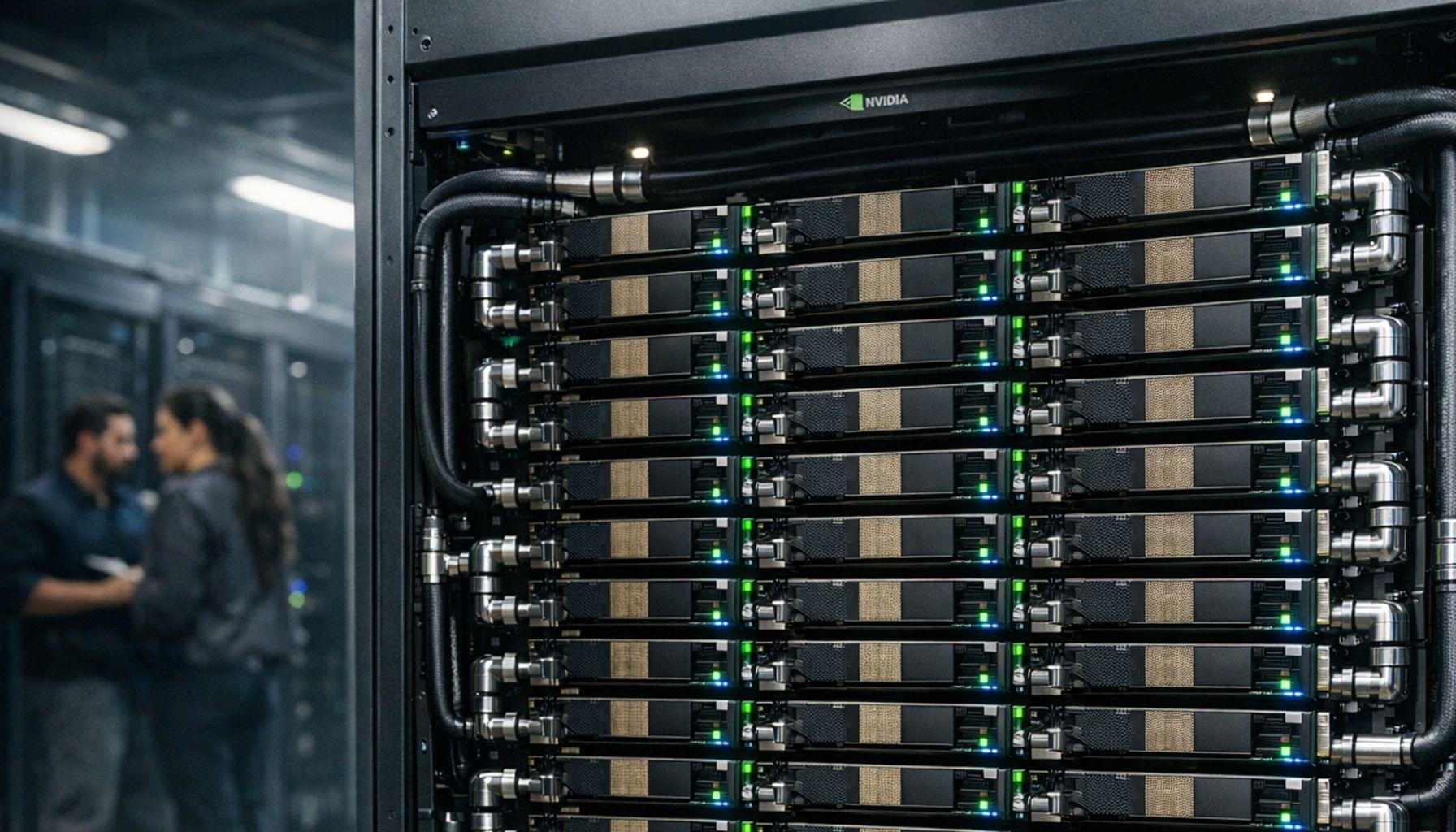
AI server manufacturers like Dell Technologies and Hewlett Packard Enterprise are among the companies that could react significantly to GTC 2026 announcements. Updates on Nvidia‘s next-generation GPU systems, including the Vera Rubin accelerators currently in production, have a direct impact on these companies’ product lines. Each new chip architecture requires adaptations in server designs, cooling systems, and power management, creating both opportunities and challenges for these manufacturers.
In the cloud computing segment, partners like CoreWeave and Nebius Group could experience volatility tied to signals about demand for AI infrastructure. CoreWeave, which is up 13% in 2026 after an impressive 77% gain in 2025, has positioned itself as one of the cloud providers most focused on artificial intelligence workloads. Any signal from Nvidia about preferred partnerships or new infrastructure models could move these companies’ stocks considerably.
Nvidia‘s networking strategy for data centers also deserves special attention, particularly because of its impact on suppliers like Arista Networks. Arista, which has maintained relatively stable performance in 2026 with a 2% gain, is one of the leading providers of switches and networking solutions for large-scale data centers. Any change in the interconnect architecture proposed by Nvidia can open or close doors for these suppliers almost instantly. Similarly, Nvidia‘s push into optical interconnects has direct implications for component manufacturers like Lumentum, which is experiencing its best stretch in years.
AI software under pressure: the specter of the SaaS-pocalypse
While data center infrastructure shines, the software sector tied to artificial intelligence is going through a rough patch. The iShares Expanded Tech-Software Sector ETF, an index that tracks a range of large-cap software companies, has fallen a full 20% in 2026. Names like Workday, Atlassian, and ServiceNow remain under selling pressure, and even Palantir, which was one of the investor darlings of 2025 with a 135% gain, is already down 15% this year.
The situation grew even more tense with the departure of Adobe‘s long-standing CEO, a move that symbolizes the turbulence sweeping through the sector. The central concern is that AI model builders like OpenAI and Anthropic could emerge as direct competitors in the enterprise market, stealing ground from traditional software companies.
One of the new terms gaining traction among investors is the SaaS-pocalypse — the idea that AI agents will replace software-as-a-service companies. This concern is not unfounded. Jeetu Patel, president and chief product officer at Cisco, stated in an interview that within the next 12 months very little code will be written by humans, and that in 12 to 24 months virtually 100% of code will be produced by AI. Statements like these fuel investor anxiety about the future of traditional software companies.
There is also the debate around outcome-based pricing, a revenue shift from per-user subscriptions to automated workflows executed by AI agents. This transition could fundamentally transform how software companies generate revenue. On the other hand, some argue that companies like Salesforce and ServiceNow are in a privileged position to monetize AI precisely because they function as systems of record — meaning they hold enormous volumes of structured enterprise data that feed and enrich artificial intelligence solutions.
The big question for investors in AI-related software stocks is how the dynamic of coopetition — simultaneous cooperation and competition — between AI model builders and traditional software companies will play out in the enterprise market over the coming years.
OpenAI’s mega funding round and its ripple effects
Amid concerns about a potential AI bubble, OpenAI closed a funding round that raised over $100 billion. Investors include heavy hitters like Amazon, SoftBank, and Nvidia itself. It is a monumental figure that reflects the biggest market players’ bet on the future of generative artificial intelligence, but it also raises questions about the company’s ability to deliver returns that match this level of investment.
Microsoft remains OpenAI’s largest shareholder, with a stake of roughly 27%, followed by SoftBank at somewhere between 12% and 14%. This capital structure puts Microsoft in a uniquely strategic position, but it also exposes the company directly to the risks tied to OpenAI’s execution of its ambitious infrastructure expansion plans.
For the broader market of artificial intelligence stocks, the question is whether this new capital injection will ease fears about the ChatGPT maker’s ability to fulfill its commitments to build data centers at massive scale. The answer may take time, but GTC 2026 should offer some clues about how Nvidia views its relationship with OpenAI and other major consumers of its chips.
Inference, NemoClaw, and the future of the Nvidia platform
If in recent years Nvidia‘s focus was heavily centered on training AI models — that phase where algorithms consume massive amounts of data to learn patterns — the company is now signaling a shift in emphasis toward inference. This is the process where already-trained models are put to work in the real world, answering questions, generating images, translating text, and executing complex tasks in real time. Inference requires a different kind of hardware optimization, and Nvidia is expected to unveil at GTC 2026 new chips and architectures designed specifically for this purpose, including solutions based on licensed technology from Groq.
For the stock market, this transition is extremely relevant because inference represents a potentially much larger market than training, since it involves the continuous and massive use of computing resources by companies of all sizes and across all industries. While training a model happens once (or periodically), inference happens millions of times a day — with every query, every search, every interaction with a chatbot or virtual assistant.
The launch of NemoClaw as an open-source AI agent for enterprises reinforces Nvidia‘s strategy of expanding its presence beyond hardware. AI agents are programs capable of executing tasks autonomously, making decisions and interacting with external systems without the need for constant human intervention. By making this tool open-source, Nvidia makes a strategic move to broaden adoption of its platform and create an even more robust developer ecosystem around its solutions. This could have a cascading effect on companies that develop artificial intelligence applications, since it lowers barriers to entry and accelerates the pace of innovation across the entire technology sector.
Reasons for concern: the shadow of the AI bubble
Not everything is rosy in the world of artificial intelligence stocks, and GTC 2026 arrives at a time when several warning signs are flashing. One of the main concerns is the growing debt load of technology companies financing the massive buildout of data center infrastructure. When companies take on enormous debt betting on a growth cycle that could slow down, the risk for investors increases significantly.
Another point of concern is the so-called circularity within the AI ecosystem. This happens when investments and commercial relationships overlap — for example, when a company invests in another that is simultaneously its customer and supplier. This dynamic can artificially inflate revenue numbers and create a false sense of organic growth.


The securitization of loans aimed at data center infrastructure builders is also worrying analysts. It is a financial mechanism that can amplify risks in the event of a sector slowdown. On top of that, there is the accounting question of depreciation: AI infrastructure is expensive and loses value over time from a bookkeeping standpoint, which directly impacts the financial results of the companies involved.
Finally, there is the energy question. AI data centers consume enormous amounts of electricity, and there is growing concern that the U.S. power grid is falling behind China’s in terms of capacity to support these massive demands. Some American lawmakers are already sounding the alarm about the risk of rising energy prices for everyday consumers as a direct consequence of this race to build AI infrastructure. ⚡
AI stock scoreboard in 2026: winners and losers
The current landscape of artificial intelligence stocks reveals a clear divide between winners and losers. On the positive side, companies tied to data center infrastructure and optical connectivity are leading the gains:
- Lumentum: up 69% in 2026 after an impressive 339% in 2025
- Vertiv Holdings: up 59% on the year
- Ciena: up 44% in 2026
- CoreWeave: up 13%
- Cloudflare: up 8%
- Arista Networks: slight gain of 2%
On the losing side, major names in software and semiconductors are struggling:
- Salesforce: down 27% in 2026
- Oracle: down 20%
- Microsoft: down 18%
- Snowflake: down 18%
- Credo Technologies: down 18%
- Palantir: down 15%
- AMD: down 10%
- Amazon: down 10%
Nvidia itself has posted a modest 3% decline in 2026 and has been trading in a sideways range since mid-2025. For many analysts, this reflects the fact that investors are more focused on the sustainability of the AI growth cycle than on its magnitude. In other words, the question is no longer how much AI will grow, but rather how long that growth will last.
What this means for anyone following the AI market
For anyone following the financial markets and holding positions in technology sector stocks, GTC 2026 is one of those events that demands extra attention. Not just because of what Nvidia will announce directly, but because of the domino effect those announcements trigger across the entire chain — from data center suppliers to software developers, semiconductor companies, and cloud providers.
The current environment calls for selectivity. Many companies that rode the AI wave in 2025 are now facing the reality of delivering concrete results. At the same time, companies building the physical infrastructure that powers this entire revolution continue to find strong demand and demonstrate real revenue growth. The rise of generative artificial intelligence represents both risk and opportunity for companies like Google, Meta, and Microsoft — which need to invest heavily to avoid falling behind, but also face uncertainty about the return on that investment.
The landscape is one of transition, with the market trying to figure out which segments of artificial intelligence will generate real and consistent returns over the coming years. And if there is anyone with the power to shape that narrative, it is Jensen Huang and Nvidia. 🚀