Jensen Huang predicts Nvidia will have 75,000 employees and 7.5 million AI agents in 10 years
Jensen Huang just dropped one of the boldest predictions about the future of work we have ever seen from a major tech company CEO.
At the GTC Conference 2026, held in San Jose, California, the founder and CEO of Nvidia did not just talk about growing the company’s human team, hiring more engineers, or opening new offices around the world. He went way beyond that.
Huang painted a scenario for 2036 where Nvidia will have 75,000 human employees — nearly double the roughly 42,000 the company currently employs — working side by side with a staggering 7.5 million AI agents. That works out to a ratio of 100 agents for every person.
Sounds like something out of science fiction, right? 🤯
But when you look at what is happening in the market right now, with companies like McKinsey already operating with 25,000 agents and 40,000 humans, and 62% of organizations experimenting with AI agents according to a McKinsey survey conducted in November 2025, Huang’s vision starts to look a lot less absurd and much closer than we might think.
The real question hanging in the air is not whether this will happen, but how the market will adapt to that kind of scale.
What Jensen Huang actually said at GTC 2026
During a press Q&A session at the conference, Jensen Huang laid out this vision of the future with a clarity that surprised even people who have been following Nvidia for years. He was not speculating or being vague. He was sketching out a real architecture for how the company plans to operate over the next decade.
His exact words, delivered to laughs from the audience, were direct:
In 10 years, we expect to have 75,000 employees, the fewest number possible, as large as necessary. They are going to be super busy. Those 75,000 employees are going to work with 7.5 million agents.
The core idea is simple on the surface but deep in its implications. Each human employee would essentially be a manager of a team of one hundred AI agents, each specialized in specific tasks, running in parallel, with no breaks, no vacations, and no meetings that could have been an email.
Huang made a point of emphasizing that this is not about replacing people, but about amplifying capability. His logic is that with AI agents taking on repetitive, analytical, and operational tasks — what he called the heavy lifting that humans do not need to complete — employees are freed up to focus on creativity, strategy, and complex decisions that still require human judgment.
On the subject of the agents, Huang added with good humor: They are going to work all the time, 24 hours. So hopefully our people will not need to keep up with them.
It is a reconfiguration of what it means to be productive inside a cutting-edge technology company. And Nvidia wants to be the living model of that transformation, not just the hardware supplier that makes it possible.
What makes this statement even more significant is the context in which it was made. The GTC Conference is the biggest stage Nvidia has for communicating its market vision, and the event draws investors, partners, developers, and industry leaders from around the world. When Jensen Huang makes a claim of this magnitude in that setting, he is not just predicting the future. He is signaling where Nvidia will direct its investments, its research, and its product development over the coming years.
AI agents are not chatbots — understand the difference
Before we go any further, it is worth clarifying an important point that a lot of people get mixed up. When Huang talks about AI agents, he is not talking about the chatbot you use to look up a recipe or plan your vacation.
AI agents are software programs that act autonomously to achieve specific goals. They reason, plan, and execute actions on their own, instead of simply responding to prompts the way a conventional language model does. The difference is enormous. A chatbot waits for you to ask something before it responds. An AI agent receives a goal and gets to work accomplishing it, making intermediate decisions along the way.
A practical and recent example of this capability came from Andrej Karpathy, one of the founding members of OpenAI. He ran a test in which an AI agent was given the mission of finding a more efficient way to train a small language model. The result? The agent ran 700 experiments in just two days, producing 20 real optimizations. That kind of execution at scale and speed would be simply impossible for a human team, even a very large and highly qualified one.
It is exactly this kind of capability that Huang envisions multiplied by 7.5 million inside Nvidia within a decade.
The Nvidia Agent Toolkit and the democratization of agents
Huang does not see this technology as something exclusive to Nvidia. At the GTC Conference itself, he announced the launch of the Nvidia Agent Toolkit, an open agent development platform designed to help companies build and operate their own AI agents.
In a press release, Huang explained the motivation behind the tool: Claude Code and OpenClaw started the inflection point of agents, extending AI beyond generation and reasoning toward action. Employees will be supercharged by teams of frontier, specialized, and custom-built agents that they themselves will deploy and manage.
Companies like Adobe, Palantir, and Cisco are already working with the Nvidia Agent Toolkit to expand agentic capabilities across their platforms. This shows that the interest is not theoretical — major corporations are already integrating this technology into their real workflows.
Opening up this platform is a smart strategic move by Nvidia. By making it easy for the entire market to build agents using its tools, the company strengthens its ecosystem and creates a healthy dependency on its infrastructure, both software and hardware.
AI adoption is already happening ahead of schedule
What is perhaps most striking about this whole story is that the future Jensen Huang describes for 2036 already has beta versions running right now. McKinsey, one of the largest consulting firms on the planet, is already operating with a ratio of roughly 25,000 AI agents to 40,000 humans, according to its CEO Bob Sternfels. This is not a pilot. This is not an isolated experiment. It is real operations at global corporate scale.
And McKinsey is not alone in this movement. It is just the most visible example of a trend spreading across completely different industries:
- Accenture, through its CEO Julie Sweet, stated that failing to adopt AI could cost employees their promotions
- Executives at OpenTable and Salesforce have already pointed to AI agents as the future of corporate work
- Meta acquired the Moltbook platform, created by Matt Schlicht, where AI agents were conversing with each other without human intervention — an experiment that produced results that were both fascinating and concerning
The November 2025 McKinsey survey showing 62% of organizations experimenting with AI agents is a number that deserves close attention. Experimenting does not mean adopting at full scale, but it does mean the psychological and technical barrier has already been overcome by the majority of relevant companies in the market. That said, it is worth noting that nearly two-thirds of the companies surveyed had not yet begun scaling AI. This signals a massive growth opportunity ahead — and also a lot of work still to be done.
When more than half of organizations have moved past the curiosity phase into the active testing phase, the natural next step is to scale what is working and discontinue what is not delivering results. That cycle tends to move faster than any conservative forecast would suggest.
On top of that, the broader ecosystem of tools for developing and orchestrating AI agents has matured at an accelerated pace over the past two years. Platforms like NVIDIA NIM, autonomous agent frameworks, and multi-agent system infrastructures are more accessible, better documented, and more stable. This drastically reduces the time and cost for a company to move from experiment to production, which further accelerates the already steep AI adoption curve.
What changes in the future of work at this scale of agents
When you start thinking about 7.5 million AI agents operating inside a single company, some questions come up naturally and immediately. How do you monitor all of that? How do you ensure the agents are making decisions aligned with the organization’s values and goals? How do you handle errors at scale? These are real questions that still do not have definitive answers, but they are being actively worked on by research teams in AI safety, governance, and distributed systems engineering around the world.
From the human worker’s perspective, transitioning to this model requires a deep reconfiguration of skills and mindset. The professional who will thrive in this environment is not necessarily the most technical one or the one who writes the best code. It is the one who can collaborate effectively with AI systems, understand the limits and capabilities of agents, identify when a decision needs human oversight, and communicate context in a way that allows models to execute with precision. It is a skill set that is still being defined as the technology evolves.
The future of work that Jensen Huang describes also raises important reflections about productivity and value. If one person can manage one hundred agents executing in parallel, the concept of hours worked loses much of its meaning as a performance metric. What starts to matter is the quality of decisions made, the clarity of instructions given to agents, and the ability to interpret and act on the results they deliver. This is a genuine paradigm shift, not just an incremental update to the way we work.
Huang is aiming at solving humanity’s biggest problems
Beyond corporate dynamics, Jensen Huang also connected this vision to a larger purpose. He believes AI agents are fundamental pieces in solving problems that humanity still considers impossible or extremely difficult.
We are going to solve really incredible problems, he said at the conference. The things we are thinking about solving today, 10 years ago nobody would have even imagined they were solvable.
Huang specifically mentioned drug discovery as an example, framing it as an engineering problem that AI can radically accelerate. He also talked about extending human life as something that is already being discussed as viable within a medium-term horizon.


His closing statement on the topic was loaded with optimism: All of us are going to feel superhuman.
That kind of statement might seem over the top at first glance. But when you put it in context with the advances that have already happened — agents running hundreds of experiments in days, autonomous systems optimizing processes that would take human teams months, and AI models contributing to real scientific discoveries — Huang’s ambition gains substance.
Why Nvidia is at the center of this transformation
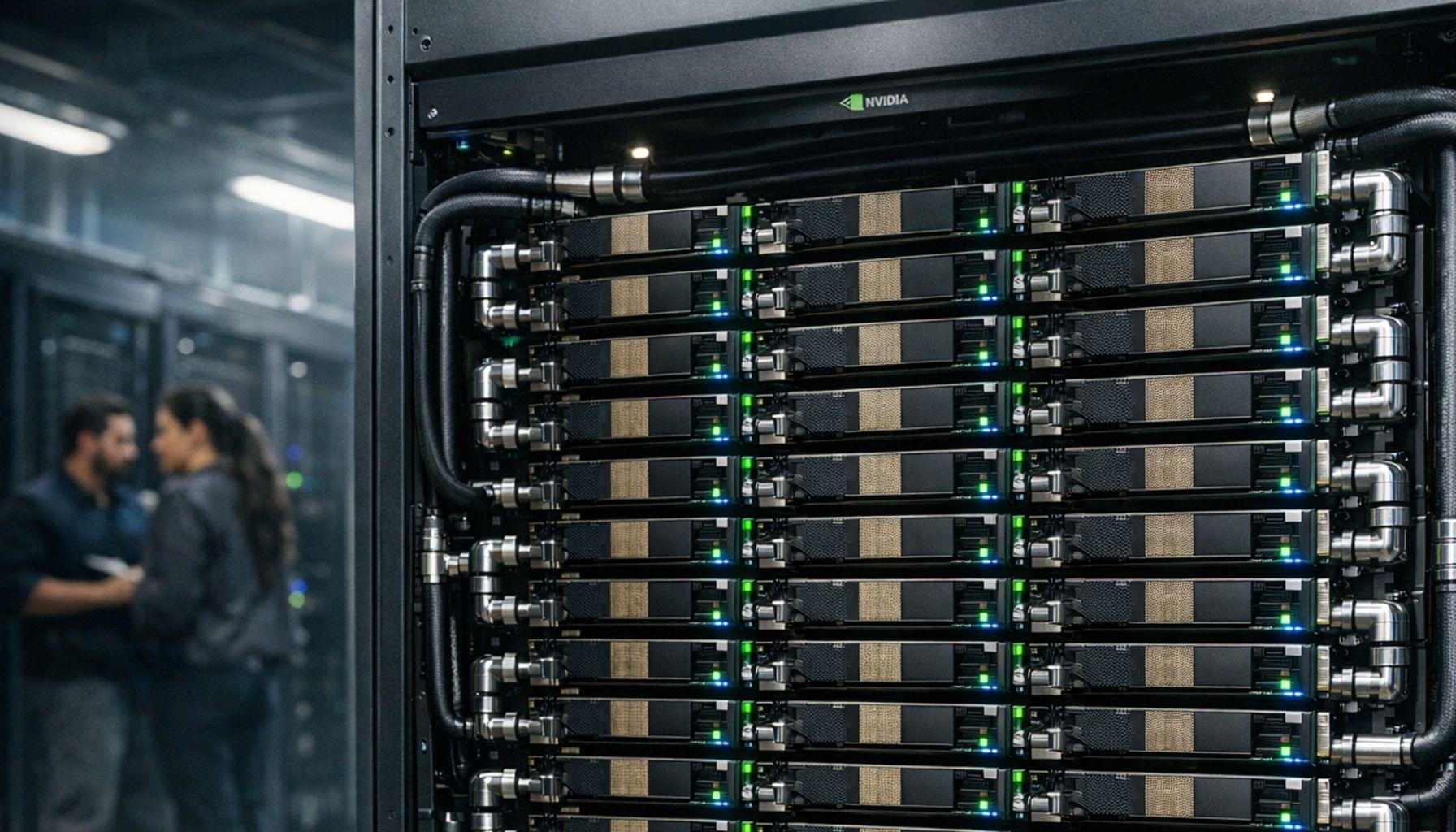
It is no coincidence that it is exactly Jensen Huang and Nvidia talking about this future with such conviction. The company has built over the past several years an absolutely central position in the infrastructure that makes all of this possible. Nvidia GPUs are the engine that trains the language models powering AI agents. And the company has also developed a complete ecosystem of software, platforms, and tools that make it easier to deploy these solutions in enterprise environments.
Talking about the future of AI agents is, for Nvidia, talking directly about its own market and its own strategic relevance. Every new layer of AI adoption at enterprise scale represents growing demand for computing power. The more companies that operate with thousands or millions of agents running in real time, the more GPU infrastructure will be needed to sustain that processing. It is a business thesis that reinforces itself, and Jensen Huang has been consistent in articulating it publicly over the past several years.
But beyond the commercial interest, there is a real technical contribution that Nvidia is making to this ecosystem. Initiatives like NVIDIA AgentIQ, agent orchestration platforms, and heavy investments in agentic AI research show that the company is not just selling hardware for others to build the future. It is actively building part of that future alongside the community. 🚀
The broader industry landscape
Huang’s statement at GTC 2026 does not exist in a vacuum. It is part of a moment in which leaders across different sectors are articulating converging visions about the role of AI agents in work.
Uber co-founder Travis Kalanick recently stated that human workers will remain extremely valuable until artificial general superintelligence enters the picture. Patreon CEO Jack Conte, on the other hand, raised legitimate concerns about how AI companies are using creative content without compensating the original creators. And even the chair of the Federal Reserve, Jerome Powell, acknowledged that the data centers powering all of this AI infrastructure are putting pressure on inflation and driving up energy costs.
These are different perspectives on the same phenomenon. Artificial intelligence is reorganizing value chains, work relationships, and even macroeconomic indicators. And AI agents, as Huang described them, are at the epicenter of that reorganization.
At the end of the day, what Jensen Huang presented at GTC 2026 is not just a bold prediction about the size of Nvidia’s workforce in 2036. It is a statement of intent about how the company sees the role of artificial intelligence in reorganizing work at a massive scale, and an implicit invitation for the entire market to start thinking in the same direction.
With the AI adoption numbers we are already seeing today and the speed at which the technology is evolving, this vision does not seem distant. It feels urgent. ⚡