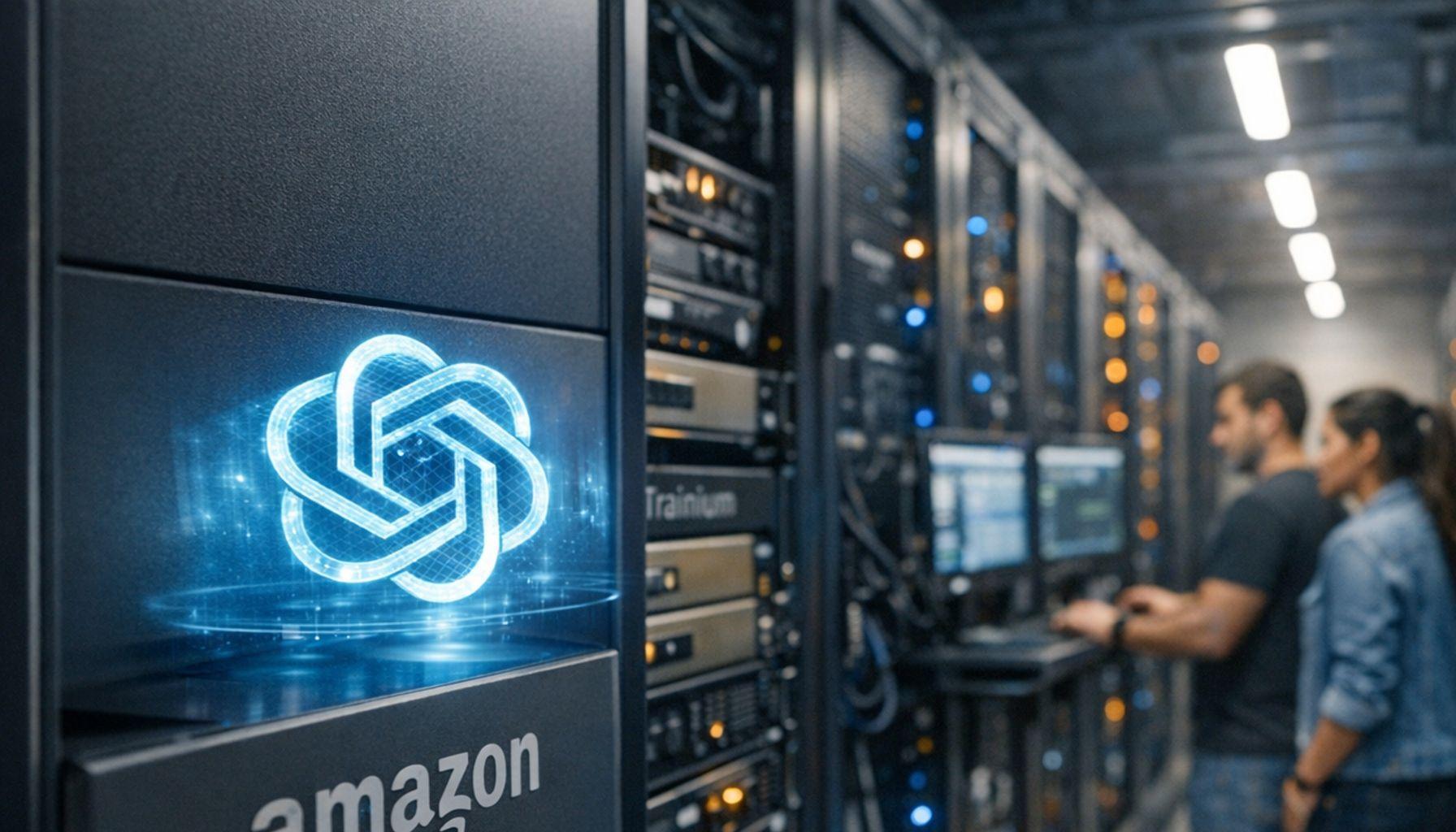
OpenAI and Oracle break ground on the Stargate data center in Michigan
OpenAI and Oracle are building something that goes far beyond a simple data center in Michigan. The Stargate Michigan project, celebrated during a groundbreaking event on Monday, represents one of the largest investments in artificial intelligence infrastructure ever seen in the United States, with more than $45 billion committed to a single location in the small city of Saline, in Washtenaw County, southwest of Ann Arbor. 🤯
To get a sense of the scale of what is being built there, the land and physical structures of the data center alone add up to $16 billion. The internal components, such as GPUs, networking, and all the technological infrastructure needed to run cutting-edge AI models, tack on another $30 to $40 billion to the bill, according to Clay Magouyrk, CEO of Oracle. And it does not stop there.
Beyond the jaw-dropping numbers, the project brings direct commitments to the local community, promises about the future of work, and some pretty firm statements from OpenAI CEO Sam Altman about how AI will transform the way all of us work in the years ahead. 👀
What is the Stargate Project and how Michigan fits into it
Stargate Michigan is not just another data center going up somewhere in the United States. It is part of a much larger initiative called the Stargate Project, a joint venture announced in January 2025 between OpenAI, Oracle, and SoftBank, with the goal of building a massive network of artificial intelligence infrastructure on American soil.
The Michigan facility is one of six locations planned for the project. The Stargate campuses span Texas, New Mexico, Wyoming, Wisconsin, and Michigan, and all of them are expected to be under construction by the end of this year. The first campus, in Abilene, Texas, is already well underway. According to Magouyrk, the initial buildings were delivered late last year, and others are already being completed.
The Michigan site will be developed on 250 acres of land in Saline Township, and the project consists of three single-story buildings, each roughly 550,000 square feet. The location earned the nickname The Barn because of the red barn that marks the entrance to the property. The expected delivery date is the end of 2027, and Related Digital, the real estate arm responsible for construction, expects to start seeing cash flow immediately after completion.
A $45 billion investment in a single location is something unprecedented in the tech sector, at least not at this scale and speed of execution. To put it in perspective, the GDP of several countries around the world is smaller than the total amount committed to this project.
Commitments to the Saline community
OpenAI and Oracle announced a series of community commitments during the groundbreaking event. According to a post on the official OpenAI blog, the project is expected to generate approximately $1 billion in tax revenue over the lease term, including support for schools and local, county, and state services.
On top of that, OpenAI, Oracle, Related Digital, and other partners agreed to contribute $10 million to the Saline Recreation Center. According to OpenAI, the city of Saline identified the recreation center as a community priority, and the investment supports a project shaped by the residents themselves.
Another noteworthy commitment involves education. The company is making about $45 million in credits available for Codex, its AI-powered coding assistant, to more than 400,000 eligible students in Michigan during the 2026 to 2027 school year. It is a way to connect infrastructure investment with training a new generation of tech professionals in the state.
OpenAI also guaranteed that all the infrastructure and energy needed to operate the data center will be funded by the project itself, with no costs passed on to local consumers and taxpayers. The cooling system at the site uses a closed-loop circuit that, according to the company, consumes roughly the same amount of water as a conventional office building.
Altman says AI will soon be running in the background all the time
Sam Altman was pretty straightforward when talking about what he expects for the future of artificial intelligence during the event. He described a fundamental shift in how people interact with AI systems.
Right now you still send a request to an AI, and it does something for you and gives a response back, he explained. But very soon, an AI is just going to be running for you in the background all the time, helping with your work, looking at all of your information, aware of all of your context, doing as much as it can to help you.
Altman gave the example of his own work, where an AI application could analyze large volumes of internal information, like documents or Slack conversations, summarize everything, and provide advice on what matters most. This kind of use case, according to him, is one of the reasons OpenAI is so focused on building infrastructure.
I can already tell that in this world, me and everybody is going to want way more of this AI infrastructure than we think, Altman said.
Altman’s stance on the competition with China
When asked about the technology race between the United States and China in the field of artificial intelligence, Altman surprised by saying that treating this competition as a race can be dangerous.
I think in some ways that is okay, and in some ways it is really dangerous, he said. I think it is okay to say we are going to win this, that we are going to have the majority of the economic benefit.
However, he pointed out that on bigger issues like control of AI systems, cybersecurity, and biosecurity, cooperation between nations is necessary, not competition. On the really big things, making sure we never lose control of AI systems, cybersecurity, biosecurity — I think we need to not treat that as a race and understand that a good future for the world is in everyone’s interest, he added.
Concerns about jobs and the fast pace of AI
Altman acknowledged that the AI industry needs to do a better job communicating to address the growing pushback against the technology’s impact on society. He said the sector has failed to articulate how people remain in control and how they can have a truly meaningful life in all the ways that matter.
On the impact on jobs, Altman was honest in saying he is not sure how AI will affect the labor market in the long run, but acknowledged that people are right to be anxious.
He did offer an interesting observation, though: The companies I know that have adopted AI the most are also the ones hiring the most, and the companies that, as a general rule, are talking about layoffs because of AI are the ones adopting the technology the least.
Altman also said the AI industry underestimated how much people will remain at the center of everything, of an economy and a world that is based on people. It is a statement that tries to balance enthusiasm for technology with the acknowledgment that the transition will not be painless for everyone.
Data centers in space, IPO, and demand for infrastructure
When asked about the possibility of building data centers in space, Altman was brief and direct. I hope humanity expands to the stars someday, and data centers along with it, but let us focus on building on Earth for now, he said.
On the race to go public, Altman said he learned that rival Anthropic had confidentially filed its IPO prospectus with the SEC. But he dismissed the idea that there is a competition to be the first AI company to hit the stock market. I think there is a race to deliver the best technology and build the best business, but going public is a financing event, and I do not think it is something we are focused on in terms of timing, he said.
On confidence in Stargate Michigan’s financial return, Altman was fairly optimistic. He said OpenAI understands how demand behaves and how much people want to use these models, and that revenue is growing at an accelerated rate both at the company and across the industry as a whole. Coding models, according to him, are the biggest demand driver right now. 🚀
Oracle sees demand outpacing its ability to deliver
Clay Magouyrk, CEO of Oracle, reinforced the message that the market is asking for more AI infrastructure than companies can build right now. There is more demand today than we can deliver, he told CNBC.
Magouyrk said the project’s development is on schedule or even ahead of expectations, both in terms of construction, permitting, power generation, and GPU delivery. The original campus in Abilene, Texas, is already at an advanced stage, with several buildings delivered.
On the cost of Stargate Michigan’s internal components, Magouyrk explained that the infrastructure inside data centers is much more expensive than the buildings themselves and has a much shorter lifespan. It is going to cost an additional $30 to $40 billion to put everything in there, in terms of networking, GPUs, and all that kind of stuff, he said. And that equipment obviously needs to be replaced over time.
When asked about the so-called SaaSpocalypse, the wave of sell-offs in software company stocks over fears of AI disruption, Magouyrk was confident. He said Oracle’s existing customer base and technology are an asset, not a liability, and that the ability to use AI to revolutionize application delivery is a competitive advantage. Oracle shares, which had taken a hit from those concerns, have already recovered their losses and are up 26% for the year.
SoftBank invests $53 billion in data centers in France
The Stargate ecosystem is not limited to American territory. The SoftBank Group announced over the weekend that it will invest $53 billion over the next five years in AI infrastructure in France, as part of a program to reach 5 GW of data center capacity in the country.
The first phase calls for 3.1 GW of AI data center capacity in the northern Hauts-de-France region by 2031, with facilities in Dunkirk, Bosquel, and Bouchain. It is SoftBank’s largest AI infrastructure investment in Europe.
CEO Masayoshi Son compared the current moment to the dot-com bubble, but on a dramatically larger scale. I think this is more than 10 times, probably 50 times bigger than the dot-com bubble, he told CNBC.


Community resistance and the protest controversy
Despite the enthusiasm from the companies involved, Stargate Michigan faced significant resistance from the local community. The Saline Township board initially voted four to one against the project. Related Digital sued the township, and the project moved forward after a settlement in the dispute.
Jeff Blau, CEO of Related Companies, acknowledged the community’s concerns, especially about water consumption, but stated that Stargate’s closed-loop cooling system will use less water than local farmers. He also highlighted that more than half of the nearly 700 acres of land will be permanently preserved as farmland.
In a controversial statement, Blau suggested, without presenting evidence, that some of the opposition to data centers may be funded by foreign actors, potentially including China. He said they are seeing protests organized and funded from outside the local communities, and that the Trump administration is investigating the possibility of foreign involvement in these efforts. The White House did not immediately respond to requests for comment on the claim.
The data shows that community opposition is real and widespread. A Gallup poll from May found that 71% of Americans oppose the construction of AI data centers in their communities. Concerns include massive water and energy consumption, worsened air quality, noise pollution, higher electricity bills, and doubts about whether job creation promises will materialize. At least $156 billion in data center projects were blocked or delayed by local opposition and litigation last year, according to a report from Data Center Watch.
Cities and counties across the country have been approving moratoriums to temporarily halt new data center projects, while lawmakers work to establish regulations and require more transparency about water and energy usage at these facilities.
The impact for Michigan and for AI infrastructure in the U.S.
For Michigan, the Stargate Project represents a game changer in economic terms. The state spent decades dealing with the decline of the auto industry and the migration of manufacturing jobs to other regions. The arrival of an investment of this magnitude in technology and artificial intelligence completely reshapes the local landscape. It is not just about the direct jobs at the data center, but the ripple effect that this kind of infrastructure creates across the entire surrounding economy, from construction and energy suppliers to real estate and retail in Saline and neighboring cities.
On the national stage, Stargate Michigan is another chapter in a geopolitical narrative about the race for artificial intelligence leadership. The United States is betting big on building domestic AI infrastructure as a matter of national security and economic competitiveness. Having processing clusters on home soil is a significant strategic advantage, especially at a time of fierce competition with other technological powers.
Related Digital, the real estate arm of the Related Companies group, famous for developing Hudson Yards in New York, is responsible for building the project’s physical infrastructure, including power substations, data halls, and cooling systems. Blau said he expects to start seeing financial returns immediately after the project’s delivery, expected by the end of 2027, and that the return profile is attractive for investors.
What becomes clear when you look at this whole picture is that we are witnessing a historic moment for global technology infrastructure. The speed at which projects like Stargate Michigan are being planned, funded, and executed shows that the biggest companies on the planet believe the race for artificial intelligence is just getting started, and that whoever has the best infrastructure will come out ahead. 👁️