Artificial Intelligence Drives Tech Stocks as Semiconductors and the Musk vs. Altman Battle Dominate the Week
Artificial intelligence continues to be the biggest engine powering the tech market, and this past week made that abundantly clear. The so-called Magnificent Seven delivered their quarterly results and, even with some concerns about rising infrastructure spending, the market responded positively, pushing stocks to all-time highs. AI-driven trading helped propel markets to historic peaks last week, solidifying the narrative that this technology is no longer a future promise but a present-day reality reflected in the balance sheets of the largest companies on the planet.
But the show is far from over. Now, the spotlight shifts to the semiconductor sector, with companies like AMD, Arm Holdings, and Lattice Semiconductor lined up to report their numbers. The big question is whether demand for data center chips remains strong and whether supply constraints, especially in components like memory chips, could create bottlenecks in the near term.
And that is not the only thing making headlines in tech. Elon Musk is in a California courtroom, facing off against Sam Altman and OpenAI in a trial that has become one of the noisiest disputes in the tech world, complete with leaked threatening messages and heavy accusations from both sides. Meanwhile, Nvidia admitted its market share in China has dropped to zero, Meta surprised everyone by diving headfirst into humanoid robotics, and Anthropic is on track to surpass OpenAI itself in market valuation.
There is a lot going on, right? 👇 Let us break it all down.
Magnificent Seven: Earnings That Impress, Spending That Alarms
When tech giants open up their quarterly books, the entire market holds its breath. This time was no different. The tech stocks of the Magnificent Seven delivered results that, on average, beat analyst expectations. Artificial intelligence showed up as the star in virtually every report, either as the justification for massive infrastructure investments or as the differentiator driving revenues higher.
Four of these giants reported their numbers on the same Wednesday, flooding investors with a wave of information to digest all at once:
- Alphabet (Google): Reported strength in its cloud segment and Gemini AI models, with earnings per share of 5.11 dollars versus estimates of 2.62 dollars. Shares rose 6% in after-hours trading, making it the only one of the four to react positively.
- Microsoft: Beat expectations on the top and bottom lines, but shares dropped 2% in extended trading. The AI business grew 123% year over year, though concerns about Azure growth and the relationship with OpenAI continued to weigh on sentiment.
- Meta: Despite beating first-quarter profit estimates, it raised its capital expenditure forecast to between 125 billion and 145 billion dollars in 2026, a 10 billion increase on both the upper and lower ends compared to January. Shares fell 6%.
- Amazon: The cloud unit AWS posted its fastest growth in 15 quarters, but AI spending weighed on free cash flow. Shares dropped about 4%, despite better-than-expected earnings.
Apple, which reported on Thursday, delivered especially strong numbers. With earnings per share of 2.01 dollars on revenue of 111.2 billion dollars, it topped Wall Street projections. iPhone revenue grew 20% for the second consecutive quarter, hitting 56.99 billion dollars. Revenue from China came in at 20.49 billion dollars, above expectations of 18.9 billion. Shares rose about 5% on Friday, and the company anticipates strong demand for the iPhone 17 lineup, despite supply chain constraints.
A curious detail came from the Mac segment. CEO Tim Cook revealed that AI developers and enthusiasts are buying Mac minis and Mac Studios at an accelerated pace to run an AI agent platform called OpenClaw. Demand exceeded Apple’s internal forecasts, and Cook said it could take several months for supply to catch up with demand. It is yet another sign of how artificial intelligence is spilling beyond data centers and reaching consumer hardware.
The point of concern, though, was spending. Companies are pouring money into data centers, servers, and chips to sustain the race for generative artificial intelligence, and that created some unease among more conservative investors. In Meta’s case, beyond AI costs, two additional risks were highlighted in the quarterly report: inflation in infrastructure components, which does not just affect domestic consumers, and growing regulatory challenges in both the European Union and the United States.
Amazon offered an interesting counterpoint to that spending worry. The company revealed that its cloud contract backlog, meaning deals already signed but not yet converted into revenue, jumped to 364 billion dollars in the first quarter. That does not even count the recent deal with Anthropic valued at over 100 billion dollars. It is a substantial increase from 244 billion the previous quarter, giving investors a concrete view that future demand justifies current spending.
Semiconductors: The Next Chapter of the Story
With the Magnificent Seven earnings in the rearview mirror, market attention now shifts to the semiconductor sector. AMD, Arm Holdings, and Lattice Semiconductor are next in line, and expectations are high. The reason is straightforward: chips are the heart of everything involving artificial intelligence. Without high-performance semiconductors, there is no model training, no large-scale inference, and no data center running at the pace AI demands.
If the Magnificent Seven results show the buyer’s perspective, semiconductor company earnings reveal the supply side of the AI boom. And that side has been particularly hot. The PHLX Semiconductor Index (SOX) surged more than 40% and had its best month since February 2000 in April, extending the record-setting rally that has been fueling AI-driven trading. AMD climbed 70% in the month leading up to its results, Arm advanced 40%, and Lattice gained 25%.
That extraordinary performance carries risk with it. Steve Sosnick, chief strategist at Interactive Brokers, noted that the sector’s elevated performance puts it at risk of a correction. But he also pointed out that if the key components of the SOX keep delivering positive surprises, it becomes much harder to bet against the sector.
AMD, in particular, carries special expectations. The company has been positioning itself as a competitive alternative to Nvidia in the AI GPU segment, and any indication that its chips are gaining traction could significantly shift market sentiment. Arm Holdings, whose processor designs are in virtually every mobile device on the planet, has been expanding its presence in data centers and servers. And Lattice Semiconductor, more focused on low-power programmable chips, represents a different barometer: how AI is spreading beyond large servers into industrial and edge applications.
Demand for data center chips and supply constraints that could affect the availability of other components, like memory chips, will be front and center when these numbers are released.
Nvidia Loses China and Faces New Competitors
Two developments involving Nvidia grabbed significant attention. The first, and perhaps most impactful, was CEO Jensen Huang’s statement that the company’s market share in China has dropped to zero. Huang made the comment during an interview on the Memos to the President program from the Special Competitive Studies Project.
Nvidia held roughly 90% of the global market share for AI chips, but export restrictions imposed by the U.S. government progressively blocked the sale of its most advanced processors to China. More recently, President Trump signaled he would allow certain shipments of Nvidia’s H200 chip, but Commerce Secretary Howard Lutnick stated the company had not yet shipped any. Critics of these sales argue the chips would inevitably help the Chinese military develop and run AI software that could be used against the United States.
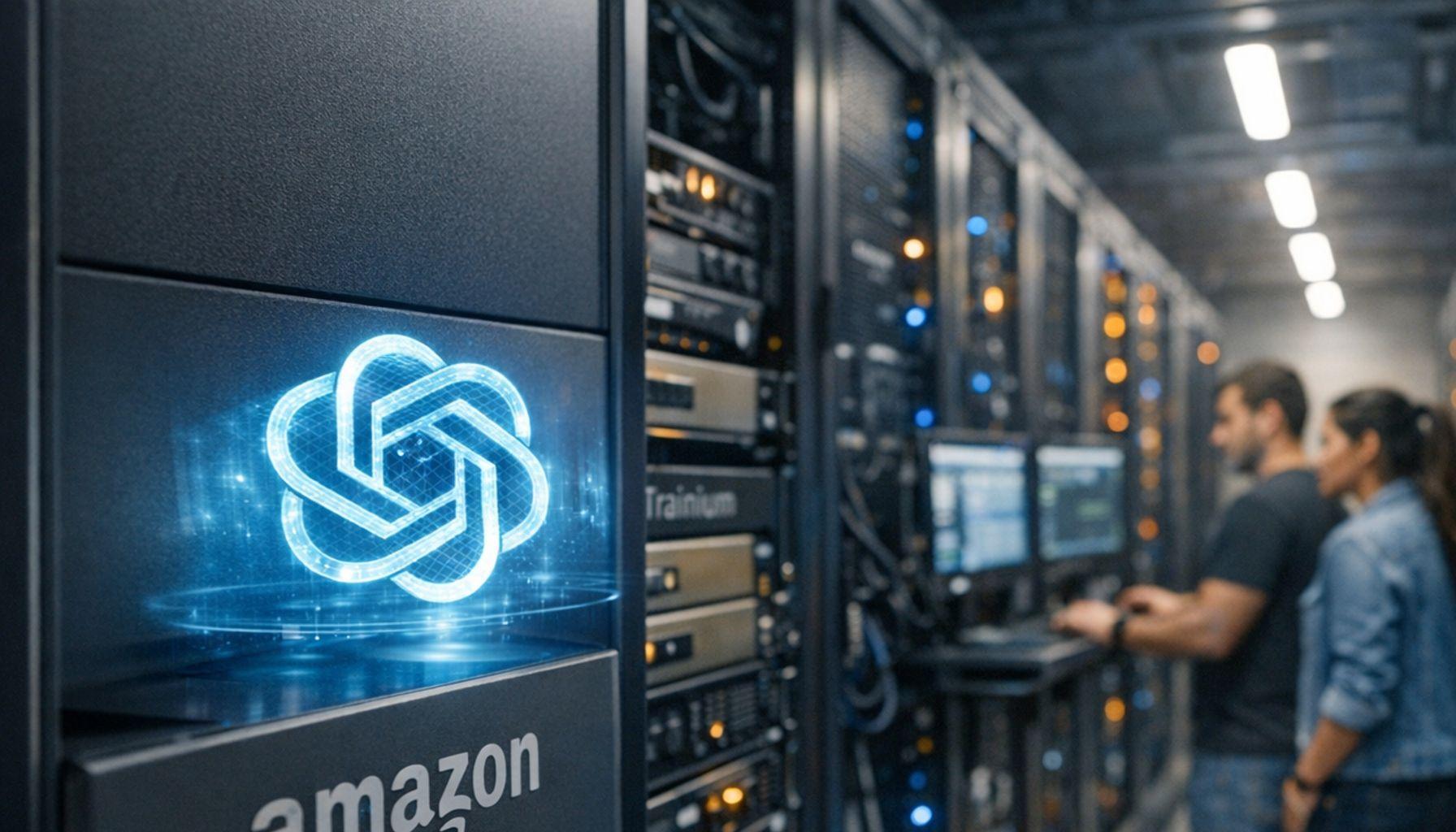
The second development came from the competition. Nvidia shares dropped more than 4% on Thursday while other chipmakers rose. Amazon highlighted during its earnings call that its custom chip business is expanding rapidly. And Google announced it will begin selling its custom tensor processing units (TPUs) to select customers, who will be able to install the chips in their own data centers. Until now, Google had only rented TPU capacity from its own data centers.
Nvidia has dismissed competition concerns, arguing that its chips offer greater flexibility for AI developers. And it is true that Amazon and Alphabet remain major buyers of Nvidia’s AI infrastructure. But the fact that its largest customers are simultaneously developing and selling their own chips adds a layer of competitive complexity that did not exist two years ago.
Elon Musk vs. OpenAI: The Trial Everyone Is Watching
Elon Musk and Sam Altman are facing each other in a California courtroom, and the case has become one of the biggest legal spectacles in the tech world in recent years. The dispute revolves around accusations that Altman, OpenAI president Greg Brockman, and others misled Musk into donating money to OpenAI, promising the organization would remain nonprofit, only to convert it into a commercial company afterward.
Musk, who co-founded OpenAI but left its board, took the witness stand and did not hold back. In his opening remarks, he struck a characteristically apocalyptic tone: if it is deemed acceptable to plunder a charity, the entire foundation of philanthropic giving in the United States will be destroyed, according to him.
What made the case even more explosive were the messages revealed during proceedings. In a communication with Brockman, Musk asked if the OpenAI co-founder would be interested in a deal. When Brockman suggested both sides drop their claims, Musk responded by saying that by the end of that week, Brockman and Altman would be the most hated men in America. Lawyers for Brockman, Altman, and OpenAI argued that this message tends to prove motivation and bias, indicating that Musk’s real intention in filing the lawsuit is to attack a competitor and its top executives.
On the second day of testimony, facing cross-examination by OpenAI’s lawyers, Musk made a notable admission: he said he did not read the fine print, just the headline, when it came to OpenAI’s conversion from a nonprofit entity to a for-profit structure overseen by a nonprofit organization. He also revealed that his AI startup, xAI, used OpenAI to train its own models, calling it standard practice in the industry, where you use other AIs to validate your own AI.
OpenAI’s side fired back, saying Musk’s actions are driven by his own commercial interests, since he founded xAI, a direct competitor in the artificial intelligence market. The argument is that Musk knew about the transition to a commercial structure and became frustrated for not having stayed with the company now that it has become a massive presence in the AI space.
Regardless of the judicial outcome, the trial is already leaving its mark. It exposes the deep tensions within the AI industry over governance, purpose, and concentration of power. Names like Microsoft CEO Satya Nadella and Altman himself are also expected to testify, turning the case into a live portrait of the power dynamics shaping the future of technology.
Anthropic Could Surpass OpenAI in Valuation
While Musk and Altman battle it out in court, another development in the AI market took on historic proportions. Anthropic, the maker of Claude, is planning a new funding round that would value the company at 900 billion dollars. If confirmed, it would be the first time Anthropic surpasses OpenAI in market value, since OpenAI last raised capital at a valuation of 852 billion dollars.
Anthropic has already received recent investments from Alphabet and Amazon, both at a valuation of 350 billion dollars. Alphabet committed 10 billion in new investment, while Amazon put in 5 billion, both retaining the option to increase their stakes in the future. The jump from 350 billion to 900 billion in just a few months illustrates the absurd speed at which the artificial intelligence market is moving.


Meta Enters Humanoid Robotics
Outside the earnings cycle, Meta surprised the industry by announcing the acquisition of Assured Robot Intelligence, a company specializing in robotic intelligence designed to enable robots to understand, predict, and adapt to human behavior in complex, dynamic environments. Co-founders Lerrel Pinto and Xiaolong Wang will lead Meta’s efforts in this area, bringing expertise in robotic control and self-learning applied to full-body humanoid control.
It is a move that puts Meta in direct competition with companies like Figure AI, Boston Dynamics, Agility Robotics, and even Tesla’s robotics plans with Optimus. The initial idea is to deploy these robots in environments too dangerous for humans or in roles involving repetitive motions that can cause injuries over time. The move shows that the boundaries between different technology segments are increasingly blurred, and major companies do not want to sit out any race involving AI.
YouTube, Google Cloud, and the Growth That Will Not Stop
Within Google’s ecosystem, YouTube continues to be a cornerstone. CEO Sundar Pichai revealed that viewers in the United States are watching more than 200 million hours of YouTube content daily on living room screens. YouTube Premium recorded its largest quarterly increase in non-trial subscribers, and the platform’s advertising revenue grew 11%, reaching 9.88 billion dollars in the first quarter. Google reported that its total paid subscriptions hit 350 million, with YouTube and Google One as the primary drivers.
On the cloud side, Google Cloud revenue was projected at 18.4 billion dollars, representing a 50% increase year over year. This accelerated growth over recent quarters, fueled by Gemini models and corporate demand for AI infrastructure, is one of the main factors behind Alphabet shares climbing roughly 30% over the past six months.
The decision to sell TPUs directly to select customers marks a significant strategic shift. Pichai explained that as demand for TPUs grows among AI labs, capital markets firms, and high-performance computing applications, the company will begin delivering chips in hardware configurations for customers’ own data centers, expanding its addressable market.
What to Expect in the Coming Weeks
What becomes clear, looking at all these developments together, is that the ecosystem of tech stocks, semiconductors, and artificial intelligence is in one of the most dynamic moments in its history. Investors continue to reward companies that can actually monetize AI, even when capital expansion investments overshadow solid results.
Earnings from AMD, Arm, and Lattice this week could provide more fuel for tech stocks, while the Musk vs. OpenAI trial promises more revelations and legal drama. Apple has its WWDC event scheduled for June 8, where it should offer more clues about its AI strategy after a series of back-and-forth moves that have cast a shadow over the company. And there is still the anticipated foldable iPhone and the planned CEO transition from Tim Cook to John Ternus in September.
The earnings are rolling in, but the tensions, whether geopolitical, legal, or competitive, are growing at the same pace. Every piece on this chessboard directly influences the others, and the coming weeks promise to bring even more action for anyone following the tech market. 🚀